SUPREME COURT ON MANDATORY REPORTING UNDER THE POCSO ACT
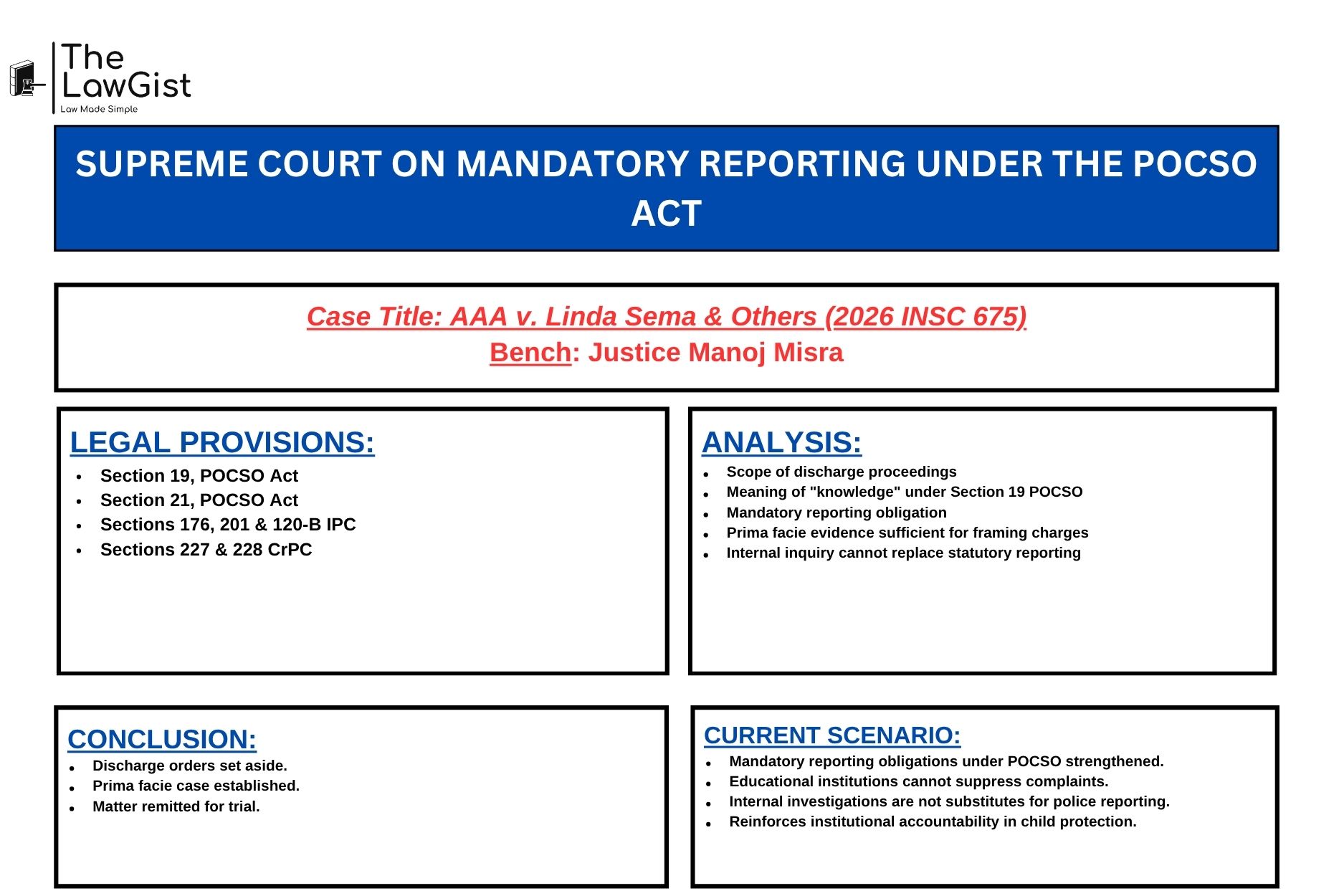
CASE SUMMARY – The Supreme Court in AAA vs. Linda Sema & Others (2026 INSC 675) considered whether school authorities who allegedly failed to report the sexual assault of a minor student could be discharged before trial. The Court held that at the stage of framing charges, courts need only determine whether the prosecution materials disclose a prima facie case and not assess the likelihood of conviction. It interpreted Sections 19 and 21 of the POCSO Act broadly, observing that knowledge of an offence may arise from credible information received from the victim. The judgment reinforces mandatory reporting obligations and strengthens institutional accountability in protecting children from sexual offences.
| Particulars | Details |
| Case Title | AAA vs. Linda Sema & Others, Criminal Appeal (Arising out of SLP (Crl.) No. 4772 of 2024), 2026 INSC 675 |
| Introduction | This Supreme Court judgment examines the mandatory reporting obligations under the Protection of Children from Sexual Offences Act, 2012 (POCSO Act). The Court considered whether school authorities who received information regarding the sexual assault of a minor child could be discharged despite allegedly failing to report the incident to the police and instead attempting to suppress it. |
| Factual Background | An eight-year-old girl studying in a residential school alleged that a juvenile student sexually assaulted her in November 2019. She informed her elder sister, who reported the matter to the Head Girl, who then informed the school authorities. The school authorities allegedly examined the child, found indications of assault, held internal meetings, instructed students not to disclose the incident, and failed to inform the police or the child’s parents. The victim’s mother learned about the incident several months later and lodged an FIR. The police filed a charge-sheet against the juvenile offender and several members of the school administration for offences under the IPC and the POCSO Act. The Trial Court discharged the school authorities, and the High Court affirmed the discharge. The victim’s mother challenged these orders before the Supreme Court. |
| Legal Issues | 1. Whether the school authorities had “knowledge” of the commission of a POCSO offence under Section 19 of the POCSO Act.
2. Whether failure to report the offence attracted liability under Section 21 of the POCSO Act. 3. Whether sufficient prima facie material existed to frame charges against the school authorities. 4. Whether the Trial Court and High Court erred in discharging the accused at the pre-trial stage. |
| Applicable Law | • Sections 19 and 21 of the Protection of Children from Sexual Offences Act, 2012.
• Sections 176, 201 and 120-B of the Indian Penal Code, 1860 (now corresponding provisions under the Bharatiya Nyaya Sanhita, where applicable). • Sections 227 and 228 of the Code of Criminal Procedure, 1973 regarding discharge and framing of charge. |
| Analysis | The Supreme Court reiterated that at the stage of framing charges, the court only determines whether the materials collected during investigation create a strong or grave suspicion against the accused and not whether conviction is certain. The Court interpreted the expression “knowledge” under Section 19 of the POCSO Act broadly, holding that knowledge may arise from information directly received from the victim or credible circumstances and does not require eyewitness evidence or personal verification. The Court observed that the police report, victim’s statement, Head Girl’s statement, and other witness statements indicated that the school authorities were informed of the allegations, examined the victim, noticed physical symptoms, held meetings, and instructed students not to reveal the incident. These facts, if accepted at face value, were sufficient to raise a prima facie case of failure to report and possible concealment of the offence. The Trial Court improperly conducted a detailed appreciation of evidence, which is impermissible at the discharge stage. |
| Conclusion | The Supreme Court held that the courts below exceeded the permissible scope of inquiry while considering discharge. Since the prosecution materials disclosed sufficient grounds for proceeding against the school authorities, the discharge orders could not be sustained. The matter was remitted for trial in accordance with law. |
| Current Scenario | The judgment significantly strengthens the mandatory reporting framework under the POCSO Act. It clarifies that schools, educational institutions, hospitals, and other authorities cannot conduct internal inquiries or suppress complaints involving child sexual abuse. Whenever credible information regarding a POCSO offence is received, immediate reporting to the police is mandatory. The decision reinforces child protection, institutional accountability, and strict compliance with Sections 19 and 21 of the POCSO Act. |
“When credible information of child sexual abuse reaches an institution, silence is not an option—the law mandates immediate reporting.”
SOURCE – SUPREME COURT OF INDIA