SUPREME COURT RULES IBA CANNOT BLACKLIST ADVOCATES FOR NEGLIGENCE
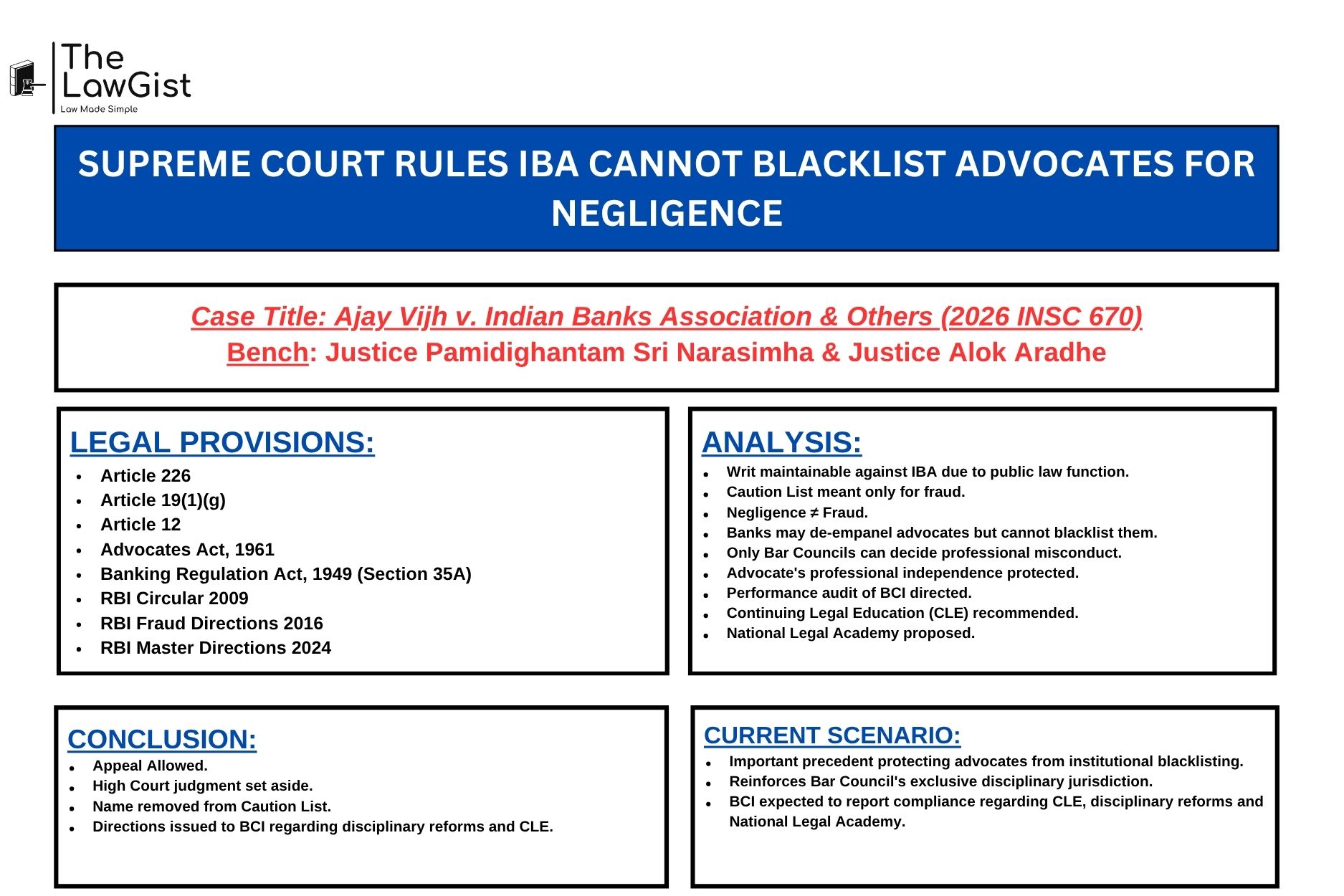
CASE SUMMARY – The Supreme Court in Ajay Vijh vs. Indian Banks Association (2026) held that an advocate cannot be included in the IBA Caution List merely for alleged negligence while rendering a legal opinion. The Court ruled that the RBI’s fraud-related circulars apply only to cases involving fraud, dishonesty or criminal misconduct and not professional negligence. It further held that allegations against advocates fall exclusively within the disciplinary jurisdiction of the Bar Councils under the Advocates Act, 1961. The Court allowed the appeal, ordered removal of the advocate’s name from the Caution List, and directed reforms including Continuing Legal Education and performance audits of the Bar Council of India.
| ASPECTS | DETAILS |
| Case Title | Ajay Vijh vs. Indian Banks Association & Others, |
| Introduction | The Supreme Court examined whether an advocate’s name could be included in the Indian Banks Association (IBA) Caution List merely for alleged negligence in rendering a legal opinion. The Court also considered the maintainability of a writ petition under Article 226 against IBA, the autonomy of the legal profession, the exclusive disciplinary jurisdiction of Bar Councils, and reforms relating to Continuing Legal Education (CLE). |
| Factual Background | Ajay Vijh, a panel advocate of Canara Bank, rendered a title opinion in 2015 regarding mortgaged property. The Bank alleged negligence because earlier sale deeds were allegedly overlooked, exposing it to financial risk. He was removed from the panel in 2019 and later placed in the IBA’s “Third Party Entities Involved in Fraud” Caution List without prior notice. The Allahabad High Court dismissed his writ petition as not maintainable, leading to the present appeal. |
| Legal Issues | 1. Whether a writ petition under Article 226 is maintainable against IBA.
2. Whether inclusion in the Caution List affects constitutional and legal rights. 3. Whether allegations of professional negligence against advocates fall exclusively within the disciplinary jurisdiction of the Bar Councils under the Advocates Act, 1961. |
| Applicable Law | • Article 226, Constitution of India
• Article 19(1)(g), Constitution of India • Article 12, Constitution of India • Sections 35 & 35A, Banking Regulation Act, 1949 • Sections 35, 36, 37 & 38, Advocates Act, 1961 • RBI Circular dated 16.03.2009 • RBI Fraud Directions, 2016 • RBI Master Directions on Fraud Risk Management, 2024. |
| Analysis | The Court held that Article 226 has a wider scope than Article 12 and extends to bodies performing public functions. The IBA Caution List substantially affects an advocate’s reputation and right to practice under Article 19(1)(g). RBI circulars were intended only for fraud-related cases and not professional negligence. Professional misconduct of advocates can only be adjudicated by the Bar Councils under the Advocates Act. Banks may remove advocates from their panels but cannot effectively blacklist them across the banking industry through the Caution List. The Court also emphasized transparency, accountability, performance audits of Bar Councils, and institutionalising Continuing Legal Education (CLE). |
| Conclusion | The Supreme Court allowed the appeal, set aside the Allahabad High Court judgment, declared inclusion of the appellant’s name in the IBA Caution List illegal, directed immediate removal of his name, ordered the Bar Council of India to conduct a performance audit of its disciplinary mechanism, and directed consideration of a National Legal Academy and Continuing Legal Education framework. |
| Current Scenario | The judgment significantly strengthens advocates’ professional independence. Banks cannot use the RBI fraud framework to penalize advocates for mere negligence. Professional misconduct remains exclusively within the Bar Council’s jurisdiction. The matter remains listed before the Supreme Court for monitoring implementation of CLE and National Legal Academy proposals. |
“Professional negligence cannot be equated with fraud, and only the Bar Councils have the authority to determine professional misconduct of advocates.”
SOURCE – SUPREME COURT OF INDIA