
Courtroom Chronicles
Courtrooms Chronicle provides comprehensive coverage of judgments, case updates, court orders, and public interest litigations (PIL). Stay informed on the latest legal developments, landmark decisions, and significant rulings across various jurisdictions. Whether you’re a legal professional, researcher, or interested citizen, Courtrooms Chronicle delivers timely and insightful content to keep you abreast of the dynamic landscape of the judiciary system.
Recent Posts
SUPREME COURT CLARIFIES THE DISTINCTION BETWEEN OBSCENE AND ABUSIVE WORDS UNDER SECTION 294 IPC
The Supreme Court ruled that abusive or vulgar language alone does not constitute obscenity under Section 294 IPC unless it appeals to prurient interests and corrupts public morality. While setting aside convictions under Sections 294(b) and 506(ii) IPC, the Court upheld the conviction under Section 326 IPC for causing grievous hurt with a dangerous weapon.
SUPREME COURT HOLDS MISSING RAILWAY TICKET CANNOT DEFEAT RAILWAY ACCIDENT COMPENSATION CLAIM
The Supreme Court ruled that non-recovery of a railway ticket does not automatically disqualify a compensation claim under Section 124A of the Railways Act, reaffirming the welfare nature of railway accident compensation law.
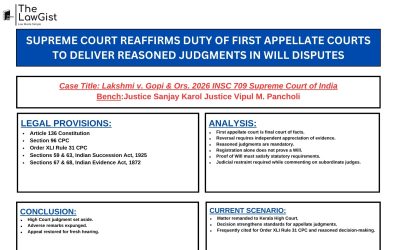
SUPREME COURT REAFFIRMS DUTY OF FIRST APPELLATE COURTS TO DELIVER REASONED JUDGMENTS IN WILL DISPUTES
The Supreme Court in Lakshmi v. Gopi & Ors. (2026) held that first appellate courts must pass well-reasoned judgments while reversing trial court findings. It restored the appeal to the Kerala High Court after finding that the High Court had failed to independently analyze the evidence regarding the execution of a Will and had unnecessarily made adverse remarks against the trial judge.
SUPREME COURT HOLDS TANKER DRIVER LIABLE IN MOTOR ACCIDENT CLAIM
The Supreme Court restored compensation to victims’ families after holding that delayed photographs could not outweigh the testimony of an injured eyewitness and reaffirmed that motor accident claims are governed by the standard of preponderance of probabilities.
SUPREME COURT JUDGMENT ON PROMOTION RULES, APR/PMS & WORK REPORT ANALYSIS
The Supreme Court clarified that CSIR promotion rules do not mandate averaging APR/PMS scores and Work Report marks, reaffirming the discretion of expert assessment committees in promotion decisions.
SUPREME COURT ON MANDATORY REPORTING UNDER THE POCSO ACT
The Supreme Court held that school authorities receiving credible information about child sexual abuse cannot suppress the complaint or conduct private inquiries instead of reporting the offence. The judgment strengthens mandatory reporting obligations under the POCSO Act and clarifies the scope of discharge proceedings.