 SUPREME COURT CLARIFIES THE DISTINCTION BETWEEN OBSCENE AND ABUSIVE WORDS UNDER SECTION 294 IPC
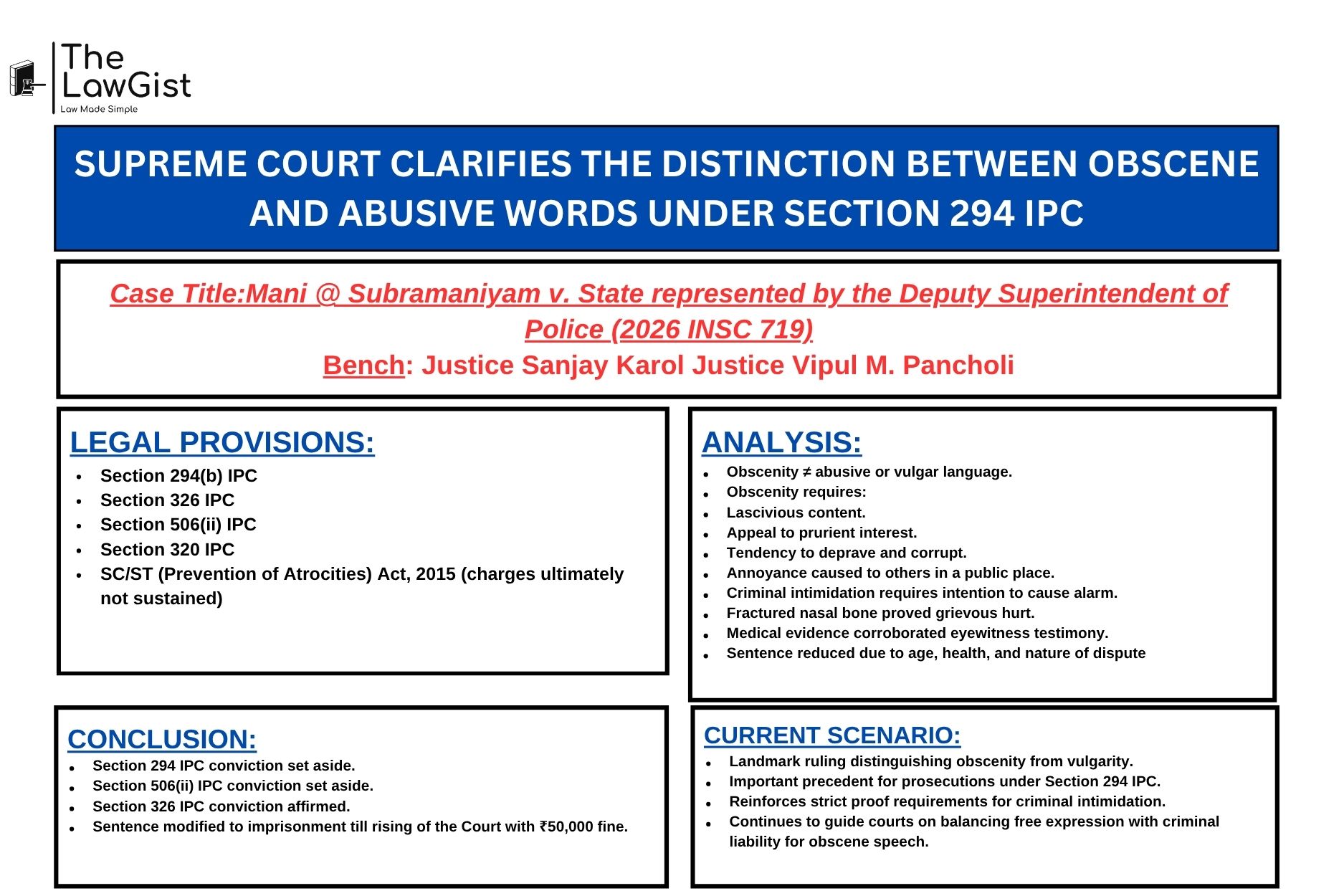
CASE SUMMARY – The Supreme Court in Mani @ Subramaniyam vs. State represented by the Deputy Superintendent of Police (2026 INSC 719) held that abusive or vulgar language does not automatically constitute obscenity under Section 294 IPC unless it is lascivious, appeals to prurient interests, and tends to deprave or corrupt others. The Court also ruled that mere threats during a quarrel do not amount to criminal intimidation without proof of intention to cause alarm. However, it upheld the conviction under Section 326 IPC because the accused caused grievous hurt with a billhook, resulting in a fractured nasal bone, while reducing the sentence considering mitigating circumstances.
| ASPECTS | DETAILS |
| Case Title | Mani @ Subramaniyam vs. State represented by the Deputy Superintendent of Police |
| Introduction | This Supreme Court judgment examines the distinction between abusive language and legally punishable obscenity under Section 294 IPC, the ingredients of criminal intimidation under Section 506 IPC, and grievous hurt under Section 326 IPC. The Court clarified that vulgar or offensive words do not automatically amount to obscenity unless they satisfy established legal tests. |
| Factual Background | A land dispute between the appellant and the complainant’s family resulted in an altercation. During the incident, the appellant allegedly abused the complainant using vulgar language, assaulted him with a billhook causing a fractured nasal bone, and threatened him. The Trial Court convicted him under Sections 294(b), 326, 506(ii) IPC and SC/ST Act provisions. The High Court acquitted him under the SC/ST Act but maintained the IPC convictions with reduced sentence. The appellant challenged the remaining convictions before the Supreme Court. |
| Legal Issues | 1. Whether abusive words constitute obscenity under Section 294(b) IPC.
2. Whether the alleged threat amounted to criminal intimidation under Section 506(ii) IPC. 3. Whether the conviction under Section 326 IPC for grievous hurt was legally sustainable. |
| Applicable Law | • Section 294 IPC (Obscene acts and words)
• Section 326 IPC (Grievous hurt by dangerous weapon) • Section 506(ii) IPC (Criminal intimidation) • Section 320 IPC (Definition of grievous hurt) • Relevant precedents including Ranjit D. Udeshi, Aveek Sarkar, Samaresh Bose, Madhanagopal, Apoorva Arora, and Naresh Aneja. |
| Analysis | The Court held that obscenity requires language that is lascivious, appeals to prurient interests, and tends to deprave or corrupt persons exposed to it. Mere abusive, profane, or vulgar expressions—even if offensive—do not satisfy this legal standard. The prosecution also failed to establish that the alleged words caused annoyance to others in a public place, an essential ingredient under Section 294 IPC. Regarding Section 506(ii), the Court observed that mere threatening words uttered during a quarrel are insufficient without proof that they were intended to cause alarm or compel the victim to act or refrain from acting. However, the conviction under Section 326 IPC was upheld because medical evidence conclusively established a fractured nasal bone caused by a billhook, qualifying as grievous hurt under Section 320 IPC. Considering the appellant’s age (70 years), health, and the dispute arising from land animosity, the Court modified the sentence to imprisonment till the rising of the Court and enhanced the fine to ₹50,000. |
| Conclusion | The Supreme Court partly allowed the appeal. Convictions under Sections 294(b) and 506(ii) IPC were set aside. The conviction under Section 326 IPC was affirmed, but the sentence was substantially reduced considering mitigating circumstances while imposing a higher fine. |
| Current Scenario | This judgment is now a significant precedent on interpreting Section 294 IPC. It reinforces that abusive or vulgar language alone is insufficient for conviction unless the statutory requirements of obscenity are satisfied. It also reiterates that criminal intimidation requires proof of intention to cause alarm, while convictions for grievous hurt must be supported by credible medical evidence. |
“Abusive or vulgar language may be offensive, but it does not become obscene in law unless it satisfies the statutory test of obscenity.”
SOURCE – SUPREME COURT OF INDIA