Supreme Court recognizes the Right to Walk and access demarcated footpaths as a Fundamental Right under Articles 19 and 21 of the Constitution.
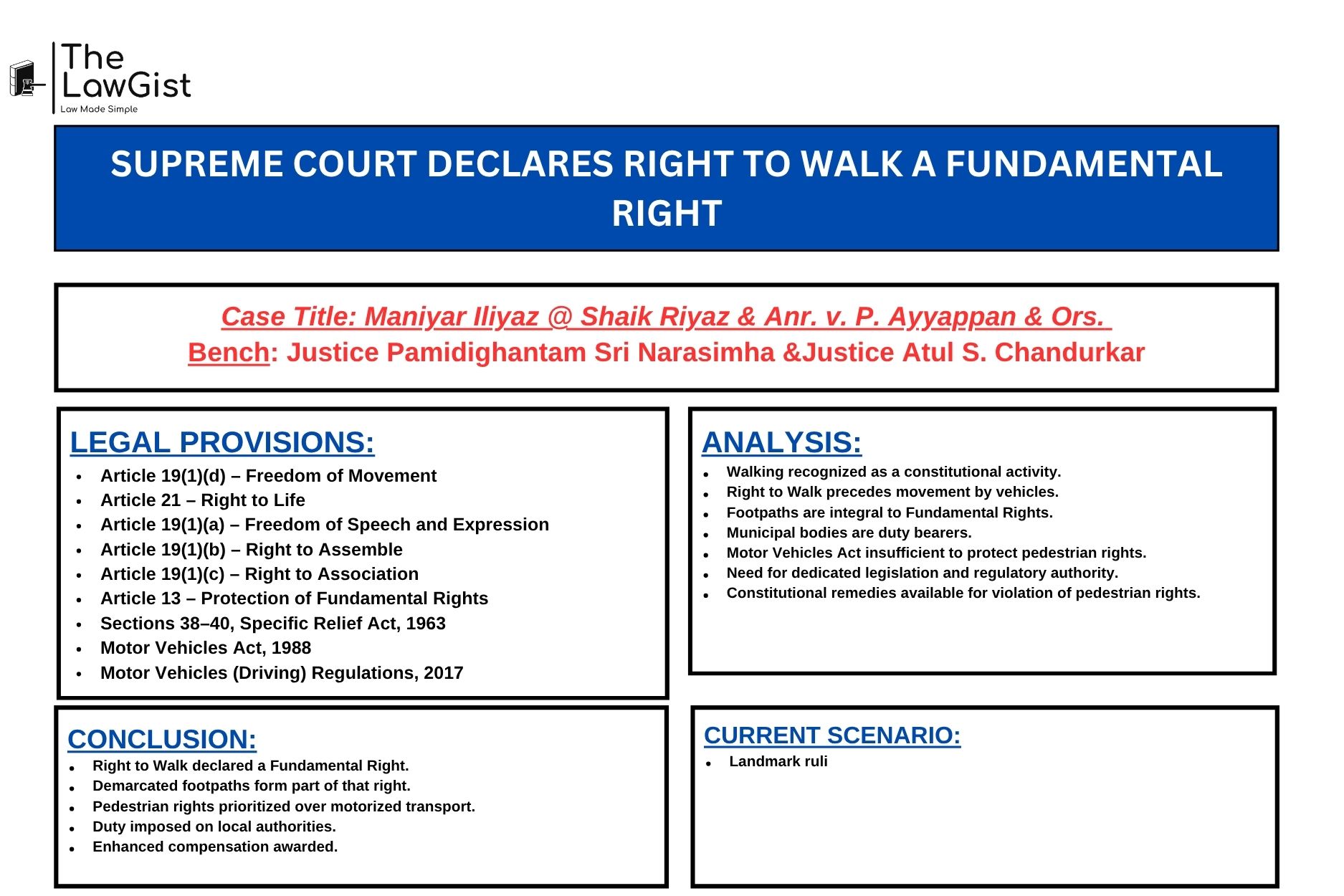
SUPREME COURT DECLARES RIGHT TO WALK A FUNDAMENTAL RIGHT
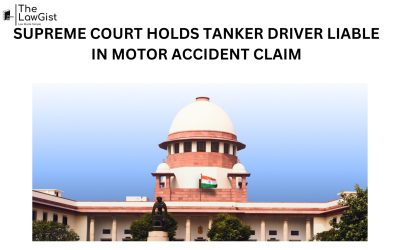
CASE SUMMARY – The Supreme Court in Maniyar Iliyaz @ Shaik Riyaz vs. P. Ayyappan (2026 INSC 647) dealt with the tragic death of a five-year-old child who was struck by a tanker while walking to school. While enhancing compensation payable to the family, the Court delivered a landmark constitutional ruling recognizing the Right to Walk and access safe, demarcated footpaths as Fundamental Rights under Articles 19 and 21. The Court held that pedestrians enjoy priority over motorized vehicles and imposed a corresponding duty upon municipal authorities and local bodies to create and maintain pedestrian infrastructure. It also called for comprehensive legislation protecting pedestrian rights.
| ASPECTS | DETAILS |
| Case Title | Maniyar Iliyaz @ Shaik Riyaz & Anr. vs. P. Ayyappan & Ors., Civil Appeal Nos. 4665-4666 of 2025, 2026 INSC 647 |
| Introduction | This landmark judgment arose from the death of a five-year-old child who was struck by a tanker while walking to school with his father. The Supreme Court used the case not only to determine compensation but also to recognize the constitutional significance of pedestrian rights and the Right to Walk. |
| Factual Background | The appellant’s five-year-old son was walking to school when a tanker hit him from behind, causing fatal injuries. The Motor Accident Claims Tribunal (MACT) awarded compensation of ₹7,82,000. The High Court reduced it to ₹4,70,000, leading to an appeal before the Supreme Court. |
| Legal Issues | 1. Whether the Right to Walk is a Fundamental Right under the Constitution.
2. Whether citizens have a right to safe and demarcated footpaths. 3. Whether local authorities owe a duty to create and maintain pedestrian infrastructure. 4. Whether the High Court was justified in reducing compensation awarded by MACT. |
| Applicable Law | Articles 19(1)(a), 19(1)(b), 19(1)(c), 19(1)(d), 21 and 13 of the Constitution of India; Motor Vehicles Act, 1988; Specific Relief Act, 1963 (Sections 38-40); Motor Vehicles (Driving) Regulations, 2017. |
| Analysis | The Court held that freedom of movement under Article 19(1)(d) necessarily includes the Right to Walk. It emphasized that walking is a basic human activity linked to dignity, life, expression, assembly, and association. The Court observed that pedestrian rights have historically been neglected due to the dominance of motor vehicles. It declared that pedestrians must receive priority over motorized vehicles and that roads should include safe, demarcated footpaths. The Court further stressed the need for a statutory framework and a dedicated regulator to protect pedestrian rights. |
| Conclusion | The Supreme Court declared that the Right to Walk and the Right to Demarcated Footpaths are Fundamental Rights under Articles 19 and 21. It held that urban development authorities, municipalities, municipal corporations, and panchayats have a corresponding duty to construct and maintain pedestrian infrastructure. The Court also enhanced compensation to ₹11,44,628. |
| Current Scenario | The judgment has transformed pedestrian rights jurisprudence in India by formally recognizing the Right to Walk as a Fundamental Right. The Court directed that the matter be converted into a petition titled “Re: Fundamental Right to Walk and Footpath” and sought governmental consideration of a statutory framework to regulate and enforce pedestrian rights nationwide. |
“The fundamental right to walk on demarcated footpaths is primary and shall have priority over movement by motorised vehicles.”
SOURCE – SUPREME COURT OF INDIA