Supreme Court clarifies distinction between intention and knowledge under Section 304 IPC in Mathu Alias Jagdish v. State of Uttarakhand (2026).
SC CLARIFIES CULPABLE HOMICIDE UNDER SECTION 304 PART II IPC IN MATHU ALIAS JAGDISH CASE
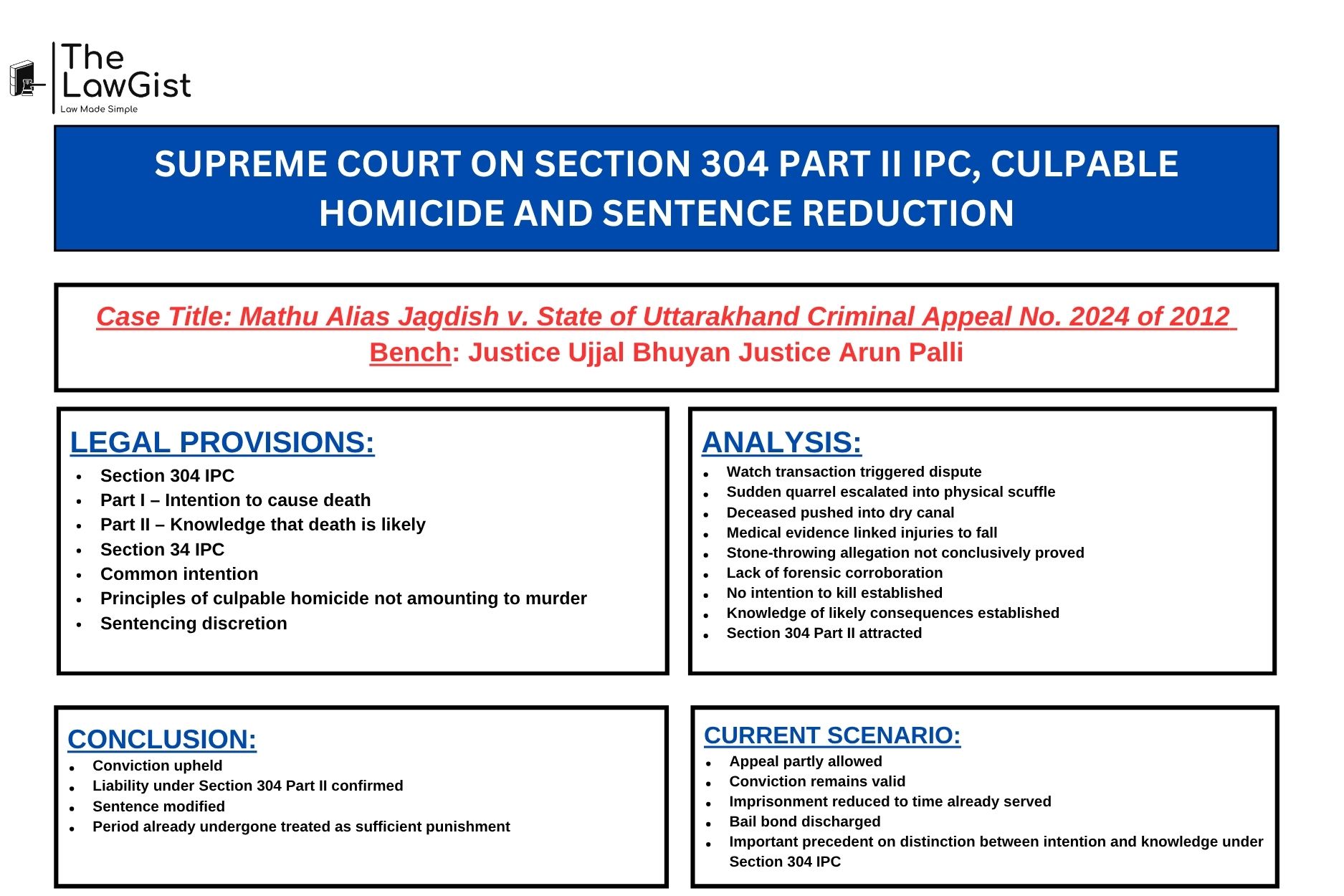
CASE SUMMARY – In Mathu Alias Jagdish vs. State of Uttarakhand (2026) involved the death of Padam Singh Shahi following a dispute arising from a wristwatch transaction. During a scuffle, the accused pushed the deceased into a dry canal with a rocky bed, resulting in fatal head injuries. The Supreme Court examined whether the offence fell under Section 304 Part I or Part II IPC. The Court found that the prosecution failed to conclusively establish that stone blows caused the death and held that the injuries resulted from the fall. Since there was knowledge but no intention to cause death, Section 304 Part II applied. The conviction was upheld, but the sentence was reduced to the period already undergone.
| ASPECTS | DETAILS |
| Case Title | Mathu Alias Jagdish vs. State of Uttarakhand, Criminal Appeal No. 2024 of 2012, Supreme Court of India, decided on 25 June 2026 |
| Introduction | The Supreme Court examined whether the conviction of the appellant under Section 304 IPC was justified and whether the sentence required modification considering the nature of the incident and the passage of time. |
| Factual Background | The dispute originated from a wristwatch sold by deceased Padam Singh Shahi to co-accused Manua. On 12.02.1997, an argument escalated into a scuffle. The accused pushed the deceased into a dry canal with a rocky bed. The prosecution alleged that Mathu also threw stones at the deceased. Padam Singh suffered severe head injuries and died. |
| Legal Issues | 1. Whether the appellant’s conduct constituted culpable homicide under Section 304 IPC.
2. Whether Section 304 Part I or Part II IPC was applicable. 3. Whether the sentence of five years’ rigorous imprisonment should be maintained. |
| Applicable Law | Section 304 IPC (Punishment for culpable homicide not amounting to murder).
Section 34 IPC (Acts done by several persons in furtherance of common intention). |
| Analysis | The Court noted that medical evidence suggested the injuries were primarily caused by the deceased’s fall into the rocky canal rather than by stones allegedly thrown by the appellant. The prosecution failed to produce any forensic report linking the recovered stone to the injuries. The Court found no evidence of intention to cause death but held that the accused had knowledge that pushing a person into a dry canal could likely result in death. Therefore, Section 304 Part II IPC was attracted rather than Part I. |
| Conclusion | The Supreme Court upheld the conviction under Section 304 IPC but held that the case fell under Section 304 Part II. Considering that nearly three decades had elapsed since the incident and the appellant had already undergone over one and a half years of imprisonment, the sentence was reduced to the period already undergone. |
| Current Scenario | The judgment serves as an important precedent in distinguishing between “intention” and “knowledge” under Section 304 IPC. It reflects the Court’s approach toward proportional sentencing, particularly where considerable time has elapsed and the accused has already undergone substantial imprisonment. |
“Where death results from an act done with knowledge of likely consequences but without intention to cause death, Section 304 Part II IPC is attracted.”
SOURCE – SUPREME COURT OF INDIA