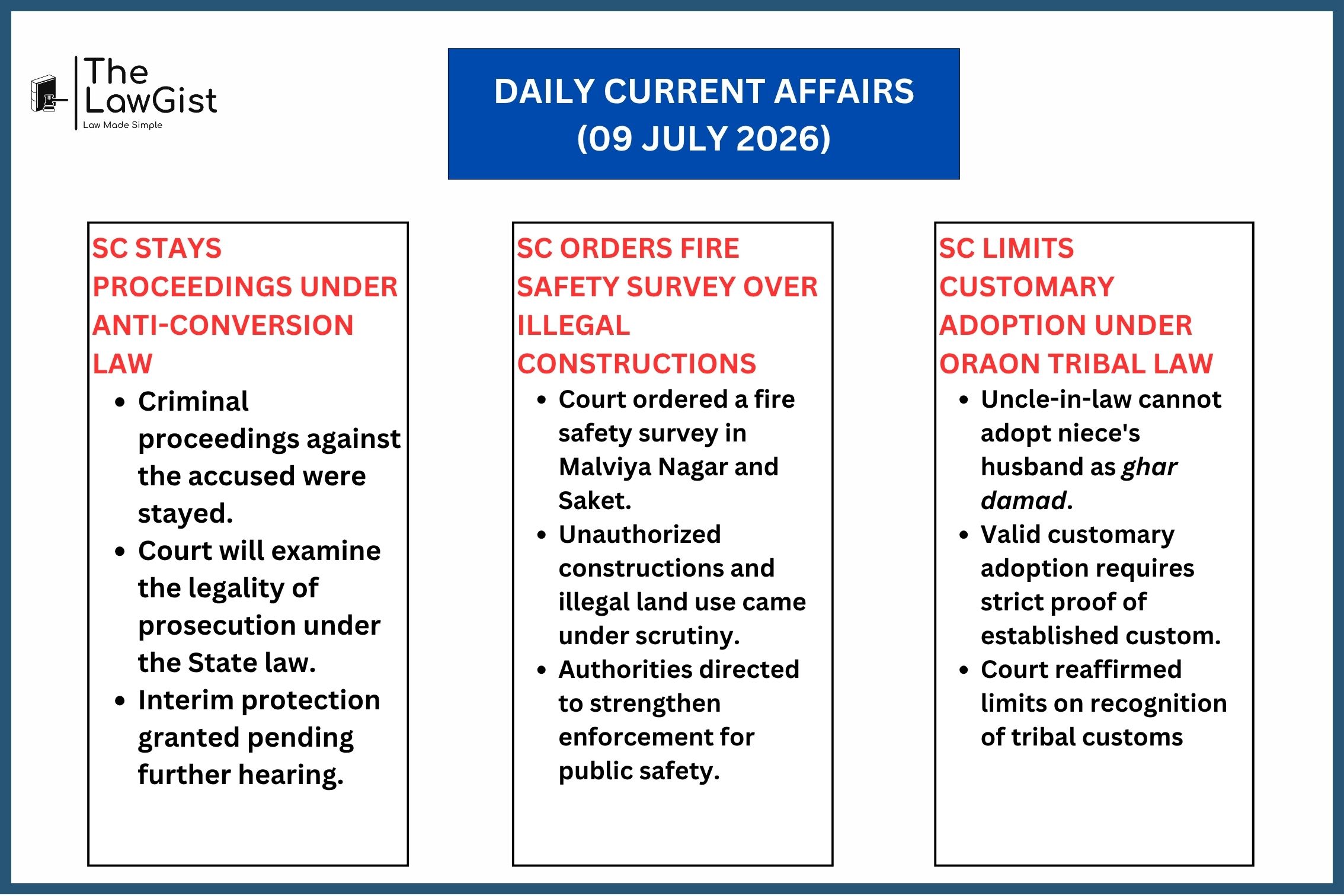
DAILY CURRENT AFFAIRS (09 JULY 2026)
SC ORDERS FIRE SAFETY SURVEY IN DELHI, GURUGRAM AFTER FLAGGING ILLEGAL CONSTRUCTIONS
Case Name: MC Mehta v. Union of India & Ors.
The Supreme Court expressed serious concern over rampant unauthorized constructions and illegal land-use violations in Delhi and Gurugram. Referring to recent fire incidents, the Court directed a comprehensive fire safety survey in Delhi’s Malviya Nagar and Saket areas and called for stricter enforcement against illegal buildings that compromise public safety.
LEGAL PROVISIONS & FRAMEWORK
- Delhi Municipal Corporation Act, 1957
- Haryana Municipal Corporation Act
- National Building Code, 2016
- Fire Safety Rules and Building Bye-Laws
- Article 21 – Right to life and safety
- Urban planning and land-use regulations
Source: Supreme Court of India
SC STAYS CRIMINAL PROCEEDINGS AGAINST HINDU MAN BOOKED UNDER ANTI-CONVERSION LAW
Case Name: Criminal Appeal concerning Uttar Pradesh Prohibition of Unlawful Conversion of Religion Act
The Supreme Court stayed criminal proceedings against a Hindu man accused of compelling his family members to embrace Islam. Issuing notice in the matter, the Court granted interim protection while examining the legality of the prosecution under the State’s anti-conversion law, leaving the merits of the allegations open for adjudication.
LEGAL PROVISIONS & FRAMEWORK
- Uttar Pradesh Prohibition of Unlawful Conversion of Religion Act, 2021
- Article 21 – Right to life and personal liberty
- Article 25 – Freedom of conscience and religion
- Criminal procedure safeguards
- Principles governing quashing of criminal proceedings
- Constitutional protection of religious freedom
Source: Supreme Court of India
UNCLE-IN-LAW CANNOT ADOPT NIECE’S HUSBAND AS ‘GHAR DAMAD’ UNDER ORAON CUSTOM: SC
Case Name: Civil Appeal concerning Oraon Tribal Customary Adoption
The Supreme Court held that an uncle-in-law cannot adopt his niece’s husband as a ghar damad under the customary practices of the Oraon tribe. The Court ruled that customary adoptions must be supported by clear evidence of a valid and established custom, and cannot be recognised merely on the basis of family arrangements inconsistent with established tribal law.
LEGAL PROVISIONS & FRAMEWORK
- Hindu Adoptions and Maintenance Act, 1956 (general principles)
- Customary law governing Scheduled Tribes
- Indian Evidence Act, 1872
- Proof of valid custom
- Tribal customary succession principles
- Judicial recognition of customary practices
Source: Supreme Court of India
Also Read: DAILY CURRENT AFFAIRS (07 JULY 2026)