SUPREME COURT REJECTS GHAR DAMAD ADOPTION UNDER ORAON CUSTOM
Case in News
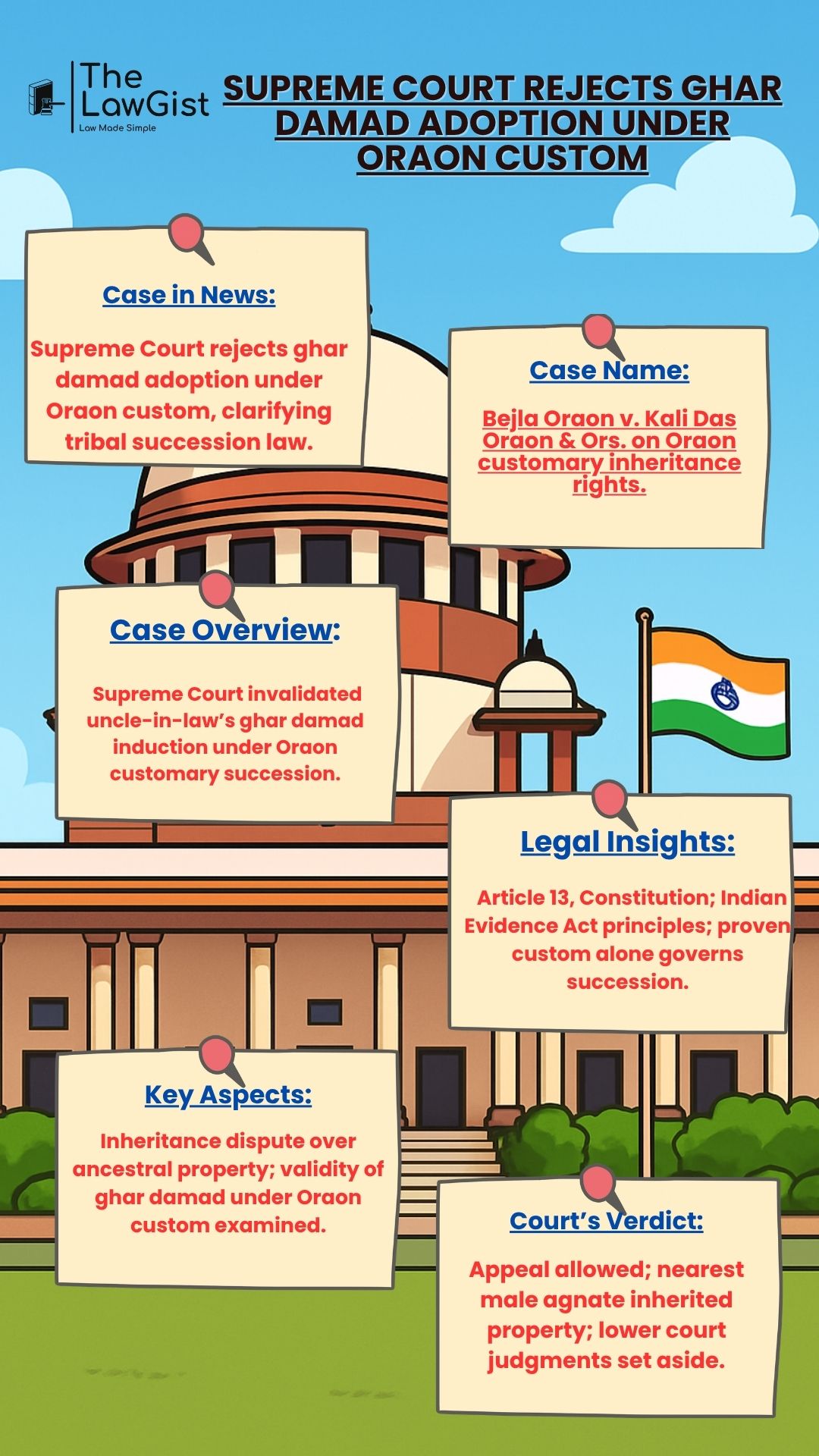
Supreme Court Rejects Ghar Damad Adoption Under Oraon Custom clarifies succession rights under Oraon tribal customary law.
Discover powerful Latin Maxims and simplify complex legal terms in seconds
Case Name
Bejla Oraon v. Kali Das Oraon & Ors.
Case Overview
The Supreme Court of India in Bejla Oraon v. Kali Das Oraon & Ors. held that an uncle-in-law cannot induct his niece’s husband as a ghar damad under the recognized customary law of the Oraon tribe. The judgment was given by a Bench comprising Justice Sanjay Karol & Justice Nongmeikapam Kotiswar Singh. The dispute arose over ancestral property after the deaths of Ledura Oraon & Bhoula Oraon. While the defendants claimed that Budhain’s husband, Punai had been validly inducted as a ghar damad & was entitled to inherit the property, the plaintiff asserted his right as the nearest male agnate. The Supreme Court found no recognized custom permitting such an arrangement by an uncle-in-law & allowed the appeal.
Key Aspects
The case primarily examined the validity of a ghar damad arrangement under Oraon customary law & its impact on succession to ancestral property. The Court also considered whether the defendants had successfully proved the existence of such a custom.
- Facts: The dispute concerned ancestral property belonging to Sukhu Oraon & competing claims of inheritance.
- Facts: The plaintiff claimed succession as the nearest male agnate after the deaths of Ledura & Bhoula.
- Facts: The defendants relied on an alleged ghar damad arrangement and a partition deed dated 27th February, 1975.
- Issue: Whether an uncle-in-law can legally induct his niece’s husband as a ghar damad under Oraon customary law.
- Issue: Whether the alleged customary practice was proved by reliable evidence.
Legal Insights
The Supreme Court of India reiterated that a customary practice affecting inheritance must be strictly proved before it can be recognized by courts. The burden lies on the party asserting the custom & courts cannot extend a custom beyond its established scope.
- Article 13 of Constitution: A custom having the force of law must be valid, certain, reasonable & well-established.
- Customary Law of the Oraon Tribe: The Court relied on S.C. Roy’s The Oraon of Chotanagpur which recognizes a ghar damad only when inducted by the last male owner or his widow.
- Indian Evidence Act, 1872 (Principles relating to proof of custom): The party relying on a custom must establish its continuous, certain & ancient existence through cogent evidence.
- Law of Succession under Oraon Custom: In the absence of a valid ghar damad or any eligible male heir directly related to the landowner the nearest male agnate succeeds to the property.
- Judicial Principle: Supreme Court Rejects Ghar Damad Adoption Under Oraon Custom reaffirmed that courts cannot recognize customs that are not legally established.
Court’s Verdict
Allowing the appeal the Supreme Court of India set aside the judgments of the Trial Court, First Appellate Court & the Jharkhand High Court. It held that the alleged ghar damad arrangement was invalid under Oraon customary law since it was made by an uncle-in-law. Consequently, the plaintiff being the nearest male agnate was declared entitled to inherit the ancestral property.
Source-Supreme Court of India
Read also – Constitution
The LawGist ensures exam success with quality notes—TPL, Current Affairs, Recent Judgments, and more. Backed by trusted resources and videos, The LawGist is every aspirant’s first choice