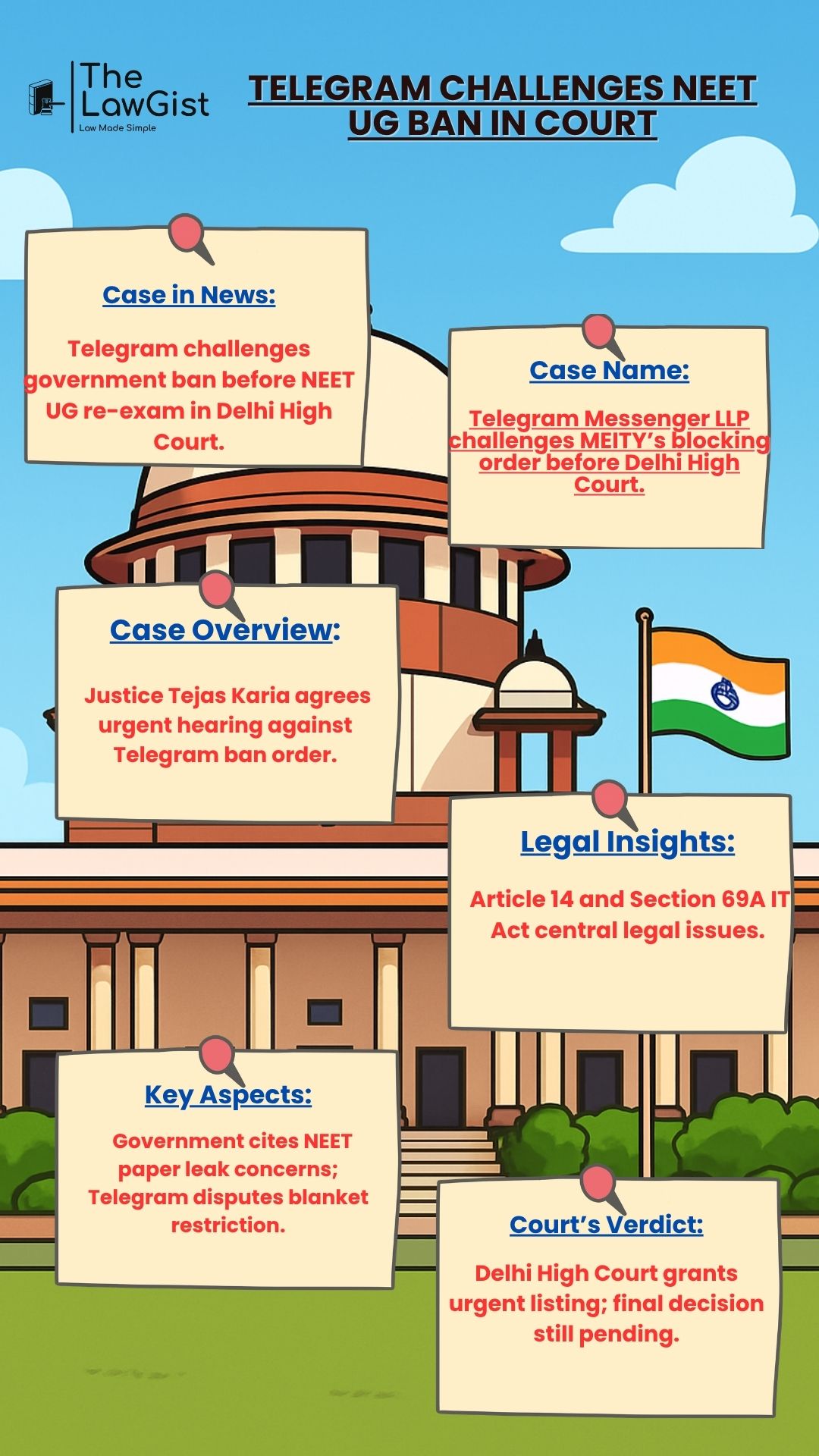
Delhi High Court hears Telegram’s urgent challenge to MEITY’s ban before NEET UG re-examination.
Case in NewsTelegram Challenges NEET UG Ban In Court before the Delhi High Court over restrictions imposed ahead of NEET UG re-examination. |
Discover powerful Latin Maxims and simplify complex legal terms in seconds
Case Overview
Case Name – Telegram Messenger LLP v. Union of India & Others
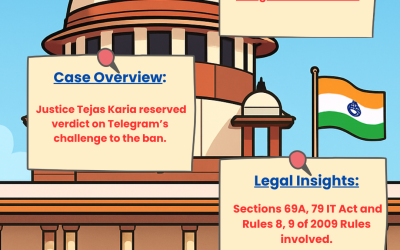
The instant messaging platform Telegram approached the Delhi High Court challenging the decision of the Central Government to temporarily block its operations in India until 22nd June, 2026. The restriction was imposed ahead of the NEET UG re-examination due to concerns regarding paper leaks & exam malpractice.
The matter was mentioned before Justice Tejas Karia who agreed to hear it on an urgent basis. Telegram argued that the ban affected over 150 million users & ignored the extensive measures taken by the platform to curb unlawful content. The blocking order was issued by MEITY under Section 69A IT Act.
Key Aspects
The dispute arises from the government’s concerns regarding misuse of Telegram channels during the NEET UG controversy. Telegram contends that the ban is disproportionate & unfairly penalizes millions of legitimate users despite its cooperation with authorities.
- The government temporarily banned Telegram until 22nd June 2026.
- Authorities alleged Telegram channels were used to circulate leaked & fake NEET papers.
- Telegram claimed it removed flagged content within 1 hour of receiving notices.
- More than 900 NEET-related unlawful links were reportedly taken down.
- The platform deployed AI tools, machine learning systems & manual moderation.
- Telegram challenged the legality & proportionality of the blanket restriction.
- A separate order disabled message-editing features until 30th June .
Legal Insights
The case raises questions regarding government regulation of digital platforms & the balance between public interest & constitutional rights. It also examines whether a complete platform ban is justified when alleged misconduct is limited to certain users.
- The petition alleges violation of Article 14 of the Constitution of India.
- Telegram argues that other social media platforms were not similarly restricted.
- The blocking order was issued under Section 69A IT Act, 2000.
- The company claims the order lacks adequate reasoning & shows non-application of mind.
- Issues concerning freedom of speech & access to information have also been raised.
Court’s Verdict
The Delhi High Court presided over by Justice Tejas Karia agreed to hear Telegram’s challenge on an urgent basis. The matter remains pending & no final decision on the validity of the government ban has been delivered so far.
Source – India Code
Read also – Constitution
The LawGist ensures exam success with quality notes—TPL, Current Affairs, Recent Judgments, and more. Backed by trusted resources and videos, The LawGist is every aspirant’s first choice