SUPREME COURT ON DISCIPLINARY AUTHORITY UNDER DMC ACT 1957
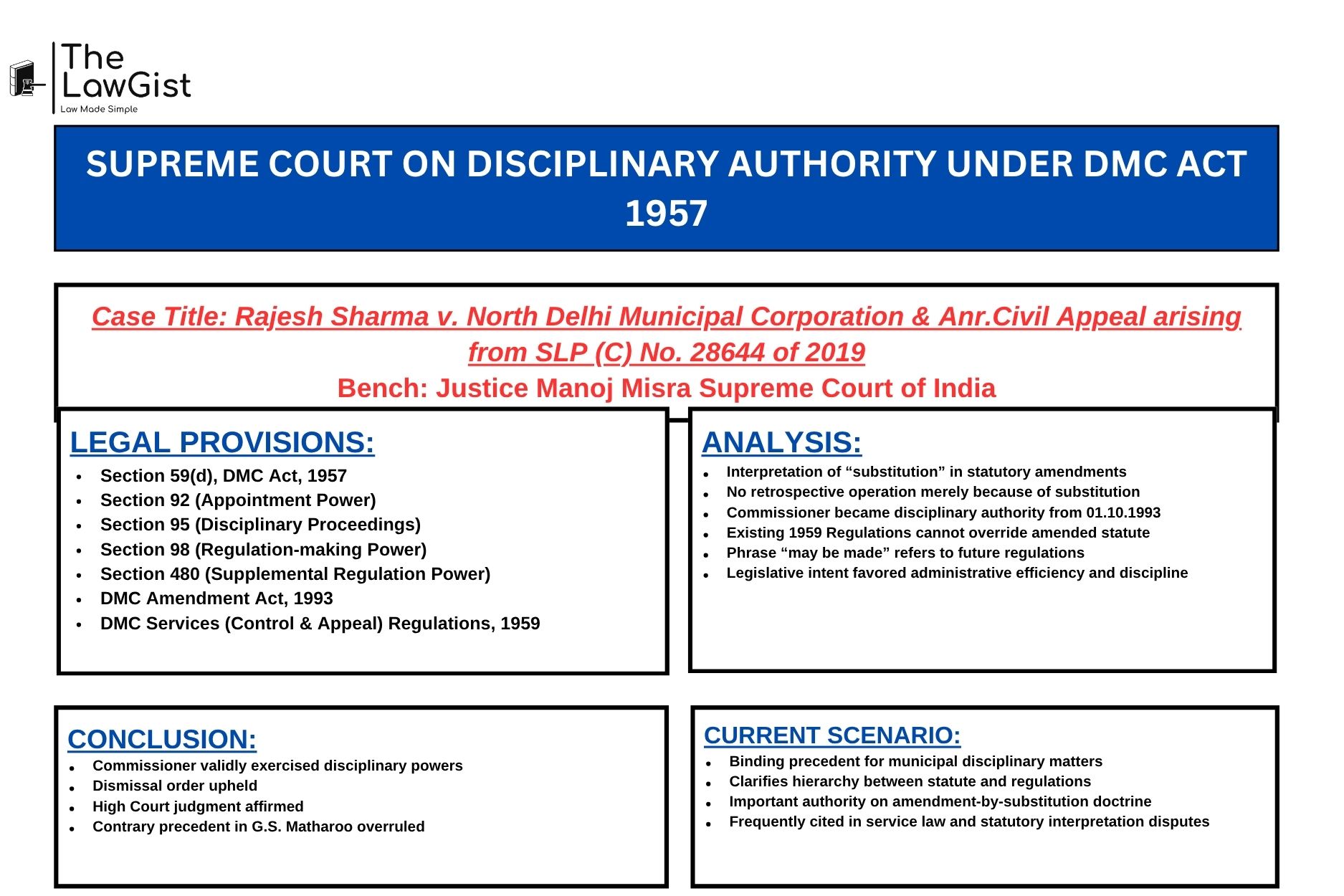
CASE SUMMARY – In Rajesh Sharma vs. North Delhi Municipal Corporation & Anr. concerned whether the Commissioner of the Municipal Corporation was competent to dismiss a Group-A officer following amendments made to the Delhi Municipal Corporation Act, 1957. The appellant argued that under the 1959 Regulations, only the Corporation could impose a major penalty. The Supreme Court held that the 1993 amendment to Section 59(d) made the Commissioner the disciplinary authority from 1 October 1993. It further ruled that the phrase “subject to any regulation that may be made” referred to future regulations, not existing ones. Consequently, the Commissioner’s dismissal order was valid and lawful.
| Particulars | Details |
| Case Title | Rajesh Sharma vs. North Delhi Municipal Corporation & Anr. |
| Introduction | The Supreme Court examined whether the Commissioner of the Municipal Corporation was competent to dismiss a Category-A officer after the 1993 amendment to the Delhi Municipal Corporation Act, 1957. The dispute centered on the interpretation of Section 59(d), Section 92, Section 95, and the 1959 Regulations. |
| Factual Background | Rajesh Sharma, an Executive Engineer (Civil), was convicted under the Prevention of Corruption Act and IPC provisions. Following conviction, the Commissioner dismissed him from service. Sharma challenged the dismissal before CAT, arguing that only the Corporation—not the Commissioner—could impose major penalties on a Group-A officer. CAT accepted his plea, but the Delhi High Court reversed the decision. |
| Legal Issues | 1. Whether the Commissioner became the disciplinary authority after substitution of Section 59(d) by the 1993 Amendment.
2. Whether Section 59(d) is subject to the existing 1959 Regulations or only future regulations. 3. Whether the High Court should have referred the matter to a larger bench due to conflicting precedents. |
| Applicable Law | Delhi Municipal Corporation Act, 1957 – Sections 59(d), 89, 92, 95, 98, 480; Delhi Municipal Corporation Services (Control & Appeal) Regulations, 1959; Delhi Municipal Corporation (Amendment) Act, 1993 (Act 67 of 1993). |
| Analysis | The Court extensively discussed the doctrine of amendment by substitution and held that a substituted provision generally operates prospectively unless expressly made retrospective. The Court concluded that Section 59(d), inserted on 01.10.1993, made the Commissioner the disciplinary authority. The phrase “subject to any regulation that may be made” referred to future regulations and not the existing 1959 Regulations. The legislative intent behind the 1993 amendment was to strengthen administrative control and disciplinary supervision by vesting such powers in the Commissioner. |
| Conclusion | The Supreme Court held that the Commissioner was the competent disciplinary authority and validly dismissed the appellant. The Court overruled the contrary view taken in G.S. Matharoo and upheld the Delhi High Court’s judgment. |
| Current Scenario | This judgment is now the leading authority on disciplinary powers under the Delhi Municipal Corporation Act. It clarifies that, post-1993 amendment, the Commissioner is the disciplinary authority unless a later regulation validly provides otherwise. The ruling also provides significant guidance on the interpretation of statutory amendments by substitution. |
“A substituted statutory provision operates from the date of substitution unless the legislature clearly intends retrospective operation.”
SOURCE – SUPREME COURT OF INDIA