Supreme Court reinforces protection of minors in succession disputes (2026).
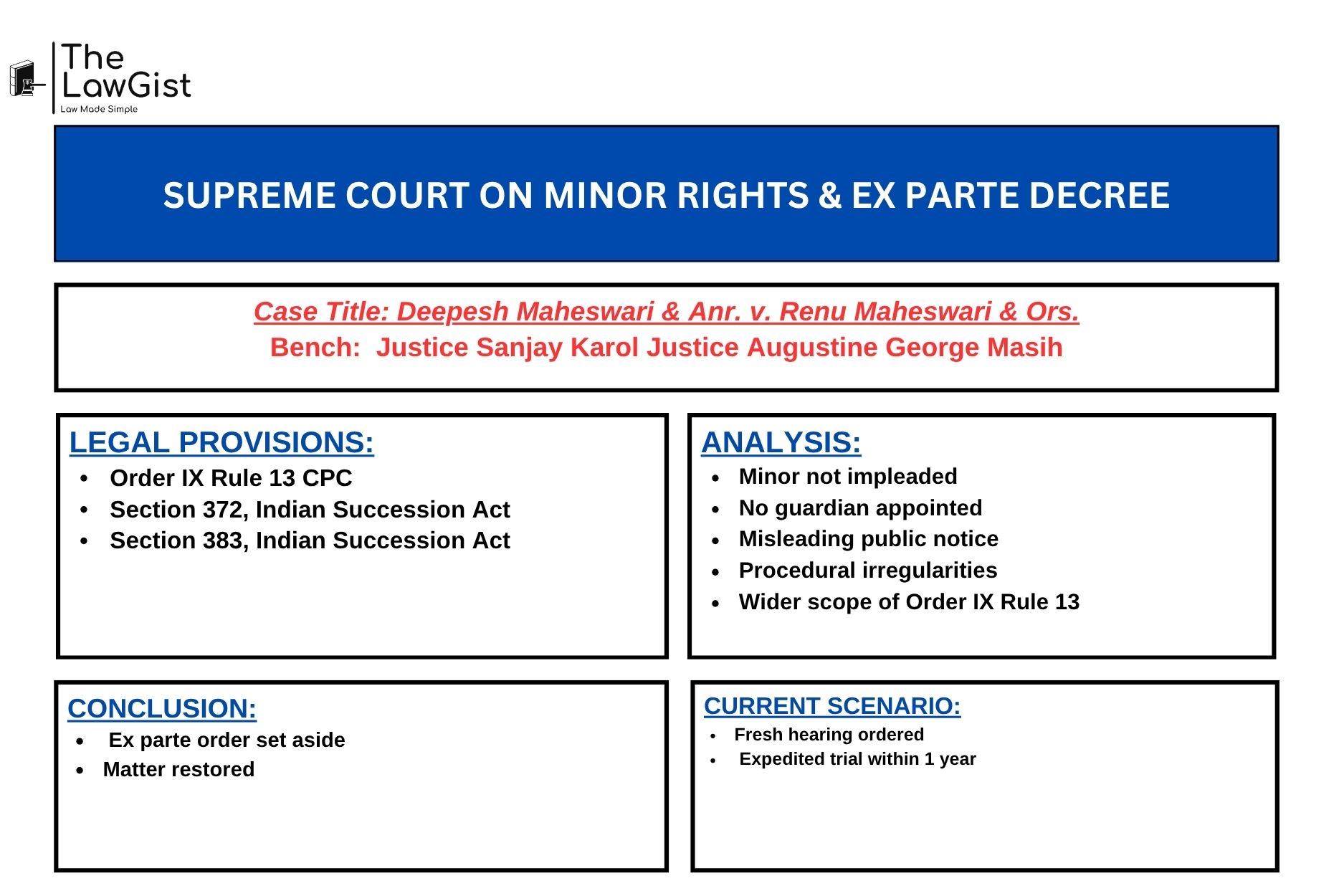
SUPREME COURT ON MINOR RIGHTS & EX PARTE DECREE
CASE SUMMARY – The Supreme Court in Deepesh Maheswari vs. Renu Maheswari (2026) addressed the validity of an ex parte succession certificate challenged under Order IX Rule 13 CPC. The case involved a minor legal heir who was not impleaded nor represented by a guardian in the original proceedings. The Court held that failure to protect the rights of a minor constitutes a serious procedural defect. It further clarified that Order IX Rule 13 CPC provides a wider remedy even after dismissal of an appeal. Consequently, the Court set aside the ex parte order and restored the matter for fresh adjudication, ensuring fair opportunity to all legal heirs.
| ASPECTS | DETAILS |
| Case Title | Deepesh Maheswari & Anr. vs. Renu Maheswari & Ors. (2026) |
| Introduction | The case deals with the validity of an ex parte succession certificate and the scope of Order IX Rule 13 CPC in setting aside such orders, particularly involving rights of a minor. |
| Factual Background | Respondents (daughters of deceased Omprakash Maheshwari) obtained a succession certificate. The appellants challenged it, claiming improper notice and exclusion of a minor legal heir. Lower courts rejected the application under Order IX Rule 13 CPC. |
| Legal Issues | 1. Whether ex parte order can be set aside under Order IX Rule 13 CPC.
2. Whether minor’s non-representation invalidates proceedings. 3. Whether succession certificate can be challenged after appeal. |
| Applicable Law | – Order IX Rule 13 CPC
– Section 372, Indian Succession Act, 1925 – Section 383, Indian Succession Act, 1925 – Case laws: Parimal v. Veena, Neerja Realtors v. Janglu, Bhanu Kumar Jain v. Archana Kumar |
| Analysis | The Supreme Court emphasized that minors cannot defend their rights independently. Failure to implead a minor and appoint a guardian is a serious procedural defect. Public notice was insufficient and misleading. The Court held that Order IX Rule 13 CPC has wider scope and can be invoked despite dismissal of appeal. |
| Conclusion | The Supreme Court allowed the appeal, set aside the ex parte succession certificate, and restored the matter for fresh adjudication. |
| Current Scenario | The case is remanded to the trial court for reconsideration. Parties must cooperate for expeditious disposal within one year. |
“Justice demands that no minor be denied a hearing due to procedural lapses.”
SOURCE – SUPREME COURT OF INDIA
Discover insights on Latin Maxims and Legal Glossary and simplify complex legal terms in seconds.The LawGist ensures exam success with quality Blogs and Articles on — Top Legal Picks (TLP), Current Affairs, latest Supreme Court judgments as Courtroom Chronicles. Backed by trusted resources and videos, The LawGist is every Professionals and Aspirant’s first choice. Discover more at thelawgist.org