Supreme Court rulings on recruitment rules, divorce law, and online gaming addiction concerns.
DAILY CURRENT AFFAIRS (3rd JUNE 2026)
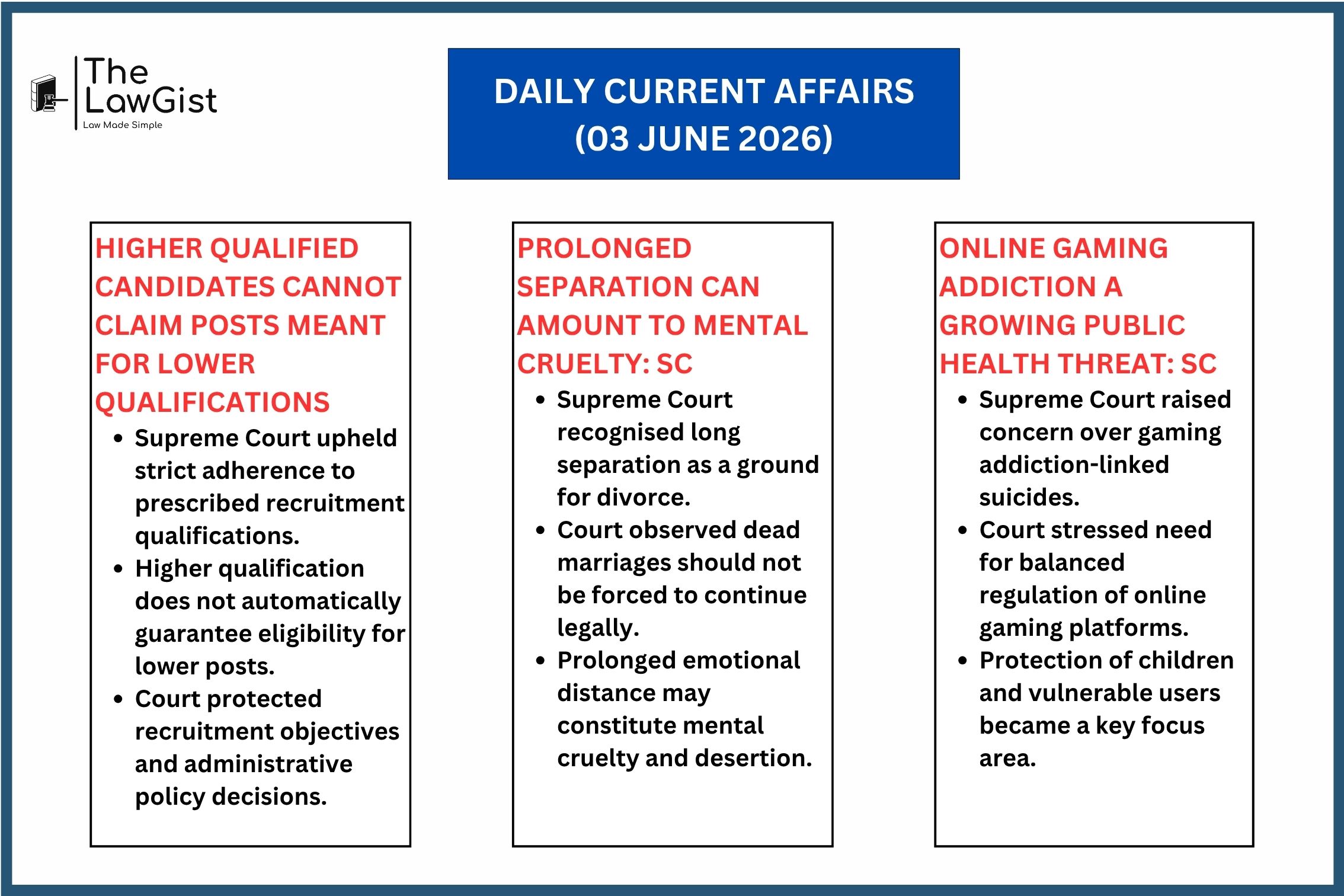
CANDIDATES WITH HIGHER QUALIFICATIONS CANNOT CLAIM POSTS MEANT FOR LOWER QUALIFICATIONS: SC
Case Name: State of Uttar Pradesh & Ors. v. Pankaj Kumar
The Supreme Court held that candidates possessing qualifications higher than those prescribed cannot automatically claim eligibility for posts specifically designed for less-qualified applicants. The Court observed that recruitment authorities are entitled to maintain distinct eligibility standards to preserve the purpose of reservation of opportunities and administrative requirements attached to particular posts.
LEGAL PROVISIONS & FRAMEWORK
- Articles 14 and 16 of the Constitution
- Equality in public employment
- Recruitment and service jurisprudence
- Eligibility criteria in public appointments
- Judicial review of recruitment rules
- Principles governing public sector employment
Source: Supreme Court of India
PROLONGED SEPARATION CAN AMOUNT TO MENTAL CRUELTY AND DESERTION: SC
Case Name: X v. Y
The Supreme Court observed that prolonged separation between spouses may itself constitute mental cruelty and desertion, justifying dissolution of marriage. The Court noted that forcing parties to continue a dead marriage without emotional or practical companionship serves no meaningful purpose and only prolongs suffering for both individuals.
LEGAL PROVISIONS & FRAMEWORK
- Hindu Marriage Act, 1955
- Section 13 – Divorce grounds
- Mental cruelty jurisprudence
- Desertion under matrimonial law
- Article 21 – Right to live with dignity
- Irretrievable breakdown principles
Source: Supreme Court of India
ONLINE GAMING ADDICTION AND SUICIDES A SERIOUS PUBLIC HEALTH THREAT: SC
Case Name: All India Gaming Federation v. State of Tamil Nadu
The Supreme Court raised concern over rising cases of online gaming addiction and linked suicides, describing the issue as a growing public health challenge. The Court emphasised the need for balanced regulation, particularly to protect children and vulnerable users from financial exploitation, psychological harm, and addictive gaming behaviour.
LEGAL PROVISIONS & FRAMEWORK
- Information Technology Act, 2000
- Public health and safety principles
- Consumer protection concerns
- Digital platform regulation
- Constitutional balance between trade and welfare
- State powers to regulate online gaming
Source: Supreme Court of India
Also read: DAILY CURRENT AFFAIRS (1st JUNE 2026)