DAILY CURRENT AFFAIRS (1st JUNE 2026)
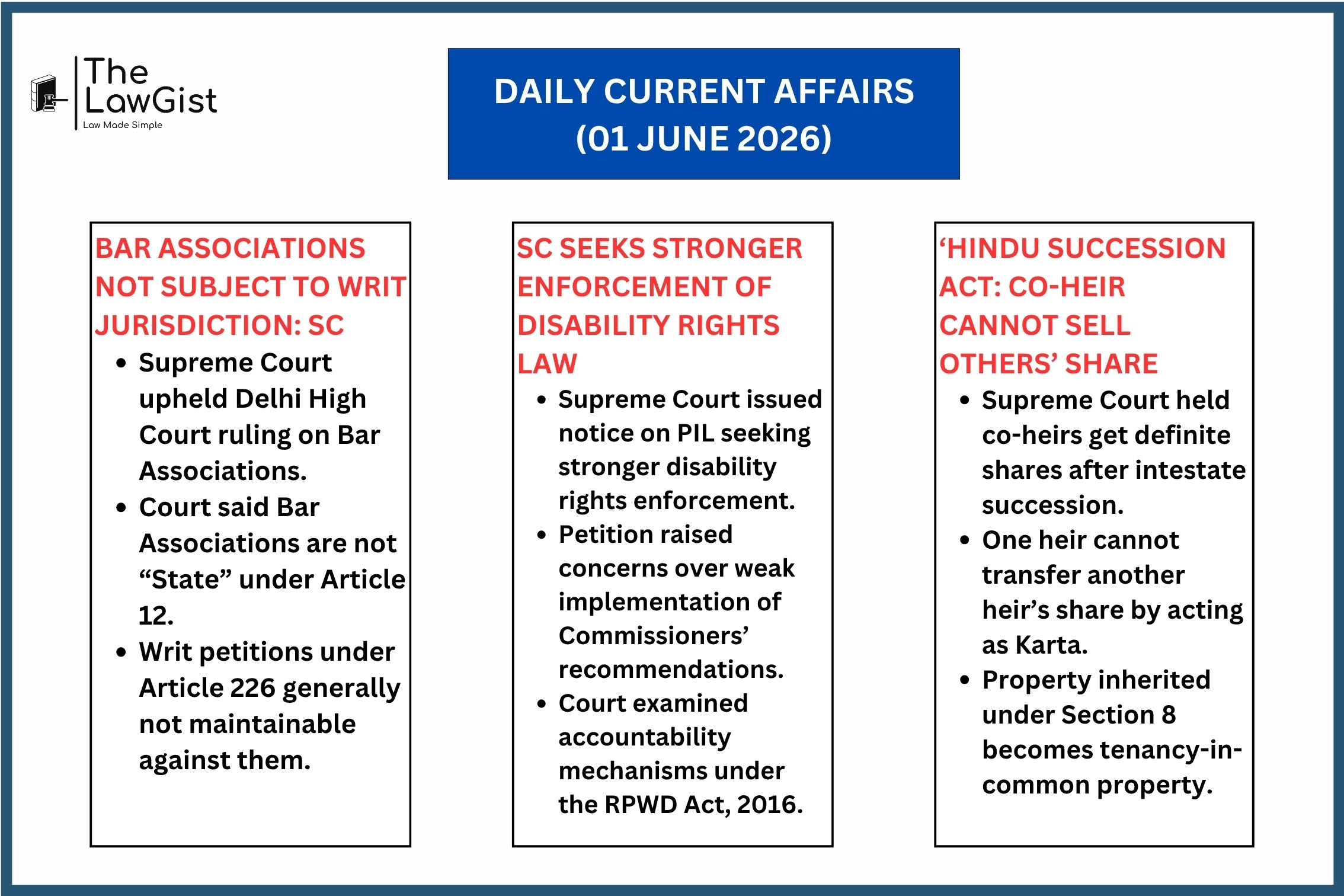
HINDU SUCCESSION ACT: CO-HEIR CANNOT SELL OTHERS’ SHARE AS KARTA
Case Name: DARUBAI & ANR. VERSUS KAMALABAI & ORS.
The Supreme Court of India held that after intestate succession under the Hindu Succession Act, inherited property is treated as tenancy-in-common and not as joint Hindu family property. Therefore, one co-heir cannot transfer or alienate the shares of other heirs by claiming the status of “Karta.” Each heir possesses a definite and independent share in the property.
LEGAL PROVISIONS & FRAMEWORK
- Hindu Succession Act, 1956
- Section 8 – General rules of succession in case of males
- Concept of intestate succession
- Tenancy-in-common principle
- Mitakshara Hindu Law principles
- Rights and limitations of Karta in HUF property
Source: Supreme Court of India
SUPREME COURT SEEKS STRONGER ENFORCEMENT OF DISABILITY RIGHTS FRAMEWORK
Case Name: Shashank Pandey v. Union of India
The Supreme Court of India issued notice to the Union Government on a PIL seeking stronger implementation of recommendations made by Chief Commissioners and State Commissioners for persons with disabilities. The plea highlighted weak enforcement mechanisms under the disability law and sought a more effective grievance redressal system to ensure accountability and protection of rights of persons with disabilities.
LEGAL PROVISIONS & FRAMEWORK
- Rights of Persons with Disabilities Act, 2016
- Sections relating to Chief Commissioner & State Commissioners
- Article 14 – Equality before law
- Article 21 – Right to dignity and life
- Article 41 – Assistance to disabled persons
- UN Convention on Rights of Persons with Disabilities (UNCRPD)
Source: Supreme Court of India
BAR ASSOCIATIONS NOT SUBJECT TO WRIT JURISDICTION: SUPREME COURT
Case Name: Sangita Rai v. New Delhi Bar Association & Ors.
The Supreme Court of India upheld the Delhi High Court ruling stating that Bar Associations are not “State” authorities under Article 12 of the Constitution and therefore are generally not amenable to writ jurisdiction under Article 226. The Court observed that Bar Associations function as private bodies and do not discharge statutory or sovereign public duties.
LEGAL PROVISIONS & FRAMEWORK
- Article 12 – Definition of “State”
- Article 226 – Writ jurisdiction of High Courts
- Advocates Act, 1961
- Principles of public function doctrine
- Maintainability of writ petitions
- Judicial review standards for private bodies
Source: Supreme Court of India
Also Read: DAILY CURRENT AFFAIRS (27 MAY 2026)