Supreme Court held that prolonged separation and denial of conjugal relations can constitute mental cruelty, affirming divorce and invoking Article 142 for complete justice.
SC ON MENTAL CRUELTY, PROLONGED SEPARATION AND IRRETRIEVABLE BREAKDOWN OF MARRIAGE
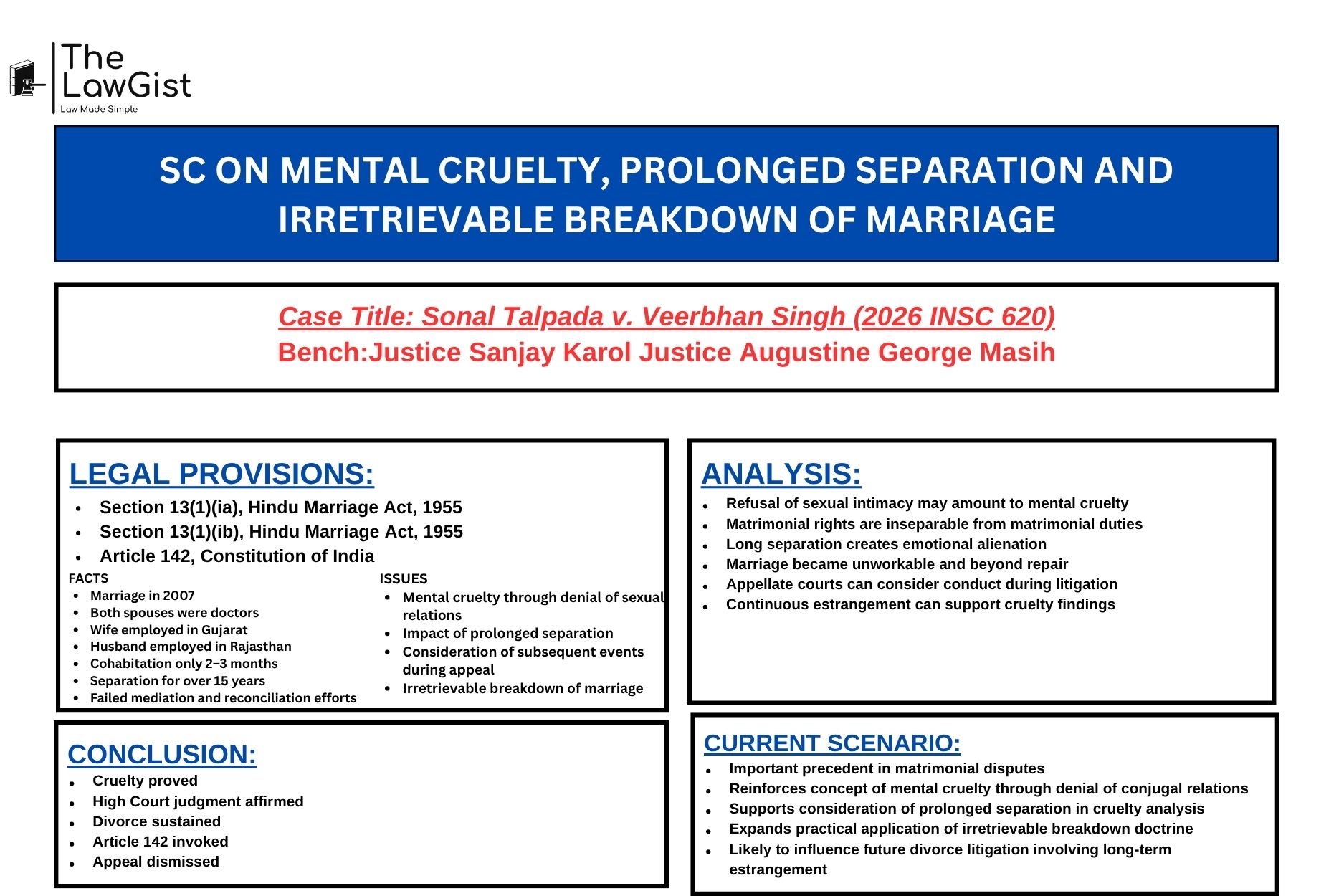
In Sonal Talpada vs. Veerbhan Singh (2026 INSC 620), the Supreme Court upheld a decree of divorce granted by the Rajasthan High Court. The parties, both doctors, had cohabited for only a few months after marriage and remained separated for more than fifteen years. The Court held that persistent denial of sexual relations without reasonable cause constituted mental cruelty under Section 13(1)(ia) of the Hindu Marriage Act. It further observed that prolonged separation, emotional alienation, and failure of reconciliation efforts demonstrated that the marriage was beyond repair. Exercising powers under Article 142, the Court dissolved the marriage on grounds of irretrievable breakdown.
| ASPECTS | DETAILS |
| Case Title | Sonal Talpada vs. Veerbhan Singh |
| Bench | Justice Sanjay Karol and Justice Augustine George Masih |
| Introduction | The Supreme Court considered whether prolonged separation, refusal of sexual relations, failure to perform matrimonial obligations, and complete breakdown of marital ties constituted mental cruelty under Section 13(1)(ia) of the Hindu Marriage Act, 1955. |
| Factual Background | The parties, both doctors, married on 05.12.2007. The wife worked in Gujarat while the husband worked in Rajasthan. They cohabited only for about 2–3 months and remained separated for over 15 years. The husband filed a divorce petition in 2009 alleging cruelty. The Family Court dismissed the petition, but the Rajasthan High Court granted divorce. The wife appealed before the Supreme Court. |
| Legal Issues | 1. Whether denial of sexual relations amounted to mental cruelty under Section 13(1)(ia) HMA.
2. Whether prolonged separation could be considered while determining cruelty. 3. Whether divorce could be sustained despite desertion not being specifically pleaded. 4. Whether the marriage had irretrievably broken down warranting exercise of Article 142 powers. |
| Applicable Law | • Section 13(1)(ia), Hindu Marriage Act, 1955 (Cruelty)
• Section 13(1)(ib), Hindu Marriage Act, 1955 (Desertion) • Article 142, Constitution of India • Precedents: Samar Ghosh v. Jaya Ghosh; Shilpa Sailesh v. Varun Sreenivasan; Vikas Kanaujia v. Sarita; Naveen Kohli v. Neelu Kohli |
| Analysis | The Court held that persistent denial of sexual intercourse without reasonable cause constitutes mental cruelty. It emphasized that marriage is a partnership involving mutual rights and obligations. The parties had lived separately for more than 15 years, made no genuine efforts toward reconciliation, and failed mediation. Such prolonged separation coupled with emotional alienation amounted to cruelty. The Court also observed that appellate courts may consider subsequent events occurring during litigation. |
| Conclusion | The Supreme Court upheld the High Court’s decree of divorce. It found mental cruelty established and further held that the marriage had irretrievably broken down. Exercising powers under Article 142, the Court dissolved the marriage and dismissed the wife’s appeal. |
| Current Scenario | The judgment strengthens the evolving jurisprudence that prolonged separation, emotional estrangement, and denial of conjugal relations may constitute mental cruelty. It also reinforces the Supreme Court’s willingness to invoke Article 142 where marriages are beyond salvage, even when statutory grounds are imperfectly pleaded. |
“Persistent refusal of conjugal relations, prolonged separation, and absence of reconciliation may constitute mental cruelty, making continuation of marriage a mere legal fiction.”
SOURCE – SUPREME COURT OF INDIA