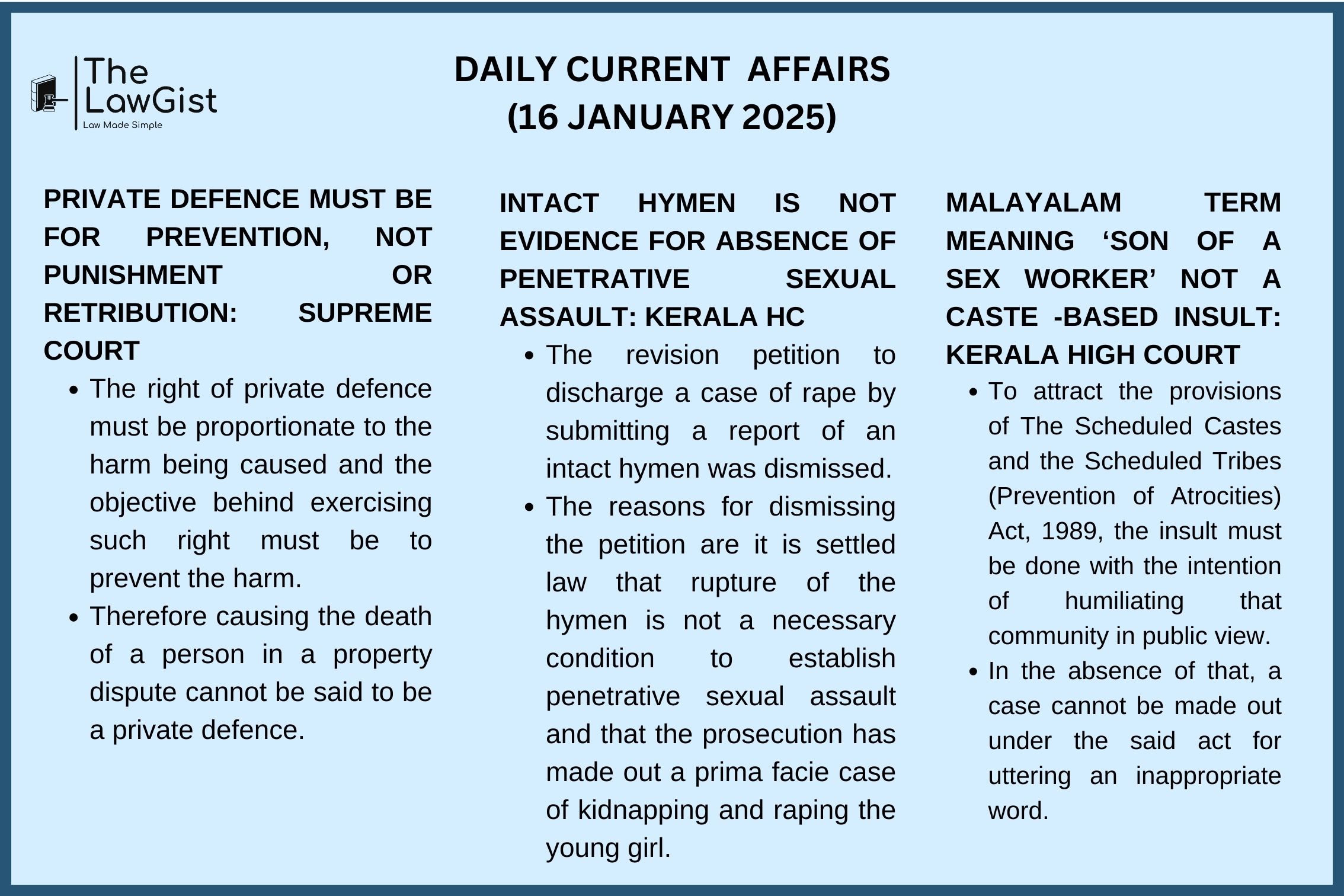
 PRIVATE DEFENCE MUST BE FOR PREVENTION, NOT PUNISHMENT OR RETRIBUTION: SUPREME COURT
Case Name: Ratheeshkumar Vs. The State Of Kerala & Anr.
While relying upon the case of Darshan Singh Vs. The State of Punjab and Anr the court held that the exercise of the right of private defence should not be excessive i.e. it must be proportionate to the harm being caused and the objective behind exercising such right must be to prevent the harm. It opined that the death of a person in a property dispute can happen only when there is a reasonable apprehension of death or grievous hurt from him and various factors like the weapon used, the manner and nature of the assault, the motive, etc. have to be taken into consideration.
Legal Provisions:
- Section 96 -106, Indian Penal Code-Right Of Private Defence
- Section 34-44, Bharatiya Nyaya Sanhita-Right Of Private Defence
Source: SUPREME COURT
INTACT HYMEN IS NOT EVIDENCE FOR ABSENCE OF PENETRATIVE SEXUAL ASSAULT: KERALA HC
Case Name: XXX v State of Kerala
The Kerala High Court dismissed a revision petition of the accused for discharging the case against him for kidnapping and raping a young girl by submitting the medical report showing that the hymen was intact and that there was no penetrative sexual assault. The court’s reasoning behind this was that since it is settled law that rupture of the hymen is not a necessary condition to establish penetrative sexual assault and that the prosecution has made out a prima facie case, the revision petition was dismissed.
Legal Provisions:
- Section 363, The Indian Penal Code- Punishment for kidnapping.
- Section 354A, The Indian Penal Code-Sexual harassment and punishment for sexual harassment.
- Section 341, The Indian Penal Code-Punishment for wrongful restraint.
- Section 376, The Indian Penal Code-Punishment for rape.
- Section 506, The Indian Penal Code-Punishment for criminal intimidation.
Source: KERALA HIGH COURT
MALAYALAM TERM MEANING ‘SON OF A SEX WORKER’ NOT A CASTE-BASED INSULT: KERALA HIGH COURT
Case Name: Sarath K S v State of Kerala
The court held that the Malayalam term meaning ‘Son Of A Sex Worker’ uttered by the accused to persons belonging to the Pulaya community is not a casteist insult and does not attract any offense under the Scheduled Castes & Scheduled Tribes (Prevention of Atrocities) Act, 1989 as the intention to humiliate a community member is not present here. If at all the word is taken to be a casteist slur, it appears not to be done in public view and hence it clearly does not fall under any provisions of the said act.
Legal Provisions:
- Section 3(1)(r), The Scheduled Castes and the Scheduled Tribes (Prevention of Atrocities) Act, 1989-intentionally insults or intimidates with intent to humiliate a member of SC/ST in public view.
- Section 3(1)(s), The Scheduled Castes and the Scheduled Tribes (Prevention of Atrocities) Act, 1989- abuses any member of an SC or ST by caste name in any place within public view.
Source: KERALA HIGH COURT
Also Read- (DAILY CURRENT AFFAIRS 15 JANUARY 2025)
WRITTEN BY – Veera Syamala Devi Nandikanuma
EDITOR – Vishakha Khatri