 Headline
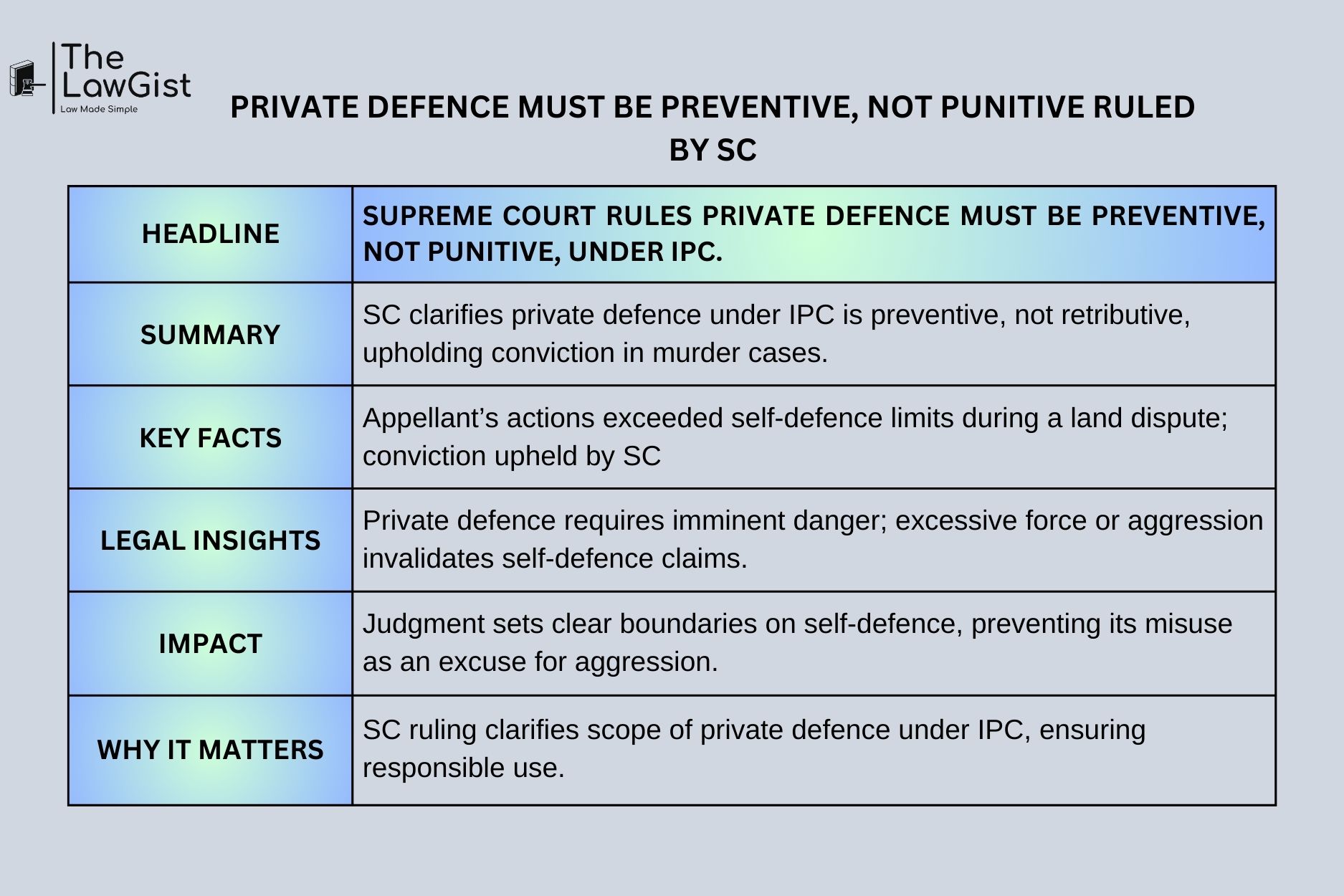
The Supreme Court shed light on private defence i.e. it must be preventive and not punitive.
Summary
The Supreme Court of India stresses that private defence under the Indian Penal Code (IPC) must be strictly preventive, not retributive. The Court upheld the conviction of the appellant, stating that his actions exceeded the boundaries of self-defence and showed aggression.
Key Facts
- Case Name: Ratheeshkumar @ Babu v. The State of Kerala & Anr.,
- Judges Name: Justice JB Pardiwala and Justice R Mahadevan
- The deceased was stabbed by the appellant during a land dispute, claiming self-defence. Trial and High Courts convicted him of murder.
- The Supreme Court observed the force used was not appropriate and beyond preventive self-defence.
Legal Insights
- Private defence under Section 100 of the Indian Penal Code (IPC) applies only when there occurs a real, immediate danger of death or grievous hurt.
- Actions exceeding necessary force or showing aggression nullifies the claim of private defence.
- The Court restated that private defence cannot be punitive or vengeful.
Impact
This judgment focuses on the boundaries of self-defence, making sure it is used adequately and not as an excuse for aggression.
Why It Matters
The ruling of the Supreme Court shed light on the scope of private defence under IPC, balancing individual rights with stopping misuse of this legal provision.
Source