Supreme Court stresses federal equality, calls out ongoing dowry abuse, and hears challenge to transgender law affecting identity and dignity rights.
DAILY CURRENT AFFAIRS (04 APRIL 2026)
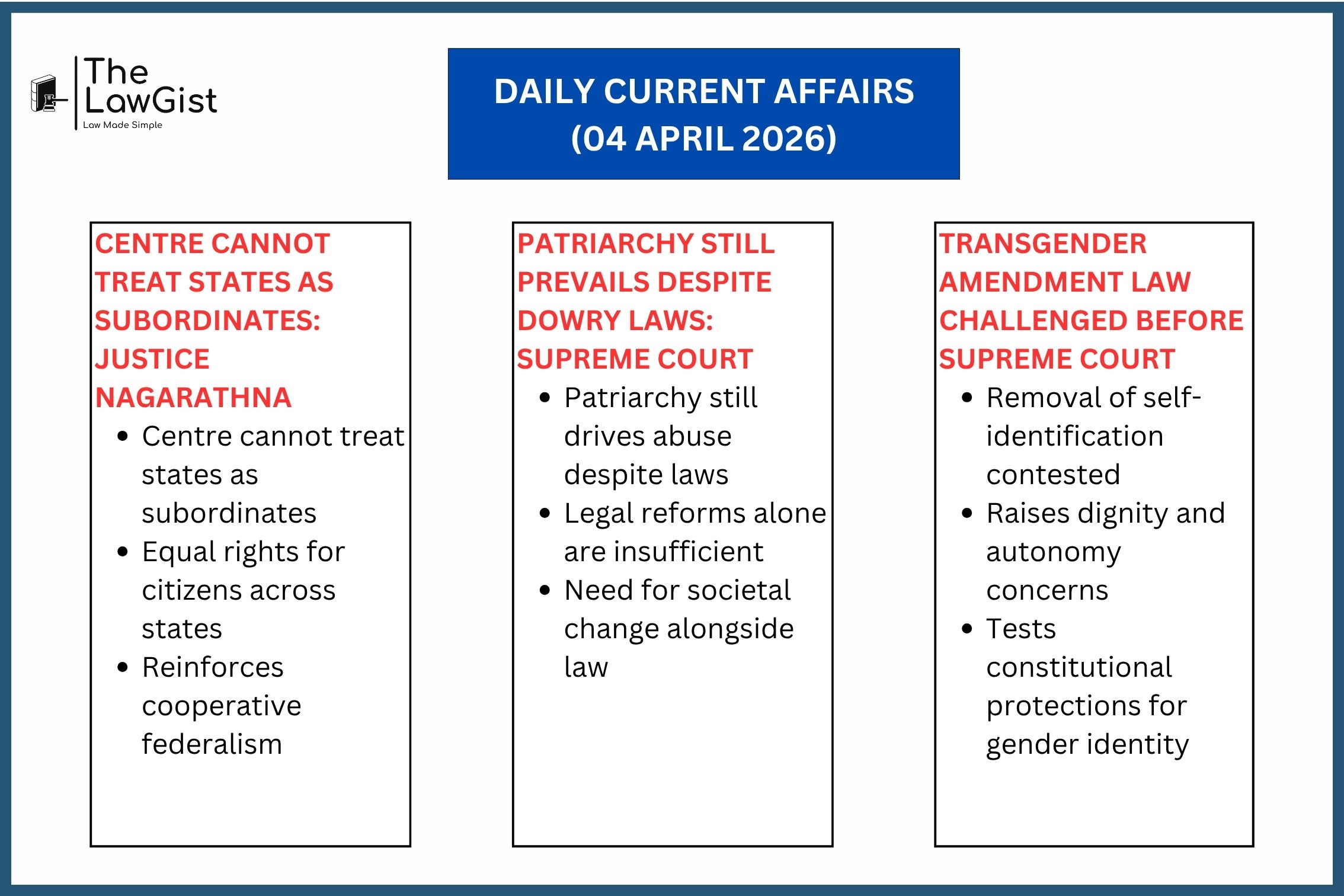
CENTRE CANNOT TREAT STATES AS SUBORDINATES: JUSTICE NAGARATHNA
Case Name: Observations by Justice B.V. Nagarathna on Federal Structure
The Supreme Court of India reiterated that India’s federal framework does not permit the Centre to treat states as subordinates. Justice B.V. Nagarathna stressed that citizens across states must enjoy equal constitutional protection, warning against discriminatory practices that undermine cooperative federalism and distort the balance of power envisaged by the Constitution.
Legal Provisions:
- Article 14 – Equality before law
- Federal Structure Doctrine
- Article 1 – Union of States
- Cooperative Federalism Principle
- Constitutional Morality
Source: Supreme Court of India
PATRIARCHY STILL PREVAILS DESPITE DOWRY LAWS: SUPREME COURT
Case Name: In Re: Dowry Harassment & Domestic Abuse Cases
The Supreme Court of India observed that despite legal safeguards, dowry harassment and domestic violence remain deeply rooted due to persistent patriarchal attitudes. It highlighted that legislative reforms alone are insufficient, calling for societal change to ensure that women’s dignity and safety are meaningfully protected beyond statutory frameworks.
Legal Provisions:
- Article 21 – Right to dignity
- Dowry Prohibition Act, 1961
- Protection of Women from Domestic Violence Act, 2005
- Gender Justice Principles
- Constitutional Equality Framework
Source: Supreme Court of India
TRANSGENDER AMENDMENT LAW CHALLENGED BEFORE SUPREME COURT
Case Name: Challenge to Transgender Persons (Amendment) Act, 2026 (Lakshmi Narayan Tripathi and another v. Union of India and another | Diary No. 20054/2026)
A petition before the Supreme Court of India challenges the Transgender Persons (Amendment) Act, 2026, arguing that removal of self-identification provisions violates personal autonomy and dignity. The plea contends that restricting gender identity recognition undermines fundamental rights and reverses progressive constitutional protections for transgender persons.
Legal Provisions:
- Article 21 – Right to dignity and identity
- Article 14 – Equality before law
- Transgender Persons Act, 2019
- NALSA Judgment Principles
- Right to Self-Identification
Source: Supreme Court of India
Also Read : DAILY CURRENT AFFAIRS (03 april 2026)