SUPREME COURT CONFIRMS MURDER CONVICTION IN DYING DECLARATION CASE
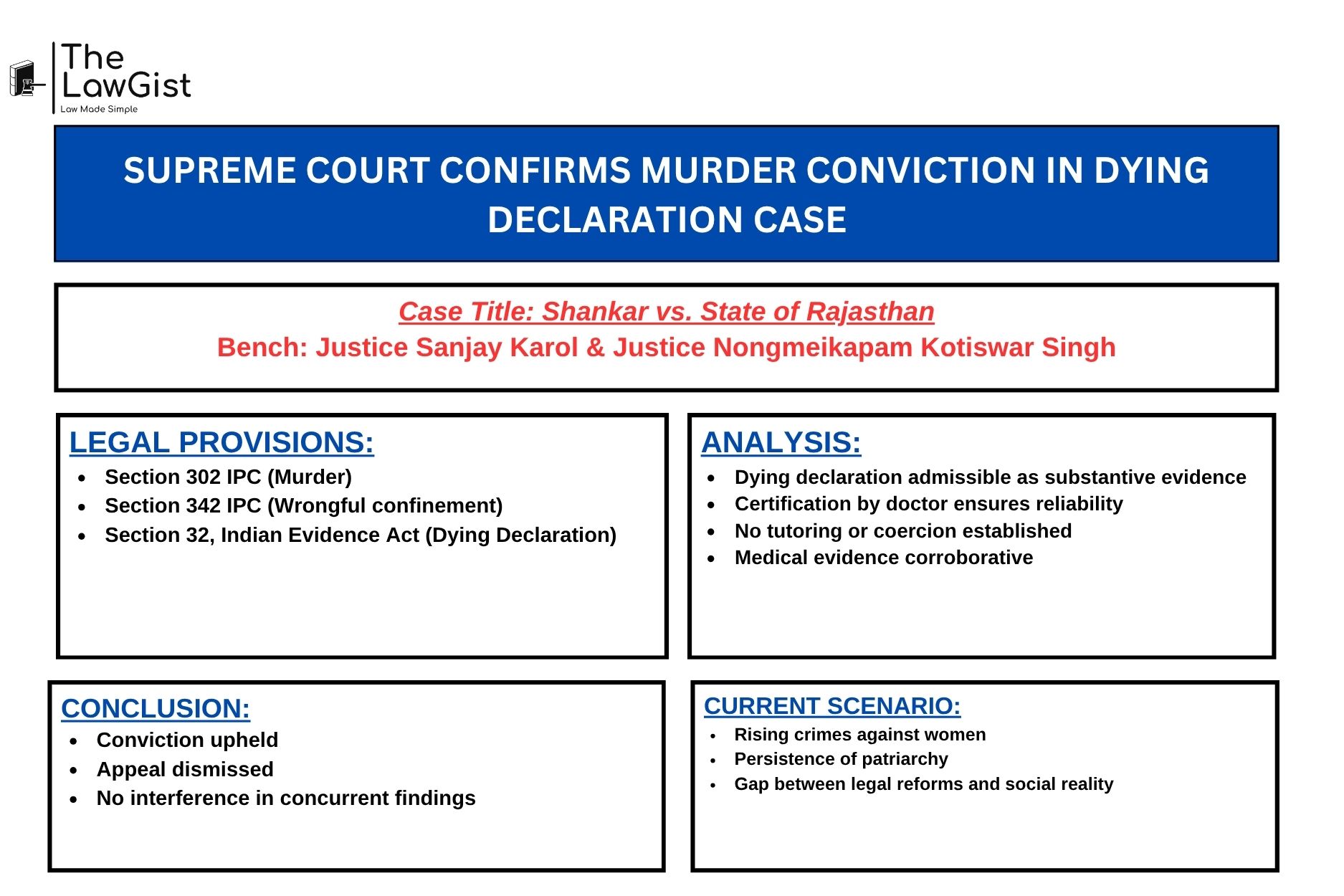
CASE SUMMARY – The Supreme Court in Shankar vS. State of Rajasthan upheld the conviction of the appellant for murdering his wife by burning her alive. The case primarily relied on the victim’s dying declaration, recorded by a Magistrate with medical certification of her mental fitness. The Court reiterated that a reliable dying declaration can form the sole basis for conviction if it is voluntary and truthful. Arguments regarding tutoring and procedural defects were rejected. Medical evidence supported the prosecution case. The Court also highlighted the continuing issue of domestic violence and gender inequality in India despite legal advancements, emphasizing the need for societal change.
| ASPECTS | DETAILS |
| Case Title | Shankar vS. State of Rajasthan (2026 INSC 315) |
| Introduction | Appeal before the Supreme Court against concurrent conviction under Sections 302 and 342 IPC for burning wife leading to death. |
| Factual Background | The appellant, allegedly intoxicated, assaulted his wife Sugna Bai, poured kerosene on her, and set her ablaze. She gave a dying declaration before a Magistrate and later succumbed to burn injuries. Trial Court and High Court upheld conviction. |
| Legal Issues | 1. Validity and reliability of dying declaration
2. Whether conviction can be sustained primarily on dying declaration 3. Scope of interference in concurrent findings |
| Applicable Law | Section 302 IPC, Section 342 IPC, Section 32 Indian Evidence Act (Dying Declaration), CrPC Section 313 |
| Analysis | The Court emphasized that a dying declaration, if voluntary, truthful, and medically certified, can form sole basis of conviction. The Magistrate followed due procedure, doctor certified fitness, and no evidence of tutoring was found. Medical evidence corroborated the declaration. |
| Conclusion | Appeal dismissed. Conviction upheld. Court found no perversity or legal error in concurrent findings. |
| Current Scenario | The Court highlighted persistent domestic violence and gender inequality in India despite legal reforms, noting societal patriarchy still contributes to crimes against women. |
“Truth spoken at the brink of death carries a sanctity that law must respect.”
SOURCE – SUPREME COURT OF INDIA