Supreme Court clarifies law on succession to Sajjadanashin in landmark ruling.
SUPREME COURT UPHOLDS NOMINATION OVER CLAIMS
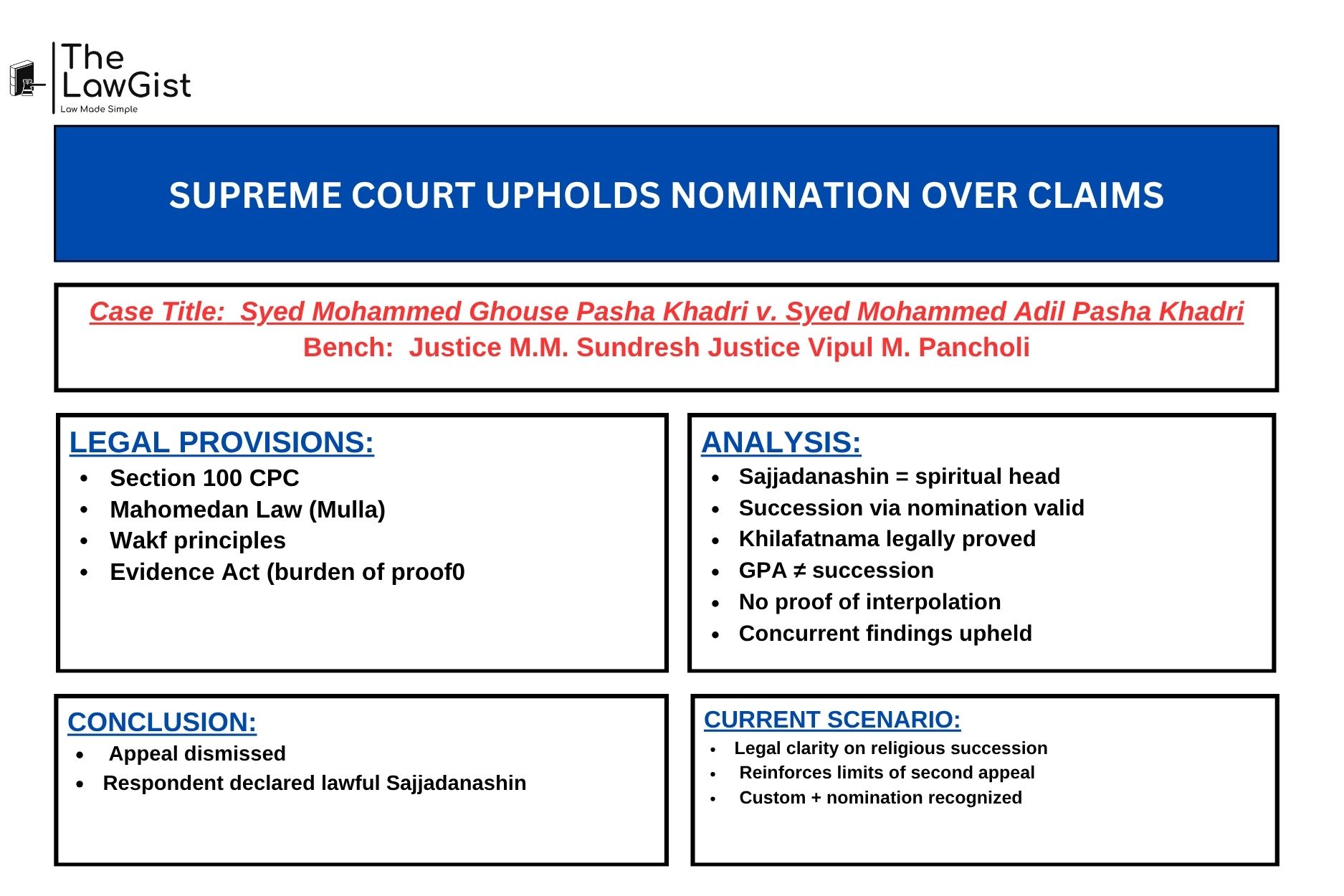
CASE SUMMARY – The Supreme Court in Syed Mohammed Ghouse Pasha Khadri vs. Syed Mohammed Adil Pasha Khadri upheld the validity of succession to the office of Sajjadanashin based on nomination through a Khilafatnama. The Court emphasized that the office is spiritual and governed by custom rather than strict inheritance. It rejected the appellant’s reliance on GPA and affidavit, holding they do not confer succession rights. Allegations of document interpolation were dismissed due to lack of proof. The Court reiterated that concurrent findings of fact cannot be interfered with under Section 100 CPC unless perverse. Accordingly, the appeal was dismissed and the respondent was confirmed as the lawful Sajjadanashin.
| ASPECTS | DETAILS |
| Case Title | Syed Mohammed Ghouse Pasha Khadri vs. Syed Mohammed Adil Pasha Khadri & Ors. |
| Introduction | The case concerns succession to the religious office of Sajjadanashin of a Dargah and the scope of interference under Section 100 CPC in concurrent factual findings. |
| Factual Background | Dispute arose between grandson (Respondent No.1) and son (Appellant) of the original Sajjadanashin over succession. The grandson relied on a Khilafatnama (1981), while the appellant relied on GPA, affidavit, and earlier documents. Trial Court, Appellate Court, and High Court all ruled in favor of Respondent No.1. |
| Legal Issues | 1. Whether succession to Sajjadanashin was valid through nomination.
2. Whether Khilafatnama (1981) was valid. 3. Whether High Court rightly refused interference under Section 100 CPC. |
| Applicable Law | Section 100 CPC, Mahomedan Law principles (Mulla), precedents like Syed Mohd. Salie Labbai, Santosh Hazari, Suraj Lamp. |
| Analysis | Court held that Sajjadanashin is a spiritual office governed by custom and nomination. Khilafatnama was validly proved. Appellant failed to prove interpolation or forgery. GPA/affidavit do not confer succession. Concurrent findings cannot be disturbed without perversity. |
| Conclusion | Supreme Court upheld lower courts and dismissed the appeal, confirming Respondent No.1 as lawful Sajjadanashin. |
| Current Scenario | Respondent No.1 remains the recognized Sajjadanashin. Judgment reinforces limited scope of second appeal and importance of customary succession in religious offices. |
“Succession to a spiritual office is governed by custom and intention, not mere documents.”
SOURCE – SUPREME COURT OF INDIA
Discover insights on Latin Maxims and Legal Glossary and simplify complex legal terms in seconds.The LawGist ensures exam success with quality Blogs and Articles on — Top Legal Picks (TLP), Current Affairs, latest Supreme Court judgments as Courtroom Chronicles. Backed by trusted resources and videos, The LawGist is every Professionals and Aspirant’s first choice. Discover more at thelawgist.org