Supreme Court declares that married daughters cannot be denied compassionate allotment benefits solely because of their marital status in Kulsum Nisha v State of U.P. (2026).
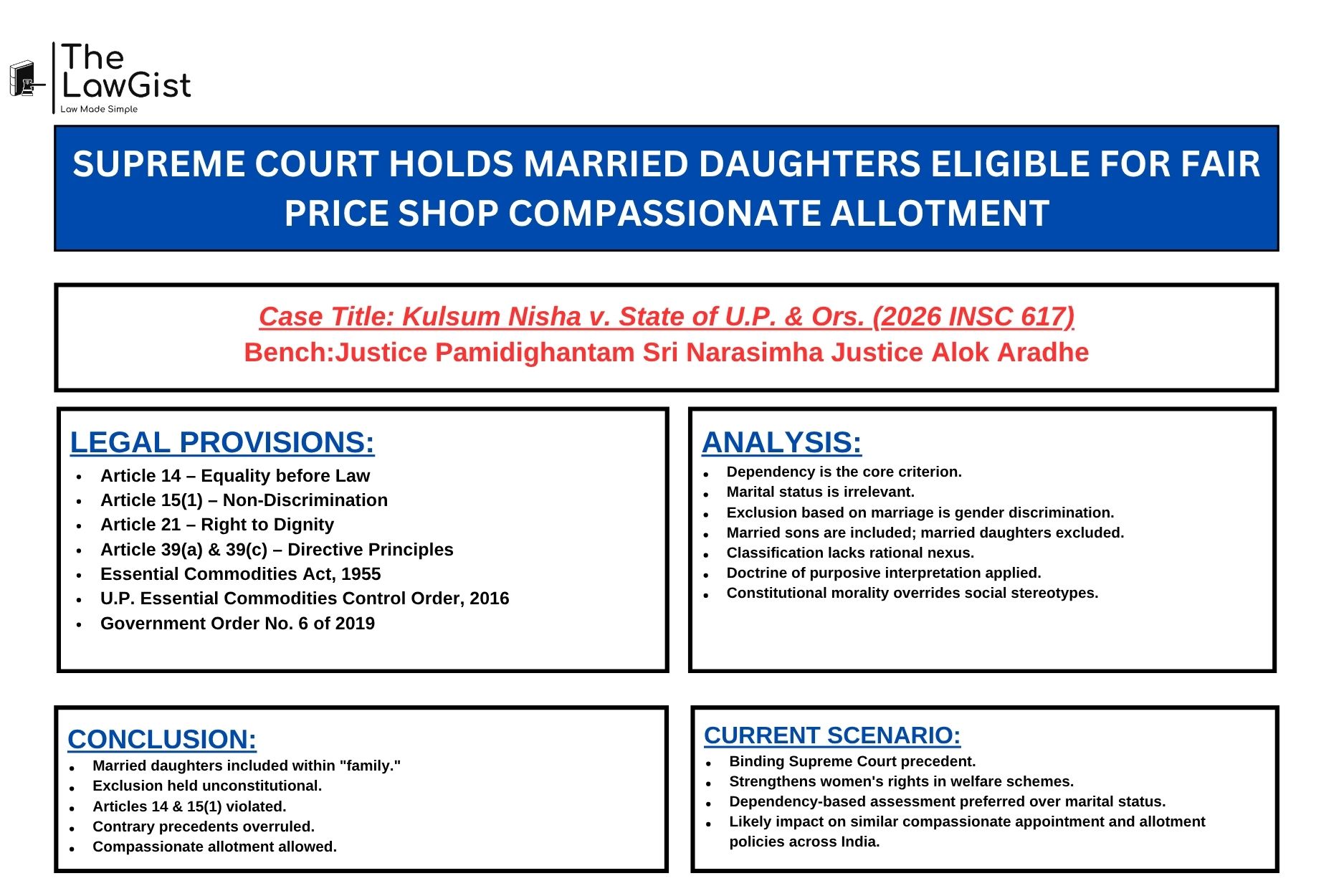
SUPREME COURT HOLDS MARRIED DAUGHTERS ELIGIBLE FOR FAIR PRICE SHOP COMPASSIONATE ALLOTMENT
CASE SUMMARY – Kulsum Nisha vs. State of U.P. & Ors. (2026) is a landmark Supreme Court decision concerning gender equality in compassionate allotment schemes. The appellant’s application for allotment of her deceased mother’s fair price shop was rejected solely because she was a married daughter. The Court held that dependency, not marital status, is the relevant criterion for determining eligibility. Excluding married daughters from the definition of “family” was found to violate Articles 14 and 15(1) of the Constitution and perpetuate gender stereotypes. Applying purposive interpretation, the Court included married daughters within the scheme and directed allotment of the shop.
| ASPECTS | DETAILS |
| Case Title | Kulsum Nisha vs. State of U.P. & Ors. |
| Introduction | The Supreme Court examined whether a married daughter can be excluded from compassionate allotment of a fair price shop merely because of her marital status. The case challenged the constitutional validity of excluding married daughters from the definition of “family” under the Uttar Pradesh fair price shop allotment scheme. |
| Factual Background | The appellant’s mother, a fair price shop dealer, died on 04.03.2024. The appellant, though married, continued residing with her mother and sisters and was the sole earning member. Her application for compassionate allotment was rejected solely because she was a married daughter and was excluded from the definition of “family” under the Government Order. The rejection was upheld by the SDM, Deputy Commissioner, and Allahabad High Court. |
| Legal Issues | 1. Whether exclusion of married daughters from the definition of “family” is constitutionally valid.
2. Whether marital status can be a ground to deny compassionate allotment of a fair price shop. 3. Whether Clause 2(p) of the 2016 Order should be interpreted to include married daughters. |
| Applicable Law | • Article 14 – Equality before law.
• Article 15(1) – Prohibition of discrimination on grounds of sex. • Article 21 – Right to live with dignity. • Article 39(a) & 39(c) – Directive Principles. • Section 3, Essential Commodities Act, 1955. • Uttar Pradesh Essential Commodities (Regulation of Sale and Distribution) Control Order, 2016. • Government Order No. 6 of 2019. |
| Analysis | The Court held that dependency, financial need, residence, and ability to run the shop are relevant factors, whereas marital status has no rational nexus with the scheme’s objective. Excluding married daughters is based on outdated gender stereotypes and violates Articles 14 and 15(1). The Court applied the doctrine of purposive construction and interpreted the term “daughter” to include married daughters who satisfy dependency and other eligibility conditions. |
| Conclusion | The Supreme Court ruled that married daughters cannot be excluded merely due to marital status. The appellant was held entitled to consideration under the dependent quota, and the rejection orders were quashed. The authorities were directed to allot the fair price shop to the appellant within four weeks. |
| Current Scenario | This judgment is now a landmark precedent affirming gender equality in welfare and compassionate allotment schemes. Married daughters who can establish dependency and satisfy eligibility requirements are entitled to equal consideration under similar schemes. It overrules contrary views in Saida Begum and Kusumlata. |
“Dependency cannot be determined by marital status alone; constitutional equality demands that married daughters receive the same consideration as other dependents.”
SOURCE – SUPREME COURT OF INDIA