Indian courts address POCSO conviction relief, election nomination disputes, and limits on automatic Waqf property claims over Dargahs.
DAILY CURRENT AFFAIRS (10th JUNE 2026)
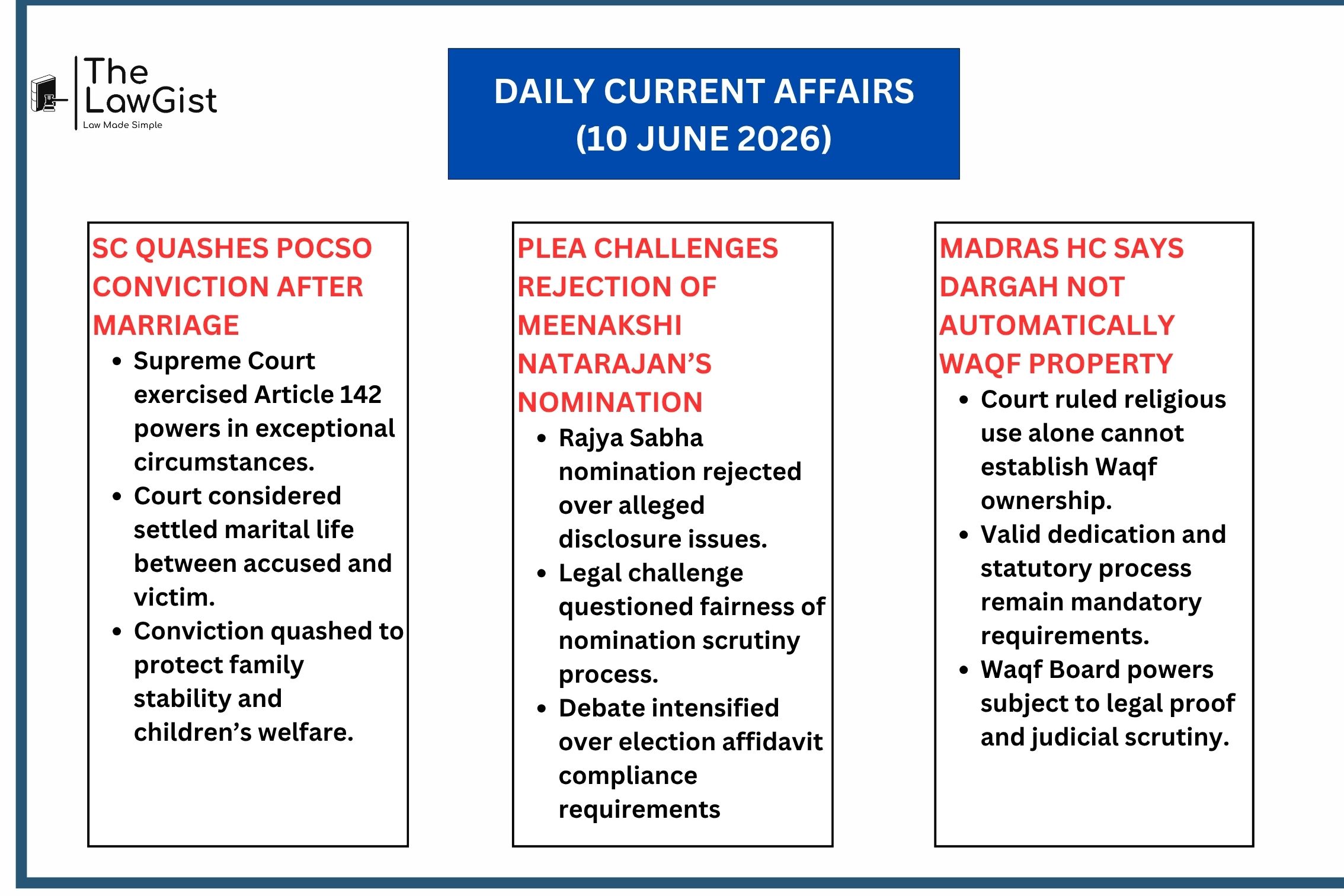
SC QUASHES POCSO CONVICTION AFTER ACCUSED AND VICTIM MARRIED
Overview: Maruthupandi v. State Represented by the Inspector of Police
The Supreme Court quashed a conviction under the POCSO Act after noting that the accused and the victim had subsequently married and were living peacefully with their family. Exercising its extraordinary powers, the Court observed that continuing punishment would disrupt their settled marital life and adversely affect their children. (Live Law)
LEGAL PROVISIONS & FRAMEWORK
- Protection of Children from Sexual Offences Act, 2012
- Article 142 – Complete justice powers
- Criminal jurisprudence on consensual relationships
- Sentencing and rehabilitation principles
- Welfare of children and family stability
- Judicial discretion in exceptional circumstances
Source: Supreme Court of India
PLEA FILED AGAINST REJECTION OF MEENAKSHI NATARAJAN’S RAJYA SABHA NOMINATION
Overview: Meenakshi Natarajan and Election Commission Authorities
A legal challenge was raised after Congress leader Meenakshi Natarajan’s Rajya Sabha nomination was rejected over alleged non-disclosure linked to a Telangana court notice. The matter has triggered debate on election disclosure norms, procedural fairness, and the scope of mandatory declarations required from candidates during the nomination process. (India Today)
LEGAL PROVISIONS & FRAMEWORK
- Representation of the People Act, 1951
- Election affidavit disclosure requirements
- Election Commission procedures
- Principles of free and fair elections
- Constitutional governance and transparency
- Judicial scrutiny of nomination rejection
Source: Election Commission Proceedings / Court Proceedings
MADRAS HC RULES DARGAH DOES NOT AUTOMATICALLY BECOME WAQF PROPERTY
Overview: Tamil Nadu Waqf Board v. Private Landowners
The Madras High Court held that the mere presence of a Dargah or grave structure does not automatically convert land into Waqf property. The Court stated that valid dedication, statutory survey, and legal recognition are necessary before the Waqf Board can exercise control over any religious property. (India Today)
LEGAL PROVISIONS & FRAMEWORK
- Waqf Act, 1995
- Sections 4 and 5 of the Waqf Act
- Religious endowment jurisprudence
- Property ownership and title law
- Principles of natural justice
- Judicial review of Waqf Board powers
Source: Madras High Court
Also Read: DAILY CURRENT AFFAIRS (8th JUNE 2026)