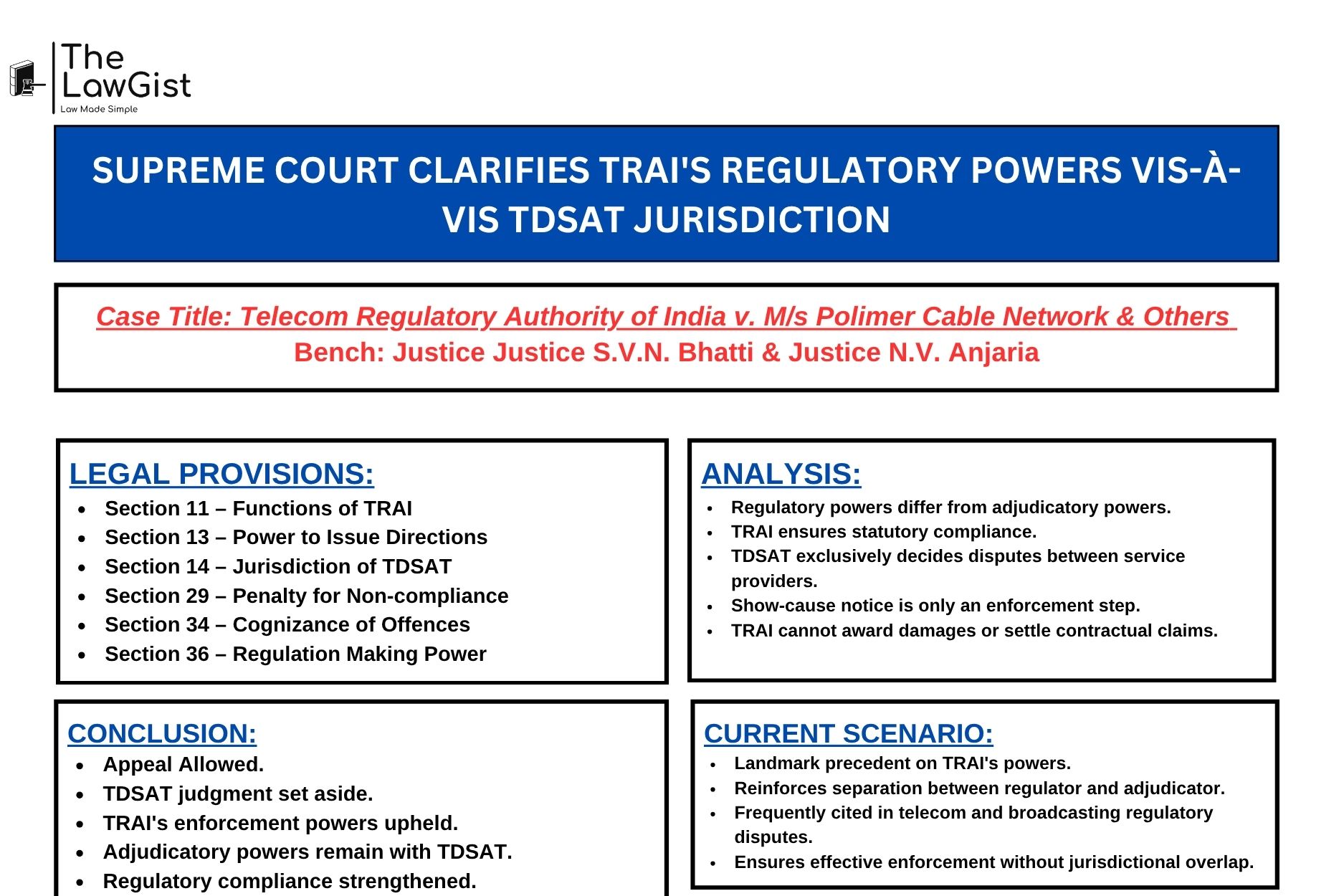
SUPREME COURT CLARIFIES TRAI’S REGULATORY POWERS VIS-À-VIS TDSAT JURISDICTION
CASE SUMMARY – The Supreme Court in Telecom Regulatory Authority of India vs. M/s Polimer Cable Network & Others (2026) clarified the distinction between TRAI’s regulatory functions and TDSAT’s adjudicatory jurisdiction under the TRAI Act. The Court held that TRAI is empowered to issue directions under Sections 11 and 13 to ensure compliance with statutory regulations and may initiate prosecution for violations. However, such regulatory action does not amount to adjudication of disputes between service providers. Only TDSAT can determine contractual disputes, award damages, quantify arrears, or mould relief. Consequently, the Court set aside the TDSAT judgment and restored TRAI’s regulatory enforcement authority.
| Particulars | Details |
| Case Title | Telecom Regulatory Authority of India vs. M/s Polimer Cable Network & Others |
| Introduction | The Supreme Court examined whether TRAI, while issuing directions under Sections 11 and 13 of the TRAI Act and initiating proceedings for non-compliance, was exercising adjudicatory powers reserved exclusively for the Telecom Disputes Settlement and Appellate Tribunal (TDSAT). The Court clarified the distinction between regulatory enforcement and adjudication. |
| Factual Background | Local Cable Operators (LCOs) complained that Polimer Cable Network (MSO) abruptly disconnected cable signals without following the Interconnection Regulations. The Madras High Court directed TRAI to consider the complaints. TRAI found prima facie violations of Regulations 4.1 and 4.3, issued directions for restoration of signals, and later issued a show-cause notice after alleged non-compliance. The MSO challenged the notice before TDSAT, which held that TRAI lacked jurisdiction. TRAI appealed to the Supreme Court. |
| Legal Issues | 1. Whether TRAI can issue binding directions under Sections 11 and 13.
2. Whether issuing such directions amounts to adjudicating disputes between service providers. 3. Whether only TDSAT possesses jurisdiction over disputes between MSOs and LCOs. 4. Whether a show-cause notice under Sections 29 and 34 amounts to adjudication. |
| Applicable Law | Sections 11, 13, 14, 29, 34, 36 and 37 of the TRAI Act, 1997; Telecommunication (Broadcasting & Cable Services) Interconnection Regulations, 2004 (as amended in 2006); BSNL v. TRAI (2014) 3 SCC 222. |
| Analysis | The Supreme Court distinguished regulatory enforcement from adjudication. TRAI’s directions merely ensure compliance with statutory regulations and do not determine contractual rights, award damages, quantify arrears or resolve disputes between service providers. Adjudication requires determination of disputed rights after hearing parties, a function exclusively vested in TDSAT under Section 14. A show-cause notice merely initiates enforcement and does not finally determine rights or liabilities. |
| Conclusion | The Supreme Court allowed TRAI’s appeal, set aside the TDSAT judgment and held that TRAI can enforce compliance with its regulations through directions and prosecution mechanisms but cannot adjudicate contractual disputes between service providers. |
| Current Scenario | The judgment now serves as the leading authority on the distinction between regulatory enforcement and adjudicatory jurisdiction under the TRAI Act. TRAI continues to regulate and enforce compliance, whereas contractual and inter-service-provider disputes remain exclusively within TDSAT’s jurisdiction. |
“A regulator may enforce compliance with statutory regulations, but enforcement cannot be equated with adjudication of disputes between private parties.”
SOURCE – SUPREME COURT OF INDIA