Supreme Court balances the accused’s right to travel abroad with the victim’s right to a speedy trial in Seesa Santosh v. State of Telangana (2026).
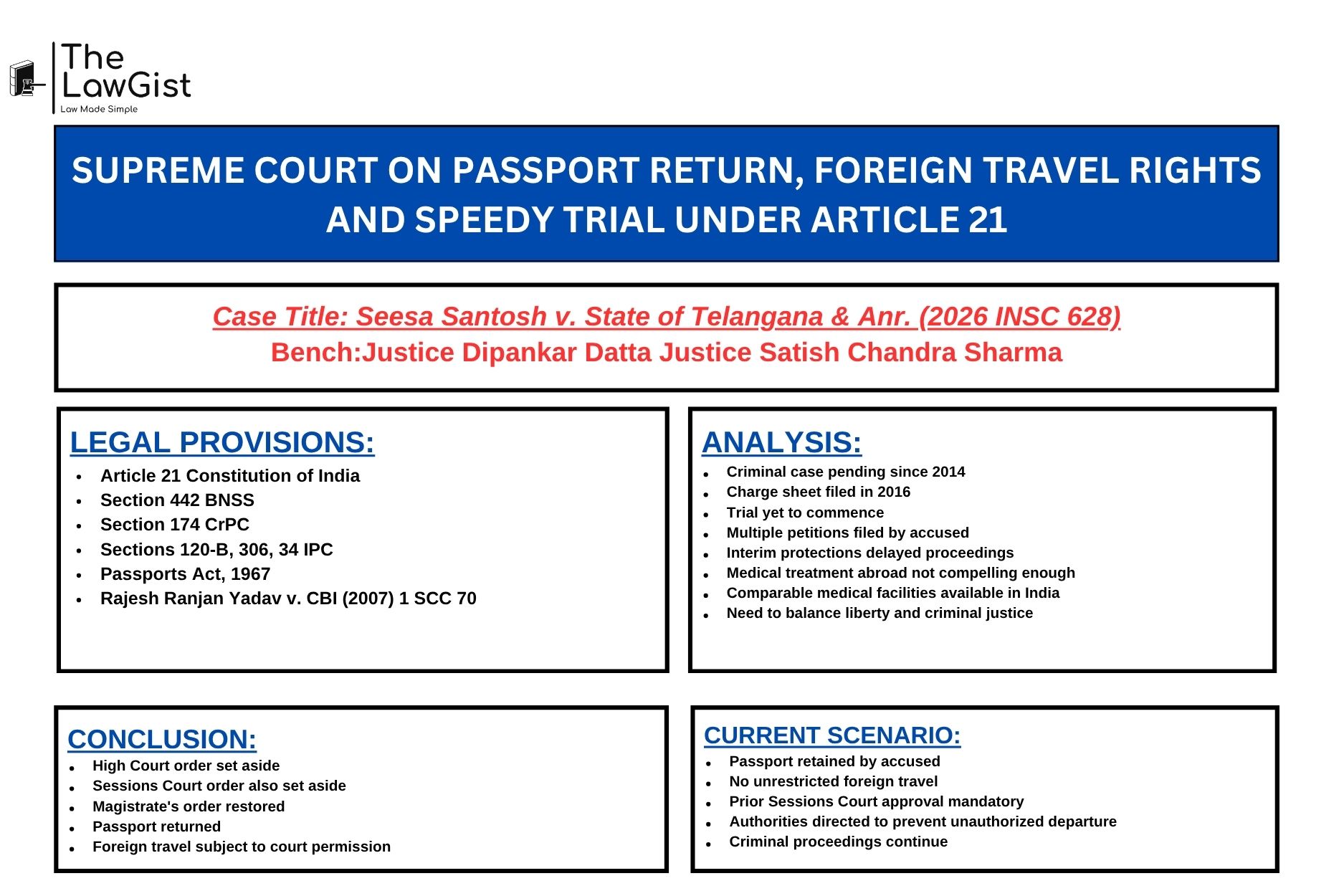
SUPREME COURT ON PASSPORT RETURN, FOREIGN TRAVEL RIGHTS AND SPEEDY TRIAL UNDER ARTICLE 21
CASE SUMMARY – In Seesa Santosh vs. State of Telangana & Anr. (2026), the Supreme Court examined whether an accused facing prosecution for offences under Sections 120-B and 306 IPC could travel abroad during pending criminal proceedings. The Court noted that the accused had repeatedly sought judicial interventions, contributing to delays in the trial. While recognizing that the right to travel abroad forms part of personal liberty under Article 21, the Court emphasized that the victim’s right to a speedy trial and societal interests are equally important. The Court restored the Magistrate’s order, allowed retention of the passport, but required prior court permission for foreign travel.
| ASPECTS | DETAILS |
| Case Title | Seesa Santosh vs. State of Telangana & Anr. (2026 INSC 628) |
| Introduction | The Supreme Court considered whether an accused facing criminal prosecution could retain his passport and travel abroad during the pendency of proceedings. The case required balancing the fundamental right to travel abroad under Article 21 against the victim’s right to a speedy trial and the need for effective criminal justice administration. |
| Factual Background | The appellant’s father died under suspicious circumstances in 2014. FIR No. 173/2014 was registered under Sections 120-B and 306 read with Section 34 IPC. Respondent No. 2 was accused. After filing of the charge sheet in 2016, Respondent No. 2 repeatedly sought judicial remedies, including quashing petitions. A Look Out Circular was suspended by the High Court, enabling him to leave India in 2017. He returned in April 2025 and was arrested at Hyderabad Airport. After release, he sought return of his passport. The Magistrate allowed return of the passport but required separate permission for foreign travel. The Sessions Court reversed this order and directed deposit of the passport. The High Court restored the Magistrate’s order and additionally permitted travel to the USA. The appellant challenged that order before the Supreme Court. |
| Legal Issues | 1. Whether an accused facing criminal trial has an unrestricted right to travel abroad under Article 21.
2. Whether courts can impose restrictions on foreign travel to ensure attendance during criminal proceedings. 3. Whether the High Court properly exercised revisional jurisdiction while permitting travel abroad. |
| Applicable Law | Article 21 of the Constitution of India; Sections 120-B, 306 and 34 IPC; Section 174 CrPC; Section 442 BNSS (earlier Section 401 CrPC); Passports Act, 1967; Rajesh Ranjan Yadav v. CBI (2007) 1 SCC 70. |
| Analysis | The Court examined the prolonged delay in the proceedings and noted that despite filing of the charge sheet in 2016, the trial had not commenced. The Court found that Respondent No. 2 had actively pursued multiple proceedings and obtained interim protections that delayed the criminal process. The Court observed that medical treatment in the USA was not sufficient justification because comparable medical facilities were available in India. It emphasized that Article 21 protects both personal liberty and the right to a speedy trial. The Court held that neither right is absolute and a balance must be maintained between individual liberty and societal interests. |
| Conclusion | The Supreme Court held that the High Court was overly indulgent in permitting travel abroad. It set aside the High Court’s order and the Sessions Court’s order. The Magistrate’s order releasing the passport was restored, but the respondent was prohibited from leaving India without prior permission from the Sessions Court after committal of the case. |
| Current Scenario | Respondent No. 2 may retain his passport but cannot travel abroad without obtaining permission from the Sessions Court. Authorities were directed to coordinate and ensure compliance. The criminal case remains pending and observations made by the Supreme Court shall not affect the merits of the trial. |
“A balance must be struck between the right to travel abroad and the right to a speedy trial, together with the larger societal interest in the effective administration of criminal justice.”
SOURCE – SUPREME COURT OF INDIA