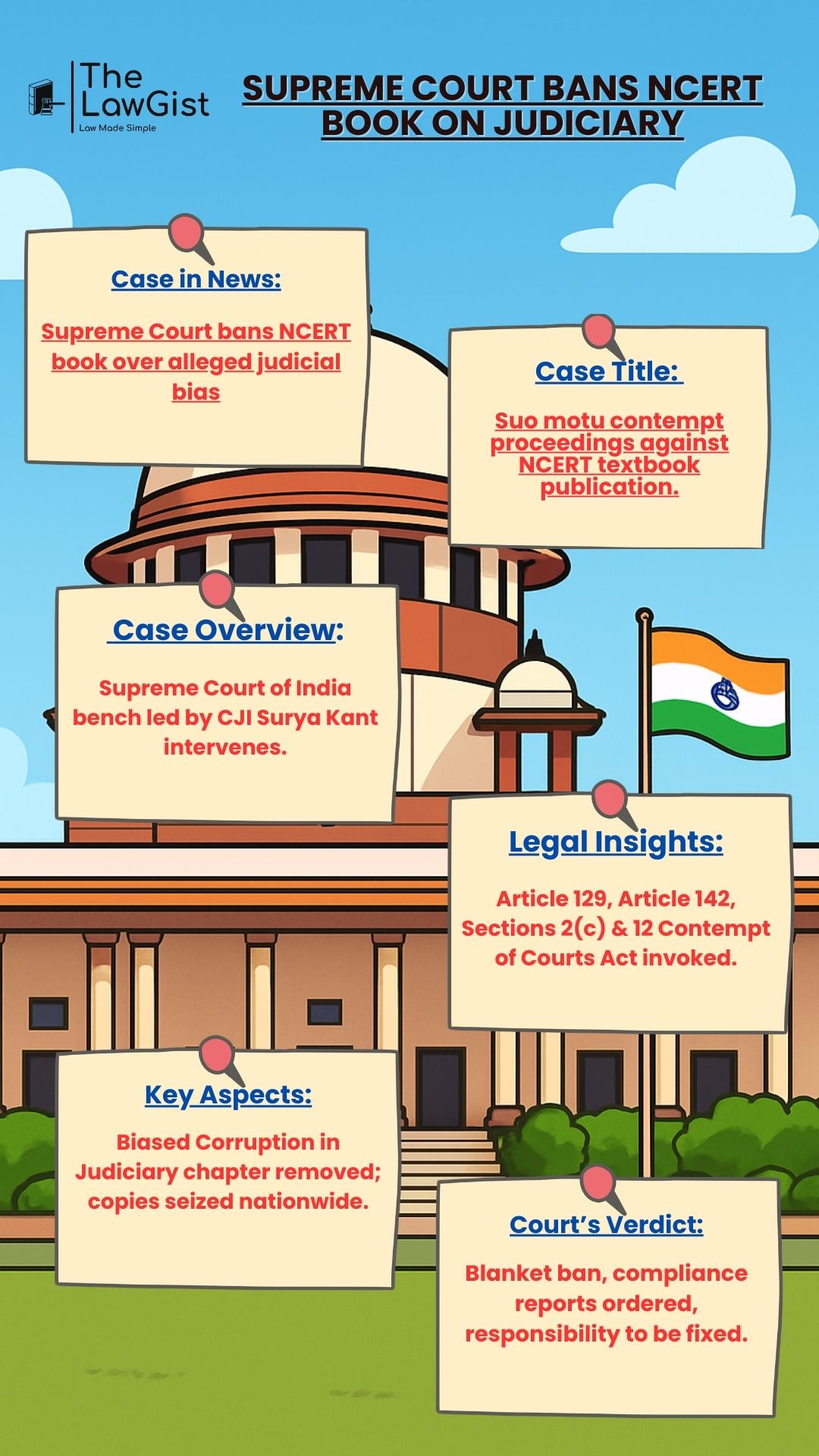
Supreme Court of India invokes Contempt of Court powers, bans NCERT textbook over controversial Corruption in Judiciary chapter and orders immediate nationwide withdrawal.
Case in NewsSupreme Court Bans NCERT Book On Judiciary over controversial chapter alleging corruption narrative . |
Discover powerful Latin Maxims and simplify complex legal terms in seconds.
Case Overview
Case Name: In Re: Controversial Chapter in NCERT Class 8 Textbook (Suo Motu Contempt Proceedings)
The Supreme Court of India headed by CJI Surya Kant & comprising Justice Joymalya Bagchi & Justice Vipul Pancholi took suo motu cognisance of a Class 8 Social Science textbook published by NCERT. The book allegedly contained a chapter of Corruption in Judiciary in a manner the Court found biased & institutionally damaging. Viewing the issue as serious, the Bench initiated proceedings under its Contempt of Court jurisdiction & sought explanations from the NCERT Director & the Department of School Education .
Key Aspects
The Supreme Court examined whether the textbook content crossed the line between academic critique & institutional denigration. It expressed concern that impressionable students were being exposed to a one-sided narrative. The Bench stressed that educational material must reflect constitutional values & institutional balance. The matter was treated as having far-reaching consequences for judicial independence .
- Chapter allegedly portrayed judiciary in a prejudiced & selective manner.
- Court described the publication as a “deep-rooted conspiracy .”
- Notice issued to NCERT Director for explanation.
- Immediate removal of all physical & digital copies ordered.
- Details of National Syllabi Board members & meeting records sought.
Legal Insights
The proceedings revolve around constitutional powers & statutory contempt jurisdiction. The Court clarified that fair criticism is allowed but scandalising the judiciary is not. The following legal provisions are central to the case :
- Article 129 of Constitution of India– Declares the Supreme Court of India as a Court of Record with power to punish for contempt.
- Article 142 of Constitution of India – Enables the Court to pass necessary orders for justice.
- Sections 2(c) & 12, Contempt of Courts Act, 1971 – Define & prescribe punishment for criminal contempt including acts that scandalise or lower judicial authority.
- The Court emphasised that deliberate institutional attack may amount to criminal contempt if it interferes with administration of justice .
Court’s Verdict
The Bench imposed a blanket ban on production & distribution of the textbook. It directed seizure of all copies & prohibited any instructional use. Compliance reports must be filed within 2 weeks. The Court indicated that responsibility will be fixed after examining records & submissions.
Source – Supreme Court of India
Read also – Constitution of India
The LawGist ensures exam success with quality notes—TPL, Current Affairs, Recent Judgments, and more. Backed by trusted resources and videos, The LawGist is every aspirant’s first choice.