MADRAS HC SAYS DECEPTION NEGATES CONSENT IN RELATIONSHIPS
Case in News
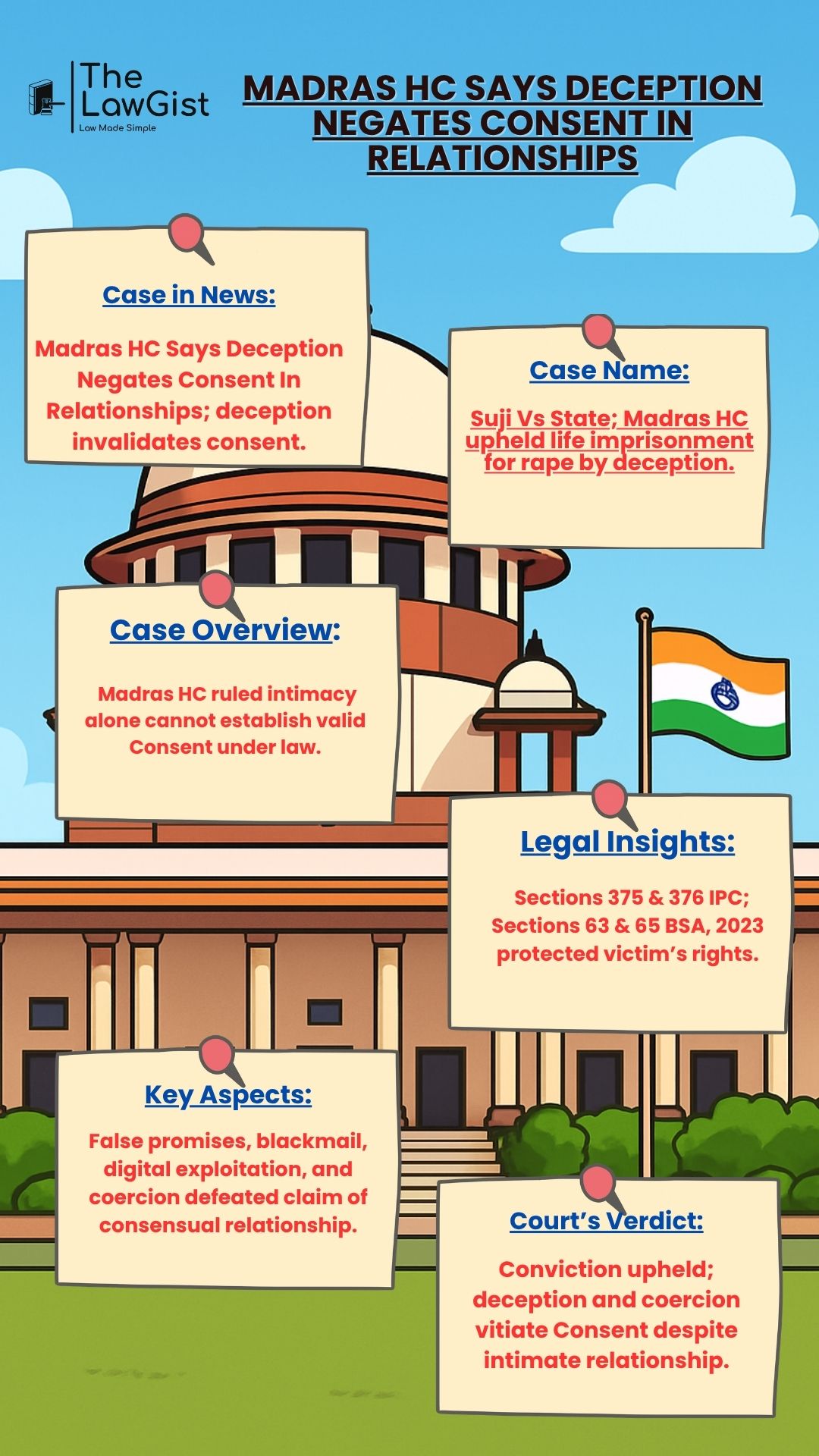
Madras HC Says Deception Negates Consent In Relationships reiterates that consent obtained through deception or blackmail has no legal validity.
Discover powerful Latin Maxims and simplify complex legal terms in seconds
Case Name
Suji Vs State
Case Overview
In Suji Vs State, the Madurai Bench of the Madras High Court comprising Justices N. Anand Venkatesh & K. Ramakrishnan upheld the conviction of a man for repeatedly raping & blackmailing a woman by making false promises of employment and marriage. The Court affirmed the sentence of imprisonment for the remainder of his natural life and held that an intimate relationship does not automatically establish Consent where the participation of the victim was secured through deception, coercion, intimidation or blackmail. The Court also issued an advisory cautioning young people against sharing intimate photographs or videos in the Digital age.
Key Aspects
The Court examined whether repeated physical intimacy during an intimate relationship could amount to valid consent when the relationship itself was built on deception & threats. It stressed that courts must evaluate the factual background instead of making assumptions based on the existence of a relationship.
- The accused befriended the victim on Facebook by promising employment & marriage.
- He allegedly sexually assaulted her, secretly recorded intimate images & later used them for blackmail.
- The victim continued meeting him due to threats of circulating the photographs & videos.
- The Court held that a consensual relationship cannot be presumed merely because there were repeated intimate encounters.
- The case was described as a classic example of romance fraud, rape by deception & sexual extortion.
- The Court advised young girls & women to avoid sharing intimate content electronically in the Digital age.
Legal Insights
The Madras High Court clarified that Consent must be voluntary, informed & free from fear, deception or coercion. Courts must assess the entire course of conduct, including the accused’s intention, surrounding circumstances & whether the victim exercised genuine free will.
- Section 375 of the Indian Penal Code, 1860 (IPC): Defines rape & recognises that consent obtained through fear, coercion or misconception of fact is not valid Consent.
- Section 376 IPC: Prescribes punishment for rape; the Court upheld the conviction & life imprisonment considering the gravity of the offence.
- Section 65B of the Indian Evidence Act, 1872 (now Sections 63 & 65 of the Bharatiya Sakshya Adhiniyam, 2023): The Court recognised the importance of electronic evidence including photographs, videos & digital records.
- The judgment emphasised that consensual sexual intercourse cannot be inferred merely because the parties were in a consensual relationship if the relationship was founded on deception or blackmail.
Court’s Verdict
The Madras High Court dismissed the appeal & upheld the conviction and sentence of imprisonment for the remainder of the natural life of tje convict. It ruled that deception, coercion, intimidation or blackmail vitiates Consent, even within an intimate or consensual relationship & called for greater awareness to prevent technology-enabled sexual exploitation in the Digital age.
The LawGist ensures exam success with quality notes—TPL, Current Affairs, Recent Judgments, and more. Backed by trusted resources and videos, The LawGist is every aspirant’s first choice
Read also-Bharatiya Sakshya Adhiniyam, 2023
Source-Madras High Court