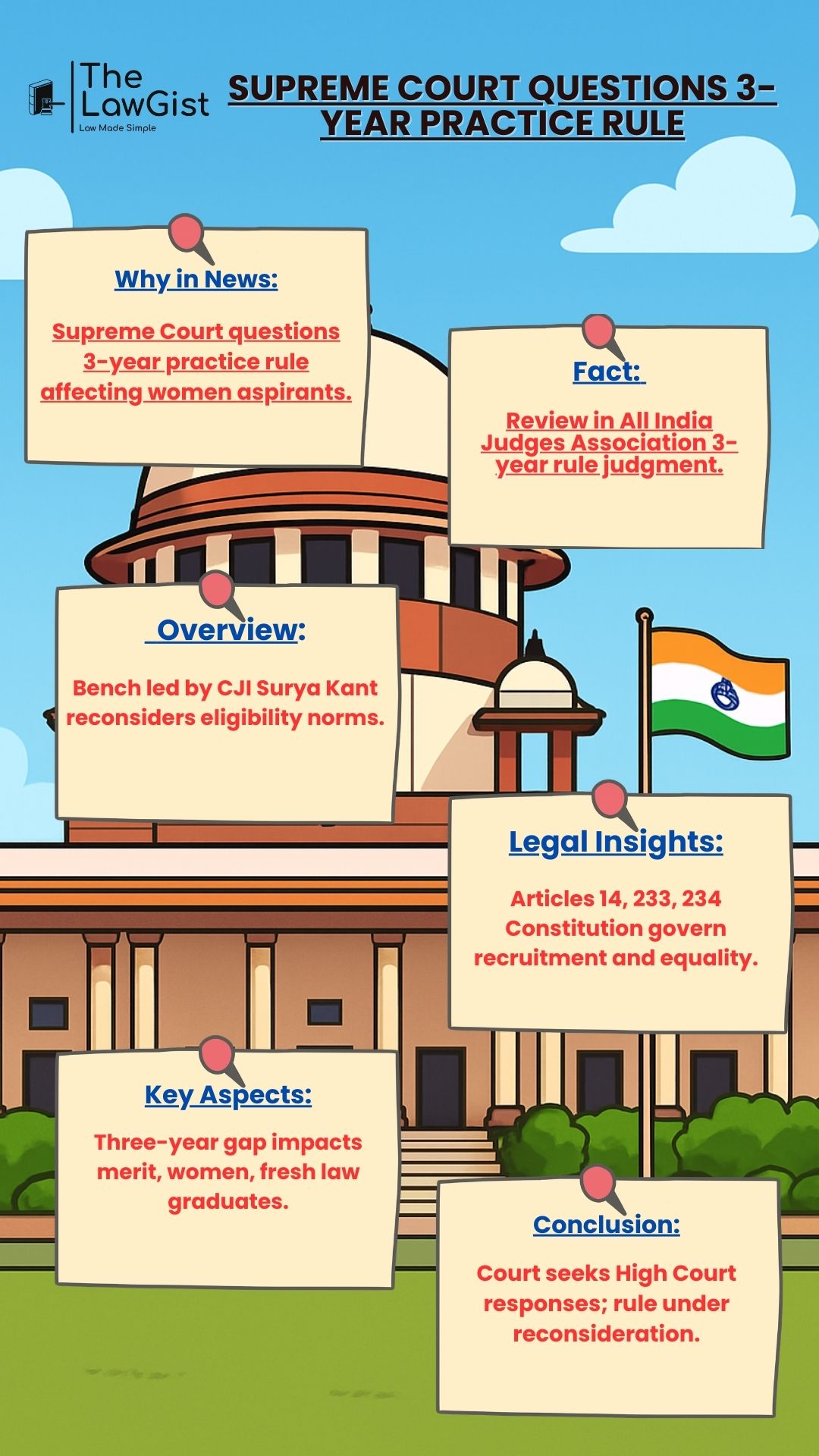
Why in NewsSupreme Court Questions 3-Year Practice Rule stating concerns over women aspirants’ impact. |
Discover powerful Latin Maxims and simplify complex legal terms in seconds.
Overview
The Supreme Court of India led by CJI Surya Kant along with Justices K. Vinod Chandran & A.G. Masih heard review petitions challenging its earlier judgment restoring the mandatory 3 year practice rule for entry-level judicial service posts. The previous ruling had reinstated the need of minimum courtroom experience as an advocate before joining the judiciary. During the present hearing the Bench orally expressed reservations about the rule’s practical consequences particularly its impact on women aspirants & fresh law graduates.
Key Aspects
The Court examined whether the 3-year practice mandate strikes the right balance between for judicial competence & maintaining equal opportunity. It highlighted concerns about merit, gender impact & recruitment gaps. The Bench stressed the need to improve the system without discouraging young talent.
- Rule allegedly creates a 3-year vacuum for fresh graduates.
- Concerns raised about societal pressures affecting women candidates.
- Nearly 60% of current judicial officers are reportedly women .
- Fear of losing meritorious young talent due to delay.
- Responses sought from High Court Registrar Generals .
Legal Insights
The issue revolves around eligibility conditions for judicial appointments & constitutional principles of equality & judicial standards:
- Article 233 of Constitution of India – Governs appointment of District Judges in consultation with High Courts.
- Article 234 of Constitution of India – Regulates recruitment of persons other than District Judges to judicial service.
- Article 14 of Constitution of India – Ensures equality before law relevant in examining disproportionate gender impact .
- Earlier judgment restored pre-2002 requirement of minimum 3 years’ advocacy practice.
Conclusion
The Supreme Court has not delivered a final ruling but expressed serious reservations about the rigid implementation of the rule . It sought responses from High Courts & indicated that reforms must ensure competence without depriving deserving candidates especially women of fair opportunity.
Source – Supreme Court of India
Read also – Constitution of India
The LawGist ensures exam success with quality notes—TPL, Current Affairs, Recent Judgments, and more. Backed by trusted resources and videos, The LawGist is every aspirant’s first choice.