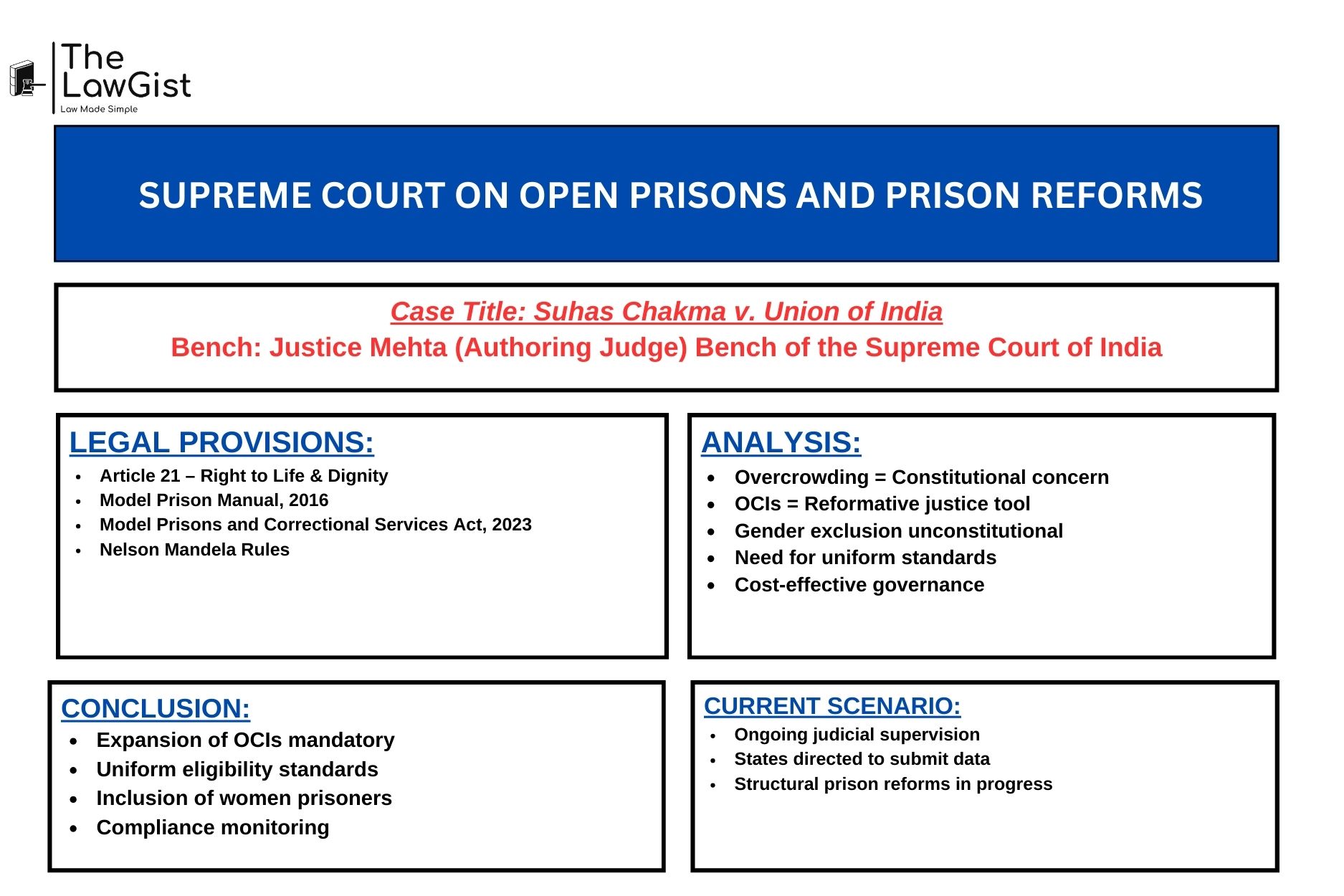
Supreme Court strengthens prison reform framework through expansion of Open Correctional Institutions in Suhas Chakma v Union of India (2026).
SUPREME COURT ON OPEN PRISONS AND PRISON REFORMS
CASE SUMMARY – In Suhas Chakma vs. Union of India (2026 INSC 198), the Supreme Court addressed chronic overcrowding in Indian prisons and examined the underutilisation of Open Correctional Institutions (OCIs). The Court held that overcrowding violates Article 21 by undermining prisoners’ dignity and humane treatment. Relying on constitutional principles, the Model Prison Manual 2016, and international standards like the Nelson Mandela Rules, the Court emphasized reformative justice over retributive incarceration. It found significant gender exclusion and lack of uniformity in OCI governance across States. The Court directed expansion of OCIs, inclusion of women prisoners, rationalised eligibility norms, and structured compliance monitoring to ensure nationwide prison reform.
| ASPECTS | DETAILS |
| Case Title | Suhas Chakma vs. Union of India & Ors. |
| Introduction | A Public Interest Litigation under Article 32 addressing prison overcrowding and advocating expansion and effective utilisation of Open Correctional Institutions (OCIs) as a reformative and cost-effective solution. |
| Factual Background | Persistent overcrowding (120%+ occupancy nationally) highlighted through NCRB data. Despite Model Prison Manual 2016 and Model Prisons Act 2023, many States underutilised or failed to establish OCIs. Gender exclusion and strict eligibility norms were also identified. |
| Legal Issues | 1. Whether overcrowded prisons violate Article 21.
2. Whether States failed to implement OCIs effectively. 3. Whether exclusion of women from OCIs is unconstitutional. 4. Need for uniform standards in OCI governance. |
| Applicable Law | Article 21 (Right to Life & Dignity); Model Prison Manual, 2016 (Ch. XXIII); Model Prisons and Correctional Services Act, 2023 (Sec. 50); Nelson Mandela Rules; Judicial precedents on prisoners’ rights. |
| Analysis | Court emphasized reformative justice. Found severe underutilisation of OCIs, gender imbalance, lack of uniform standards, restrictive eligibility norms, and cost-effectiveness of open prisons over closed prisons. Reinforced constitutional mandate for humane incarceration. |
| Conclusion | Directed States/UTs to expand OCIs, frame uniform minimum standards, ensure women’s access, rationalise eligibility, and submit compliance reports. Recognised OCIs as integral to constitutional prison reform. |
| Current Scenario | Monitoring continues. Some States non-compliant. Court mandated structured implementation and compliance mechanisms to ensure expansion and effective governance of OCIs nationwide. |
“No one truly knows a nation until one has been inside its jails.”
SOURCE – SUPREME COURT OF INDIA
Discover insighs on Latin Maxims and Legal Glossary and simplify complex legal terms in seconds.The LawGist ensures exam success with quality Blogs and Articles on — Top Legal Picks (TLP), Current Affairs, latest Supreme Court judgments as Courtroom Chronicles. Backed by trusted resources and videos, The LawGist is every Professionals and Aspirant’s first choice. Discover more at thelawgist.org