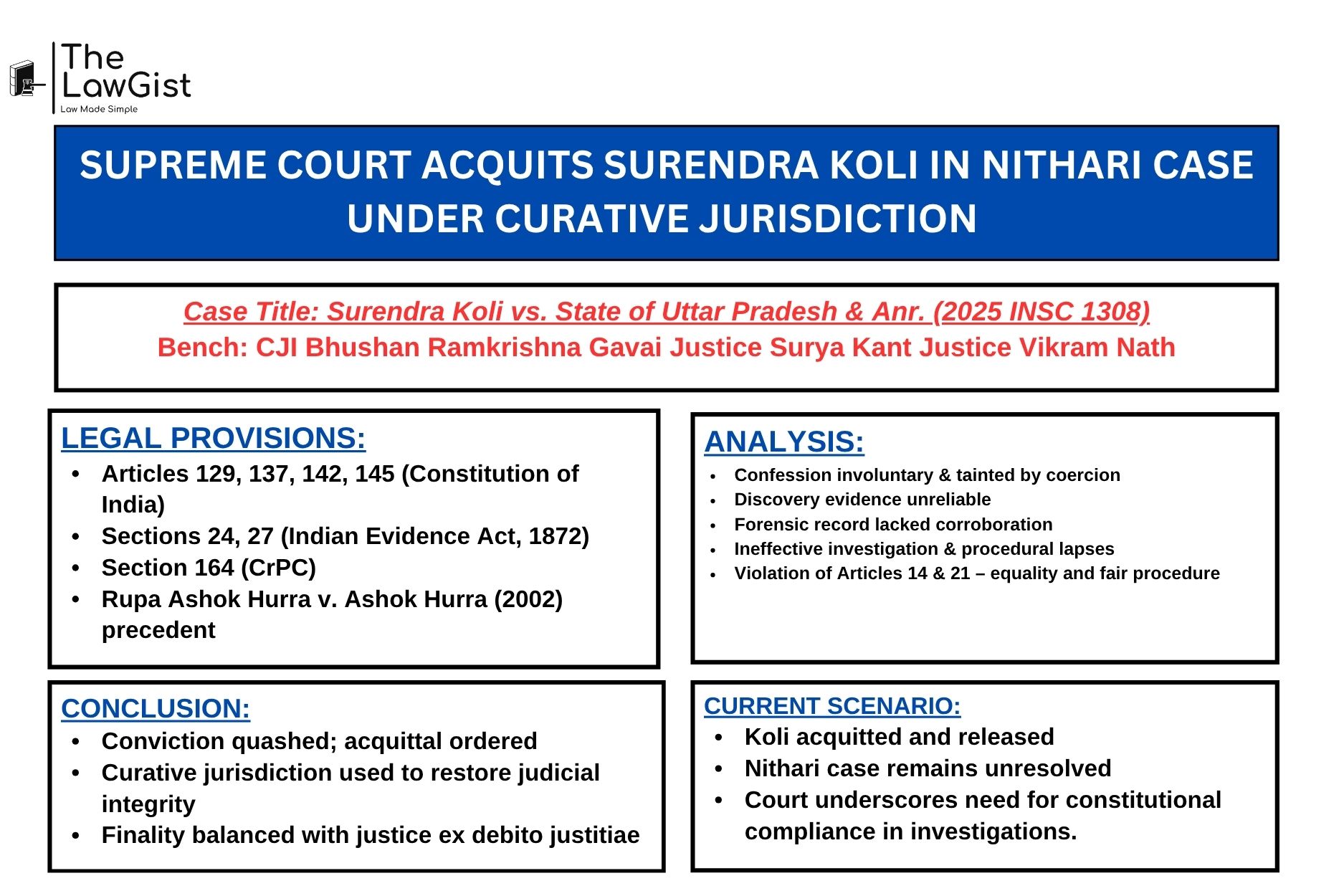
Supreme Court delivers landmark curative judgment acquitting Surendra Koli in the Nithari case (2025).
SUPREME COURT ACQUITS SURENDRA KOLI IN NITHARI CASE UNDER CURATIVE JURISDICTION
CASE SUMMARY – In Surendra Koli vs. State of Uttar Pradesh (2025 INSC 1308), the Supreme Court invoked its curative jurisdiction to correct a grave miscarriage of justice in the Nithari case. Koli’s conviction for the murder of Rimpa Haldar was overturned as the same evidence had been deemed unreliable in twelve identical cases. The Court held that coerced confessions and flawed recoveries violated Articles 14 and 21, stressing that equality and due process must prevail. Finding the investigation tainted and evidence inadmissible, the Court set aside all convictions, acquitted Koli, and ordered his release, reaffirming that suspicion cannot replace proof.
| ASPECTS | DETAILS |
| Case Title | Surendra Koli vs. State of Uttar Pradesh (2025 INSC 1308) |
| Introduction | The Supreme Court of India exercised its curative jurisdiction to correct a manifest miscarriage of justice arising from inconsistent outcomes on identical evidence in the Nithari killings cases. |
| Factual Background | Surendra Koli, domestic help of Moninder Singh Pandher, was convicted for the murder of Rimpa Haldar in the Nithari case (Ghaziabad). While Koli’s conviction was upheld in 2011, later trials based on the same evidence led to acquittals affirmed by the Supreme Court in 2025. |
| Legal Issues | Whether a conviction can stand when other identical cases based on the same evidence were reversed as unreliable and whether curative jurisdiction can remedy such inconsistency. |
| Applicable Law |
|
| Analysis | The Court found that Koli’s confession was involuntary due to prolonged custody, lack of legal aid, and improper recording. The alleged discoveries were inadmissible as they were made from publicly known sites. Forensic inconsistencies further weakened the prosecution case. |
| Conclusion | The Supreme Court set aside Koli’s conviction and sentence, declaring that maintaining different outcomes on identical evidence violates Articles 14 & 21. Koli was acquitted and ordered to be released immediately. |
| Current Scenario | As of November 2025, Surendra Koli stands acquitted of all charges. The Court emphasized investigative accountability and reaffirmed that suspicion cannot replace proof beyond reasonable doubt. |
“Suspicion, however grave, cannot replace proof beyond reasonable doubt.”
SOURCE – SUPREME COURT OF INDIA
READ ALSO –
- Articles 129, 137, 142, 145 of the Constitution of India;
- Sections 24 & 27 of the Indian Evidence Act, 1872;
- Section 164 of the Code of Criminal Procedure, 1973
Discover insighs on Latin Maxims and Legal Glossary and simplify complex legal terms in seconds.The LawGist ensures exam success with quality Blogs and Articles on — Top Legal Picks (TLP), Current Affairs, latest Supreme Court judgments as Courtroom Chronicles. Backed by trusted resources and videos, The LawGist is every Professionals and Aspirant’s first choice. Discover more at thelawgist.org