SUPREME COURT ON MEDICAL COLLEGE FEE LIABILITY & STUDENT RELOCATION
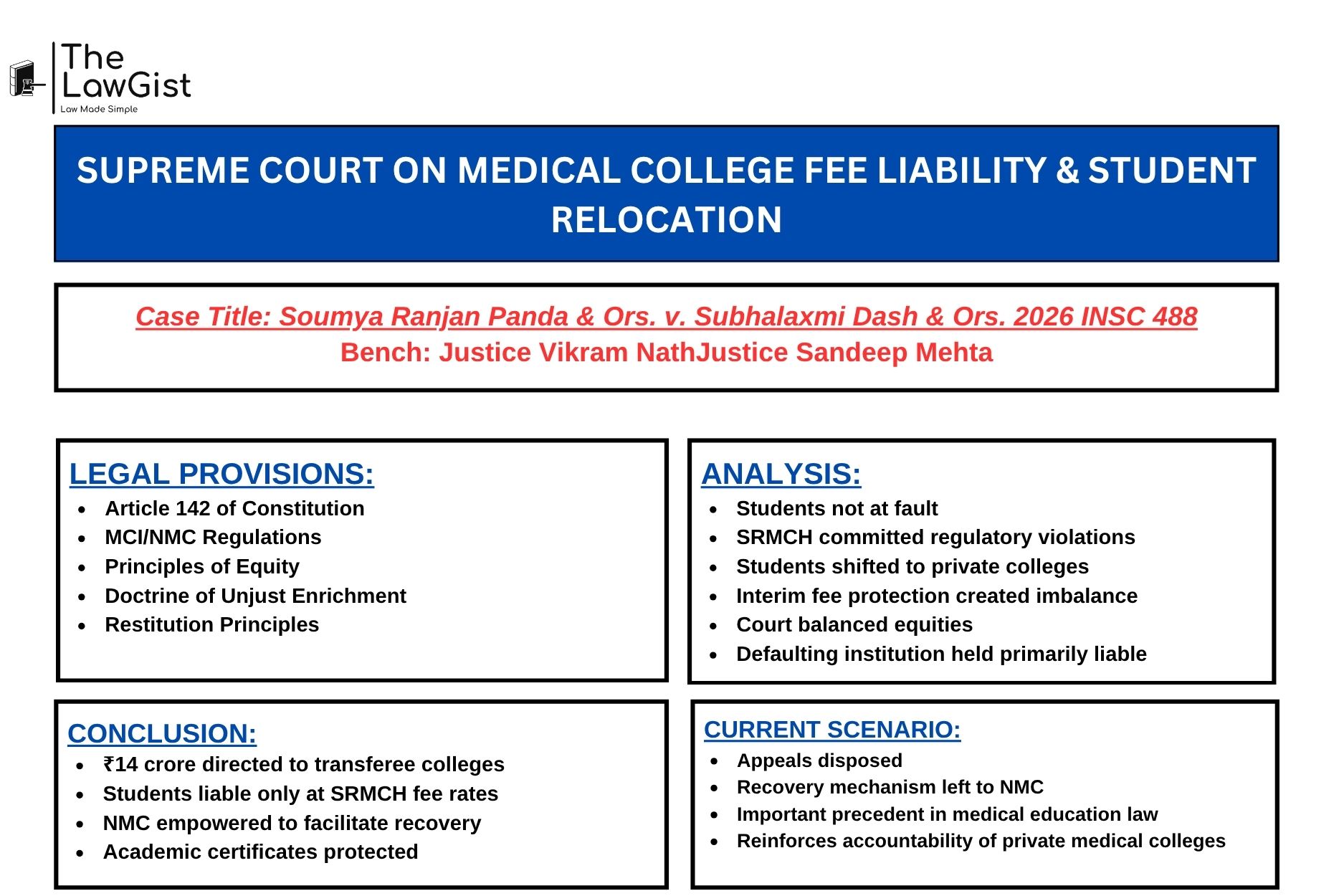
CASE SUMMARY – The Supreme Court in Soumya Ranjan Panda vs. Subhalaxmi Dash (2026 INSC 488) addressed the issue of fee liability after MBBS students were relocated from Sardar Rajas Medical College due to regulatory deficiencies. The Court protected students from losing academic years by facilitating transfer to recognized private medical colleges. However, it held that students could not permanently benefit from subsidized government-rate fees because they originally joined a private institution. The Court ruled that SRMCH/Selvam Trust must primarily bear the financial burden and directed distribution of approximately ₹14 crores to transferee colleges while permitting recovery of remaining dues from students at SRMCH fee rates only.
| ASPECTS | DETAILS |
| Case Title | Soumya Ranjan Panda & Ors. vs. Subhalaxmi Dash & Ors. |
| Introduction | The Supreme Court examined the financial and legal consequences arising after students of Sardar Rajas Medical College (SRMCH) were relocated to other private medical colleges due to serious infrastructural and regulatory deficiencies in SRMCH. |
| Factual Background | SRMCH admitted MBBS students during 2013-14 and 2014-15 sessions. Inspections by MCI/NMC revealed severe deficiencies, resulting in denial of recognition renewal. To protect students from losing academic years, the High Court and later the Supreme Court ordered relocation of students to recognized private colleges. The relocated students continued studies by paying only government-rate fees under interim court directions. Later, transferee colleges sought reimbursement of unpaid fees. |
| Legal Issues | 1. Whether transferred students should pay government-rate fees or private college fees.
2. Whether liability should fall upon students, SRMCH/Selvam Trust, State Government, or MCI/NMC. 3. Whether transferee colleges were entitled to reimbursement. 4. Whether students obtained unjust enrichment through interim protection orders. |
| Applicable Law | Article 142 of the Constitution of India; Medical Council of India/National Medical Commission Regulations; Principles of Equity and Restitution; Doctrine against unjust enrichment; Latin maxim Commodum ex injuria sua nemo habere debet. |
| Analysis | The Court held that students were originally admitted to a private institution with higher fee obligations and therefore could not indefinitely claim subsidized government-rate fees. However, students were not at fault and their academic interests deserved protection. The Court emphasized that SRMCH/Selvam Trust was primarily responsible because regulatory deficiencies led to the crisis. The Court balanced equities by directing release of bank guarantees and deposits furnished by Selvam Trust to transferee colleges while permitting recovery of remaining dues from students at SRMCH fee rates only. |
| Conclusion | The Supreme Court directed that approximately ₹14 crores secured through bank guarantees and court deposits be distributed equally among the transferee colleges. Students were directed to clear remaining dues at SRMCH rates, not higher transferee college rates. The Court ensured students receive academic certificates upon compliance with fee obligations. |
| Current Scenario | The appeals and interlocutory applications were disposed of on 14 May 2026. Transferee colleges may approach NMC for recovery of remaining fee deficits from students. The judgment now serves as an important precedent regarding equitable allocation of liabilities in medical education disputes involving relocation of students due to institutional failures. |
“No one should derive benefit from their own wrong — the defaulting medical institution must bear the primary financial burden caused by its regulatory failures.”
SOURCE – SUPREME COURT OF INDIA