SC ON NATURAL JUSTICE, REMOVAL OF MATHADHIPATI AND ARTICLE 142 POWERS
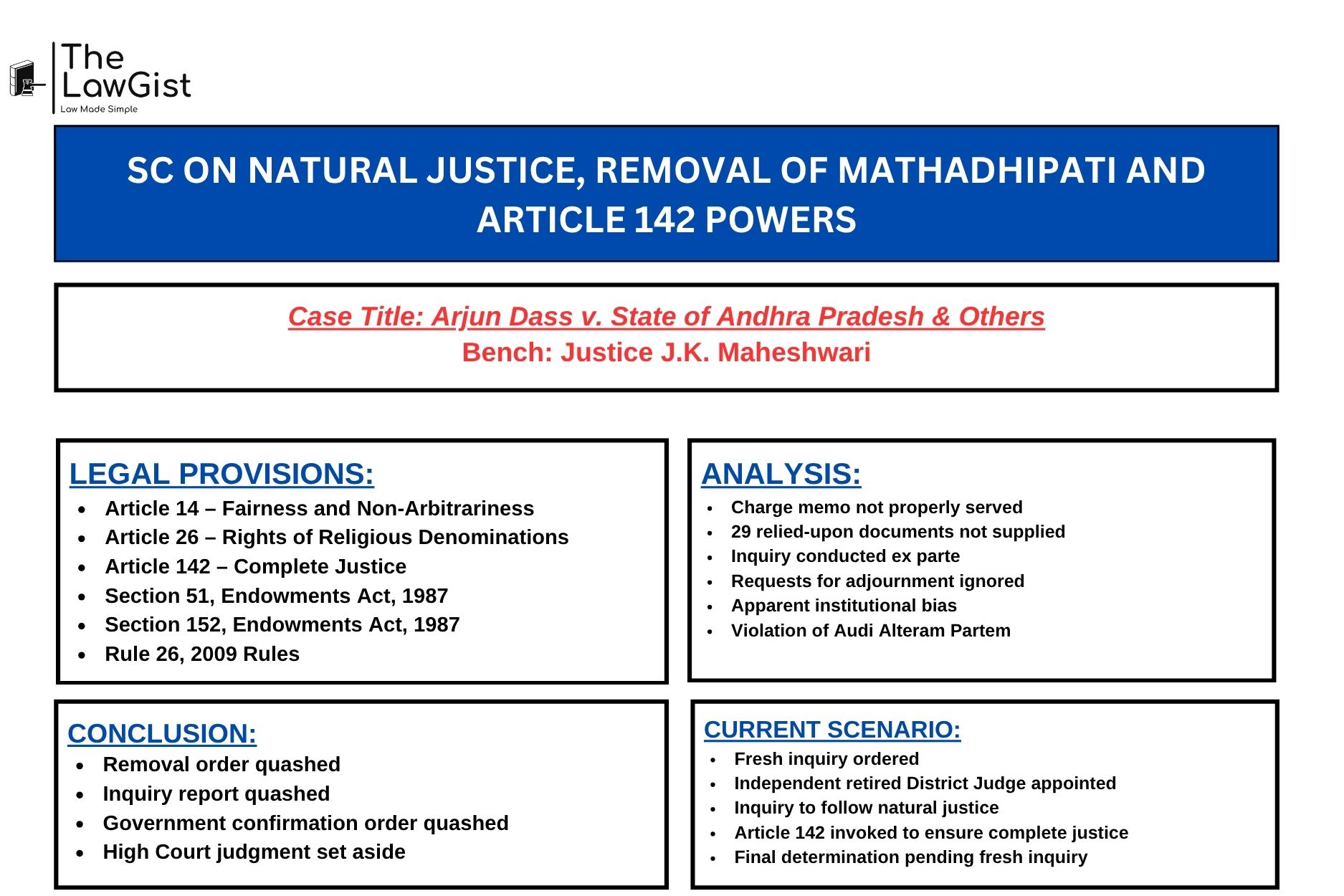
CASE SUMMARY – In Arjun Dass vs. State of Andhra Pradesh (2026 INSC 592) involved the removal of the Mathadhipati of Sri Swamy Hathiramji Mutt by the Dharmika Parishad under Section 51 of the Andhra Pradesh Endowments Act, 1987. The Supreme Court held that the proceedings were vitiated by serious violations of natural justice, including failure to supply relied-upon documents, denial of adequate opportunity to defend, and apparent institutional bias in the inquiry process. The Court found that the High Court failed to properly address these defects. Exercising powers under Article 142 of the Constitution, the Court set aside the removal and ordered a fresh independent inquiry.
| ASPECTS | DETAILS |
| Case Title | Arjun Dass vs. State of Andhra Pradesh & Others |
| Introduction | The case concerned the removal of Arjun Dass, Mathadhipati (Mahant) of Sri Swamy Hathiramji Mutt, Tirupati, by the Dharmika Parishad under Section 51 of the Andhra Pradesh Charitable and Hindu Religious Institutions and Endowments Act, 1987. The Supreme Court examined whether the removal proceedings complied with principles of natural justice. |
| Factual Background | Arjun Dass had been associated with the Mutt since 1970 and became the 21st Mahant in 2000. Multiple disputes arose regarding management of Mutt properties. In 2023, the Dharmika Parishad framed 16 charges, suspended him, appointed a Fit Person, conducted an inquiry, and ultimately removed him. The High Court upheld the removal, leading to the present appeal. |
| Legal Issues | 1. Whether the removal proceedings violated principles of natural justice. 2. Whether non-supply of relied-upon documents vitiated the inquiry. 3. Whether the inquiry committee suffered from apparent bias. 4. Whether the High Court properly exercised appellate jurisdiction under Section 51(4). 5. What relief should be granted. |
| Applicable Law | Article 14, Article 26, Article 142 of the Constitution of India; Section 51 and Section 152 of the Andhra Pradesh Charitable and Hindu Religious Institutions and Endowments Act, 1987; Rule 26 of the 2009 Rules. |
| Analysis | The Court found that the 27-page charge memo and 29 supporting documents were never properly served. Affixation on premises already taken over by authorities was invalid service. Requests for documents and time to respond were ignored. The inquiry was conducted ex parte. The inquiry committee was composed of members of the same body that had initiated proceedings, creating reasonable apprehension of bias. The High Court failed to adequately address these procedural defects. |
| Conclusion | The Supreme Court set aside the High Court judgment, removal order, confirmation order, and inquiry report. It held that the proceedings violated natural justice and could not stand. |
| Current Scenario | The Court restored the appellant’s position subject to further inquiry and, invoking Article 142, appointed a retired District Judge, Mr. Boddepalli Rama Rao, as a one-man independent inquiry committee to conduct a fresh inquiry in accordance with natural justice. |
“An opportunity afforded on the basis of a tainted enquiry report cannot substitute for a valid enquiry under law.”
SOURCE – SUPREME COURT OF INDIA