SC REAFFIRMS RIGHTS OF RAILWAY EMPLOYEES IN PENSION AND PAY WEIGHTAGE CASE
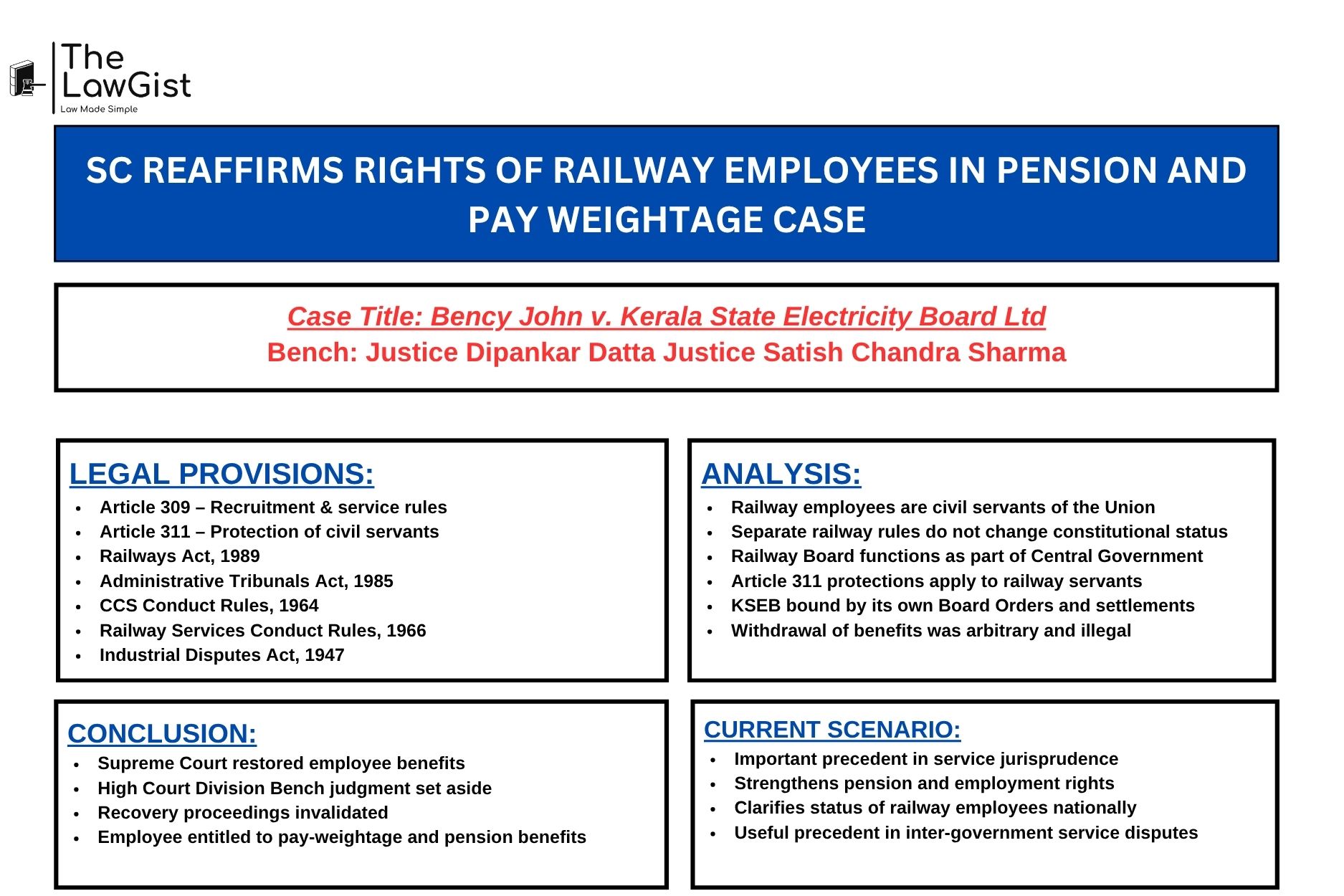
CASE SUMMARY – The Supreme Court in Bency John vs. Kerala State Electricity Board Ltd ruled that railway employees are Central Government servants even though they are governed by separate railway service rules. Bency John, a former railway employee who later joined the Kerala State Electricity Board, was initially granted service weightage and pension benefits. These benefits were later withdrawn on the ground that railway service was not Central Government service. The Court rejected this reasoning, holding that railway servants hold civil posts under the Union. It restored all benefits and held that KSEB could not arbitrarily withdraw previously granted entitlements.
| ASPECTS | DETAILS |
| Case Title | Bency John vs. Kerala State Electricity Board Ltd |
| Introduction | The Supreme Court examined whether railway employees are Central Government servants despite being governed by separate railway service rules. The matter also involved withdrawal of pay-weightage benefits granted by the Kerala State Electricity Board (KSEB). |
| Factual Background | Bency John worked in Indian Railways from 1990 and later joined KSEB in 2001. KSEB accepted pro-rata pension contribution from Railways and granted service weightage benefits. Later, KSEB withdrew those benefits claiming railway service was not Central Government service. The Single Judge allowed the employee’s claim, but the Kerala High Court Division Bench reversed the decision. The matter reached the Supreme Court. |
| Legal Issues | 1. Whether a railway servant remains a member of the civil service of the Union despite separate service rules. 2. Whether KSEB could withdraw benefits after accepting pension contribution and granting weightage benefits for years. |
| Applicable Law | Articles 309 and 311 of the Constitution of India; Railways Act, 1989; Administrative Tribunals Act, 1985; CCS Rules, 1964 & 1965; Railway Services Rules; Industrial Disputes Act, 1947; precedents including Parshotam Lal Dhingra, Moti Ram Deka, and Rafiq Masih. |
| Analysis | The Court held that railway employees hold civil posts under the Union and remain Central Government servants. Separate railway rules exist only for administrative convenience and do not alter constitutional status. The Court relied on constitutional provisions, the Railways Act, Railway Board structure, Article 311 protections, and earlier precedents. It further ruled that KSEB was estopped from withdrawing benefits after acknowledging the employee’s railway service and accepting pension liability contributions. |
| Conclusion | The Supreme Court set aside the Kerala High Court Division Bench judgment and restored the Single Judge’s decision. The appellant was declared entitled to all service and pensionary benefits without recovery. |
| Current Scenario | The judgment strengthens the legal recognition of railway employees as Central Government servants. It also reinforces principles against arbitrary withdrawal of service benefits and protects retired employees from unjust recoveries. The ruling is likely to influence future service and pension disputes involving inter-departmental transfers between Railways and other government bodies. |
“A railway servant does not cease to be a member of the civil service of the Central Government merely because his conditions of service are regulated by rules specific to the Railways.”
SOURCE – SUPREME COURT OF INDIA