Overview of offences against the state and their legal implications under Indian criminal law.
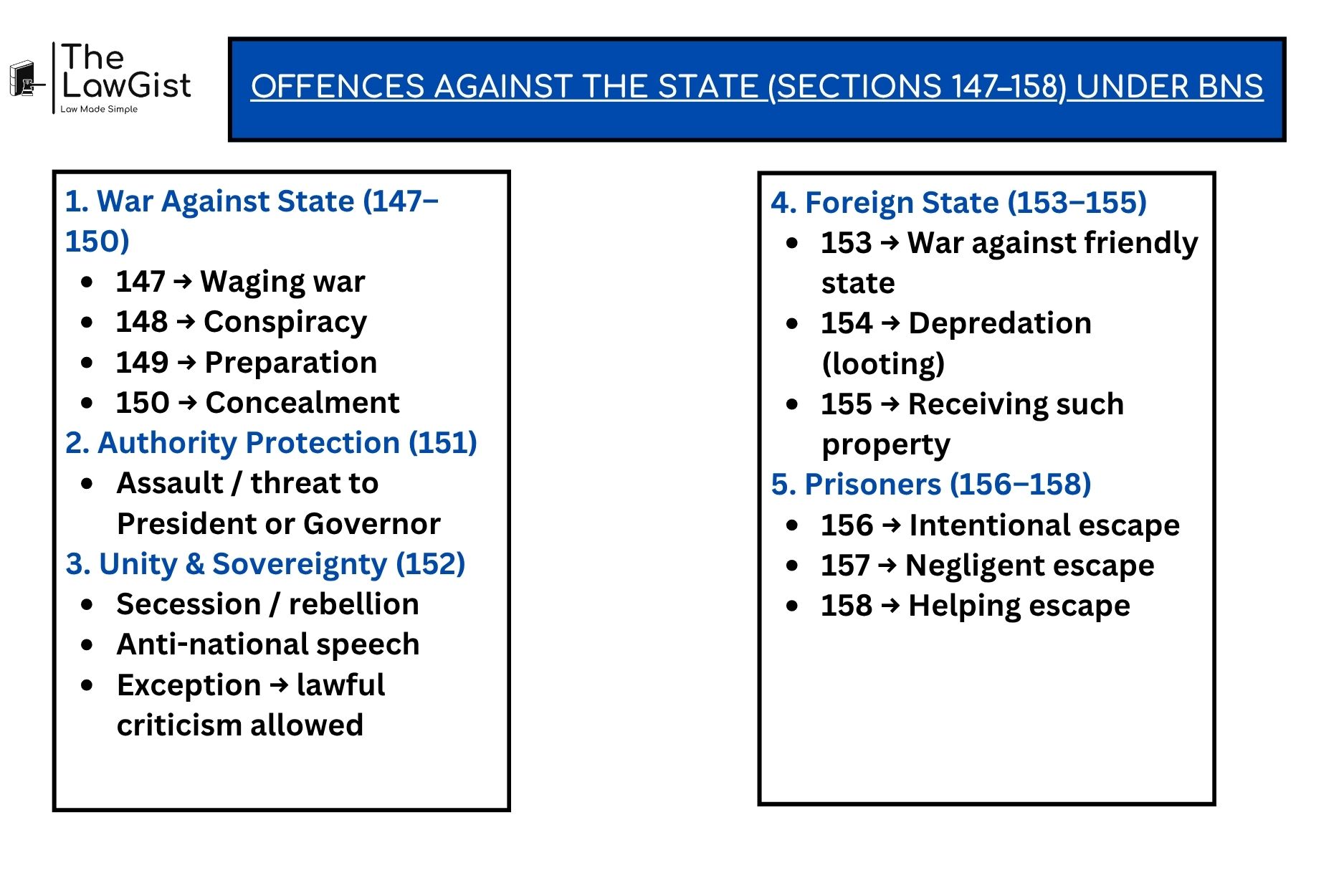
OFFENCES AGAINST THE STATE (SECTIONS 147–158) UNDER BNS
Offences against the State are among the most serious crimes in criminal law, as they directly threaten the sovereignty, unity, and security of India. These offences are now reflected in modern legislation such as the Bharatiya Nyaya Sanhita (BNS), 2023, replacing older provisions of the IPC.In recent years, with the rise of digital communication, separatist movements, and cyber influence, laws like Section 152 (related to secession and rebellion) have gained renewed importance. Courts have also clarified that criticism of the government is allowed, but actions threatening national integrity are punishable. |
SECTION 147 – WAGING WAR AGAINST GOVERNMENT
Definition: Waging war means using force or violence against the Government of India to challenge its authority.
Example- A group takes up arms and attacks government forces to overthrow authority.
Case Law
State vs. Navjot Sandhu (Parliament Attack Case) – Court held that organized violent attacks against government institutions amount to waging war.
SECTION 148 – CONSPIRACY TO WAGE WAR
Definition: Agreement between two or more persons to plan war or threaten the government using force, even if no act is done.
Example – Secret meetings to plan an armed rebellion.
Case Law
Kehar Singh vs. State (Indira Gandhi Assassination Case) – Court explained that conspiracy itself is punishable, even without execution.
SECTION 149 – PREPARATION TO WAGE WAR
Definition: Collecting men, weapons, or resources with intent to wage war against the government.
Example – Stockpiling arms and training people for rebellion.
Case Law
Mohd. Ajmal Kasab vs. State of Maharashtra – Preparation and participation in attacks seen as acts against the State.
SECTION 150 – CONCEALING PLAN TO WAGE WAR
Definition: Hiding knowledge of a plan to wage war, intending to help such act succeed.
Example – A person knows about a terrorist plan but does not inform authorities.
Case Law
No major direct case; principles derived from conspiracy laws like Kehar Singh vs. State (Indira Gandhi Assassination Case).
SECTION 151 – ASSAULT ON PRESIDENT OR GOVERNOR
Definition: Using force or threat to compel or influence constitutional authorities (President/Governor).
Example – Physically threatening a Governor to force a decision.
Case Law
Rarely litigated; general principles from constitutional protection cases apply.
SECTION 152 – ACTS ENDANGERING SOVEREIGNTY (SECESSION, REBELLION)
Definition :Acts (including speech, writing, digital communication) that promote secession, rebellion, or threaten unity of India.
Example – Spreading messages encouraging separation of a state from India.
Case Law
- Kedar Nath Singh vs. State of Bihar – Only speech that incites violence or public disorder is punishable.
- Shreya Singhal vs. Union of India – Protected online speech, limiting punishment to incitement.
SECTION 153 – WAR AGAINST FRIENDLY FOREIGN STATE
Definition: Waging or attempting war against a country that is at peace with India.
Example – Indian citizens attacking an embassy of a friendly nation.
Case Law
Rare; guided by principles of international law and national security.
SECTION 154 – DEPREDATION AGAINST FOREIGN STATE
Definition – Looting or attacking property in a friendly foreign country.
Example – Organizing raids on property across borders.
Case Law
No major landmark case; interpreted through general criminal law.
SECTION 155 – RECEIVING PROPERTY FROM SUCH OFFENCES
Definition: Receiving property knowing it was obtained through offences like war or depredation.
Example – Buying stolen goods taken during an armed raid on foreign territory.
Case Law
Applied similarly to stolen property principles in criminal law.
SECTION 156 – PUBLIC SERVANT ALLOWING ESCAPE (INTENTIONAL)
Definition – A public servant intentionally allowing a state prisoner or prisoner of war to escape.
Example – A jail officer deliberately releases a dangerous prisoner.
Case Law
General principles of breach of duty by public servants apply.
SECTION 157 – ESCAPE DUE TO NEGLIGENCE
Definition – A public servant carelessly allowing escape of such prisoners.
Example- Failing to lock prison gates properly leading to escape.
Case Law
Negligence cases under criminal law guide interpretation.
SECTION 158 – HELPING ESCAPE OF STATE PRISONER
Definition
Helping, rescuing, hiding, or assisting a prisoner of war or state prisoner to escape.
Example– Providing shelter to an escaped prisoner.
Case Law
Principles similar to aiding offenders; no major standalone landmark case.
| Section | Offence | Meaning | Punishment |
| 147 | Waging war | Fighting against Government of India | Death or life imprisonment + fine |
| 148 | Conspiracy | Planning war or threatening government | Life imprisonment or up to 10 years + fine |
| 149 | Preparation | Collecting arms or preparing for war | Life imprisonment or up to 10 years + fine |
| 150 | Concealment | Hiding plan to wage war | Up to 10 years + fine |
| 151 | Assault on President/Governor | Forcing them by threat or force | Up to 7 years + fine |
| 152 | Secession/Rebellion | Promoting anti-national activities | Life imprisonment or up to 7 years + fine |
| 153 | War against friendly state | Attacking friendly foreign country | Life imprisonment or up to 7 years + fine |
| 154 | Depredation | Looting foreign territory | Up to 7 years + fine + forfeiture |
| 155 | Receiving property | Taking property from such offences | Up to 7 years + fine + forfeiture |
| 156 | Escape of prisoner (intentional) | Public servant helping escape | Life imprisonment or up to 10 years + fine |
| 157 | Escape (negligence) | Carelessness leading to escape | Up to 3 years + fine |
| 158 | Helping escape | Assisting prisoner of war/state prisoner | Life imprisonment or up to 10 years + fine |
- Sections 147–152 deal mainly with threats to India’s government and unity.
- Sections 153–155 deal with foreign relations offences.
- Sections 156–158 deal with custody and escape of prisoners.
“Freedom allows criticism, but the law protects the nation from actions that threaten its unity and sovereignty.”
SOURCE – MHA