Understanding the distinction between wrongful restraint and wrongful confinement under BNS: Partial vs Complete restriction of personal liberty.
SECTION 126-127 WRONGFUL RESTRAINT AND WRONGFUL CONFINEMENT UNDER THE BHARATIYA NYAYA SANHITA
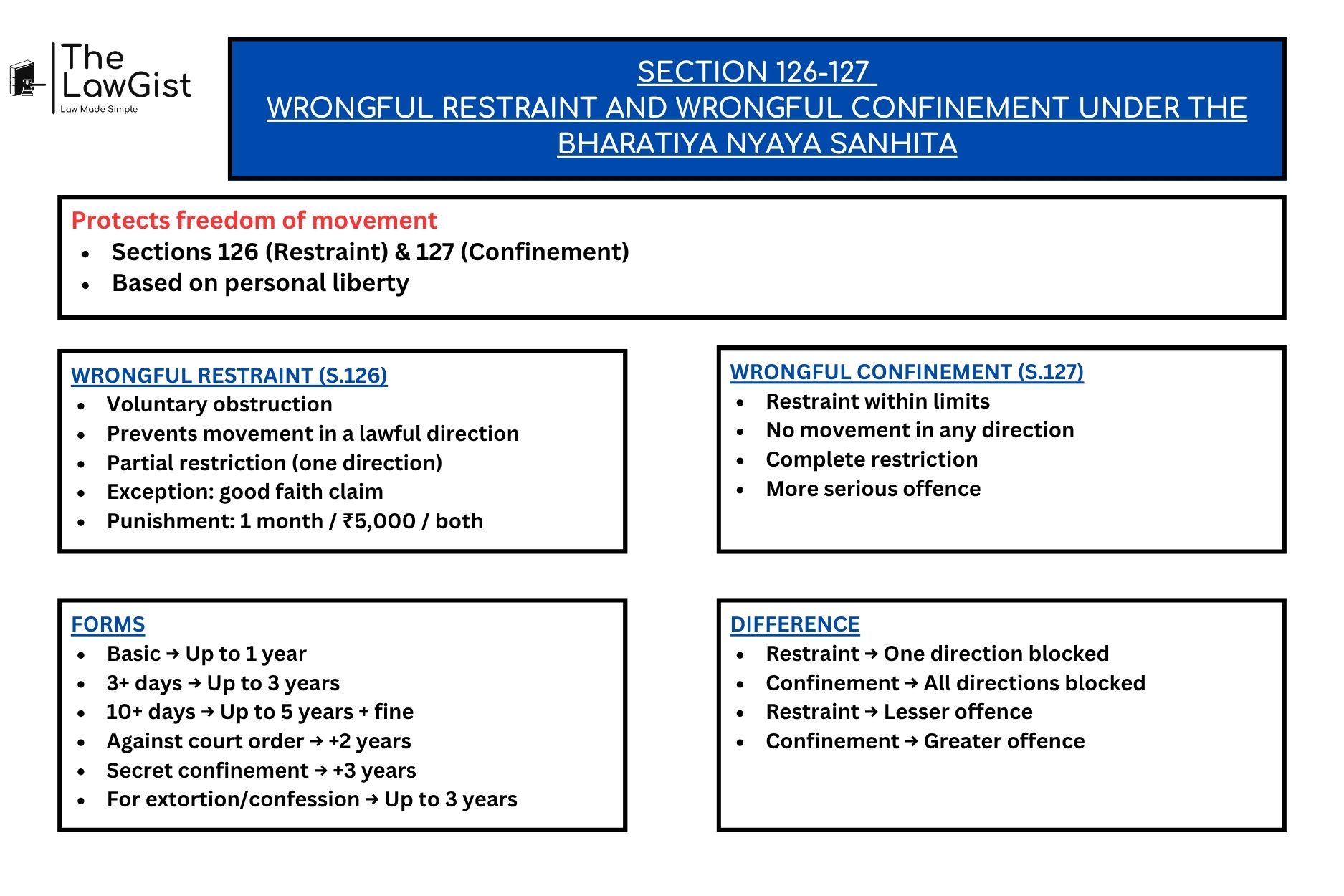
The provisions relating to wrongful restraint and wrongful confinement under the Bharatiya Nyaya Sanhita (BNS) are designed to safeguard one of the most fundamental civil liberties—freedom of movement. Sections 126 and 127 establish a structured legal framework that distinguishes between partial and complete restrictions on liberty while prescribing proportionate punishments. |
Discover insights on Latin Maxims and Legal Glossary and simplify complex legal terms in seconds.The LawGist ensures exam success with quality Blogs and Articles on — Top Legal Picks (TLP), Current Affairs, latest Supreme Court judgments as Courtroom Chronicles. Backed by trusted resources and videos, The LawGist is every Professionals and Aspirant’s first choice. Discover more at thelawgist.org
Wrongful Restraint (Section 126 BNS)
Definition – Wrongful restraint occurs when a person voluntarily obstructs another person so as to prevent them from proceeding in any direction in which they have a lawful right to proceed.
Essential Ingredients
- Voluntary obstruction
- Prevention of movement
- The direction must be legally permissible
Illustration – If A blocks a public pathway and prevents Z from passing, despite Z having a legal right to use that path, A commits wrongful restraint.
Exception – Where obstruction is made in good faith, under a belief of lawful right (such as a property dispute), it does not amount to an offence.
Punishment
- Simple imprisonment up to 1 month, or
- Fine up to ₹5,000, or
- Both
This reflects that wrongful restraint is treated as a less serious infringement, involving only partial restriction of movement.
Wrongful Confinement (Section 127 BNS)
Wrongful confinement is an aggravated form of wrongful restraint.
Definition – A person is said to wrongfully confine another when they restrain them within circumscribed limits, preventing them from proceeding beyond those limits.
Essential Ingredients
- Wrongful restraint: Restriction in one direction
- Wrongful confinement: Restriction in all directions within a boundary
Illustrations
- Locking a person inside a room
- Guarding exits to prevent escape
- Threatening harm if a person attempts to leave
Discover insights on Latin Maxims and Legal Glossary and simplify complex legal terms in seconds.The LawGist ensures exam success with quality Blogs and Articles on — Top Legal Picks (TLP), Current Affairs, latest Supreme Court judgments as Courtroom Chronicles. Backed by trusted resources and videos, The LawGist is every Professionals and Aspirant’s first choice. Discover more at thelawgist.org
Types of Wrongful Confinement under Section 127 BNS
The law provides a graded classification based on duration, intention, and circumstances:
| Section | Type of Confinement | Key Element | Punishment | Example |
| 127(2) | Basic confinement | General unlawful restriction | Up to 1 year or fine or both | Locking someone temporarily |
| 127(3) | Confinement ≥ 3 days | Prolonged detention | Up to 3 years or fine or both | Holding someone over a dispute |
| 127(4) | Confinement ≥ 10 days | Extended detention | Up to 5 years + fine (min ₹10,000) | Illegal captivity for long duration |
| 127(5) | Confinement despite court order | Disobedience of writ | Additional 2 years + fine | Ignoring habeas corpus |
| 127(6) | Secret confinement | Concealment from authorities | Additional 3 years + fine | Hidden detention |
| 127(7) | For extortion/illegal acts | Coercion for property or acts | Up to 3 years + fine | Forcing payment |
| 127(8) | For confession/recovery | Forcing confession or settlement | Up to 3 years + fine | Extracting confession |
Key Distinction between Wrongful Restraint and Wrongful Confinement
| Aspect | Wrongful Restraint | Wrongful Confinement |
| Nature | Partial restriction | Complete restriction |
| Scope | One direction blocked | All directions blocked |
| Severity | Lesser offence | More serious offence |
| Example | Blocking a road | Locking a person in a room |
Recent Case Laws
A recent and relevant decision is Dilbag Singh @ Dilbag Sandhu vs. Union of India and another . In this case, the petitioner challenged illegal detention by authorities, arguing that the detained individual was not produced before a magistrate within the legally prescribed time. The key issue before the Court was whether such detention amounted to wrongful confinement under principles now reflected in the Bharatiya Nyaya Sanhita.
The Court held that detention beyond lawful limits without judicial oversight constitutes wrongful confinement. It emphasized that even state authorities must comply strictly with procedural safeguards. The Court further observed that such unlawful custody amounts to a violation of personal liberty.
This judgment is significant as it clarifies that wrongful confinement applies not only to private individuals but also to state authorities acting beyond legal limits, and it reinforces constitutional protections under Article 21 and Article 22.
For additional case laws, this database includes judicial interpretations of wrongful restraint (earlier Section 341 IPC) and wrongful confinement (earlier Sections 340–342 IPC), which remain relevant for understanding similar provisions under the Bharatiya Nyaya Sanhita.
Practical Relevance
These provisions are frequently invoked in situations such as:
- Illegal detention for debt recovery
- Workplace exploitation
- Domestic disputes involving forced restriction
- Custodial misconduct
- Situations resembling kidnapping without formal abduction
They act as a safeguard against both private coercion and abuse of authority.
Conclusion
Sections 126 and 127 of the Bharatiya Nyaya Sanhita establish a comprehensive legal mechanism to address unlawful restrictions on personal liberty. While wrongful restraint addresses minor obstructions, wrongful confinement deals with more serious and often coercive restrictions.
The graded punishment system ensures that:
- The duration of confinement
- The intention behind the act
- The manner in which confinement is carried out are all taken into account.
The law ultimately affirms a fundamental principle: no individual—whether a private person or a state authority—can curtail another’s liberty without lawful justification.
“Freedom of movement is not just a right—it is the foundation of personal liberty, and any unlawful restriction strikes at the heart of justice.”
SOURCE – MHA
Discover insights on Latin Maxims and Legal Glossary and simplify complex legal terms in seconds.The LawGist ensures exam success with quality Blogs and Articles on — Top Legal Picks (TLP), Current Affairs, latest Supreme Court judgments as Courtroom Chronicles. Backed by trusted resources and videos, The LawGist is every Professionals and Aspirant’s first choice. Discover more at thelawgist.org