Supreme Court reiterates that disputes relating to rejection of nomination papers during an ongoing election must be raised through an election petition after the election process concludes.
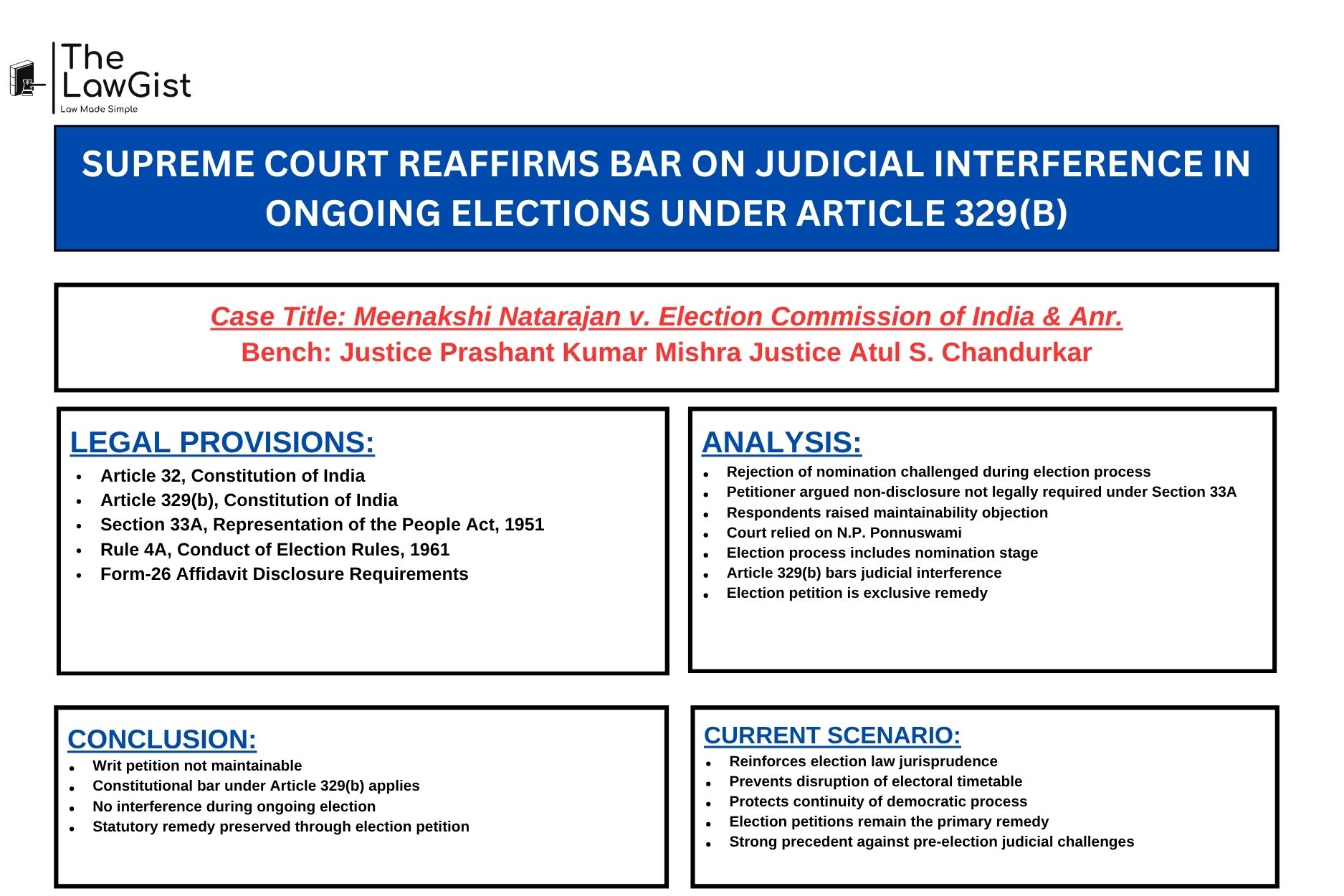
SUPREME COURT REAFFIRMS BAR ON JUDICIAL INTERFERENCE IN ONGOING ELECTIONS UNDER ARTICLE 329(B)
CASE SUMMARY – Meenakshi Natarajan vs. Election Commission of India concerned the rejection of the petitioner’s Rajya Sabha nomination for allegedly failing to disclose a pending criminal case in Form-26. The petitioner approached the Supreme Court under Article 32 seeking immediate relief. The Court held that Article 329(b) of the Constitution bars judicial interference in ongoing election processes. Relying on the landmark decision in N.P. Ponnuswami v. Returning Officer, the Court reiterated that election-related disputes, including rejection of nomination papers, must be challenged only through an election petition after the election concludes. Consequently, the writ petition was dismissed as not maintainable.
| ASPECTS | DETAILS |
| Case Title | Meenakshi Natarajan vs. Election Commission of India & Anr. |
| Introduction | The petitioner challenged the rejection of her nomination for a Rajya Sabha seat from Madhya Pradesh. The Returning Officer rejected the nomination on the ground that she failed to disclose a pending criminal case in Form-26 affidavit. The principal issue before the Supreme Court was whether such rejection could be challenged under Article 32 during the ongoing election process. |
| Factual Background | Meenakshi Natarajan, an Indian National Congress candidate, filed nomination papers for the Rajya Sabha election. The Returning Officer rejected her nomination on 09.06.2026, alleging suppression of material information relating to a pending criminal case. She approached the Election Commission and subsequently filed a writ petition under Article 32 seeking intervention before completion of the election process. |
| Legal Issues |
|
| Applicable Law |
|
| Analysis | The Court relied heavily on N.P. Ponnuswami v. Returning Officer and subsequent precedents. It reiterated that “election” includes the entire electoral process from nomination to declaration of results. Since Article 329(b) creates a constitutional bar against judicial intervention during elections, disputes concerning nomination rejection must be raised through an election petition after the election. The Court declined to examine whether the Returning Officer was correct on merits regarding disclosure obligations. |
| Conclusion | The writ petition was dismissed as not maintainable. The Court held that Article 329(b) expressly bars judicial interference in ongoing elections and that the petitioner must pursue the statutory remedy of an election petition after completion of the election process. |
| Current Scenario | The judgment strengthens the long-standing constitutional principle that courts should not interrupt election processes. Any challenge to rejection of nomination papers must ordinarily be pursued through election petitions after elections conclude. The ruling reinforces electoral stability and continuity in election administration. |
“Election disputes arising during the electoral process must ordinarily await adjudication through an election petition after completion of the election process.”
SOURCE – SUPREME COURT OF INDIA