Supreme Court reviews Punjab’s EWS admission implementation, comments on RTI misuse, and examines the legality of a Bihar minister’s re-appointment.
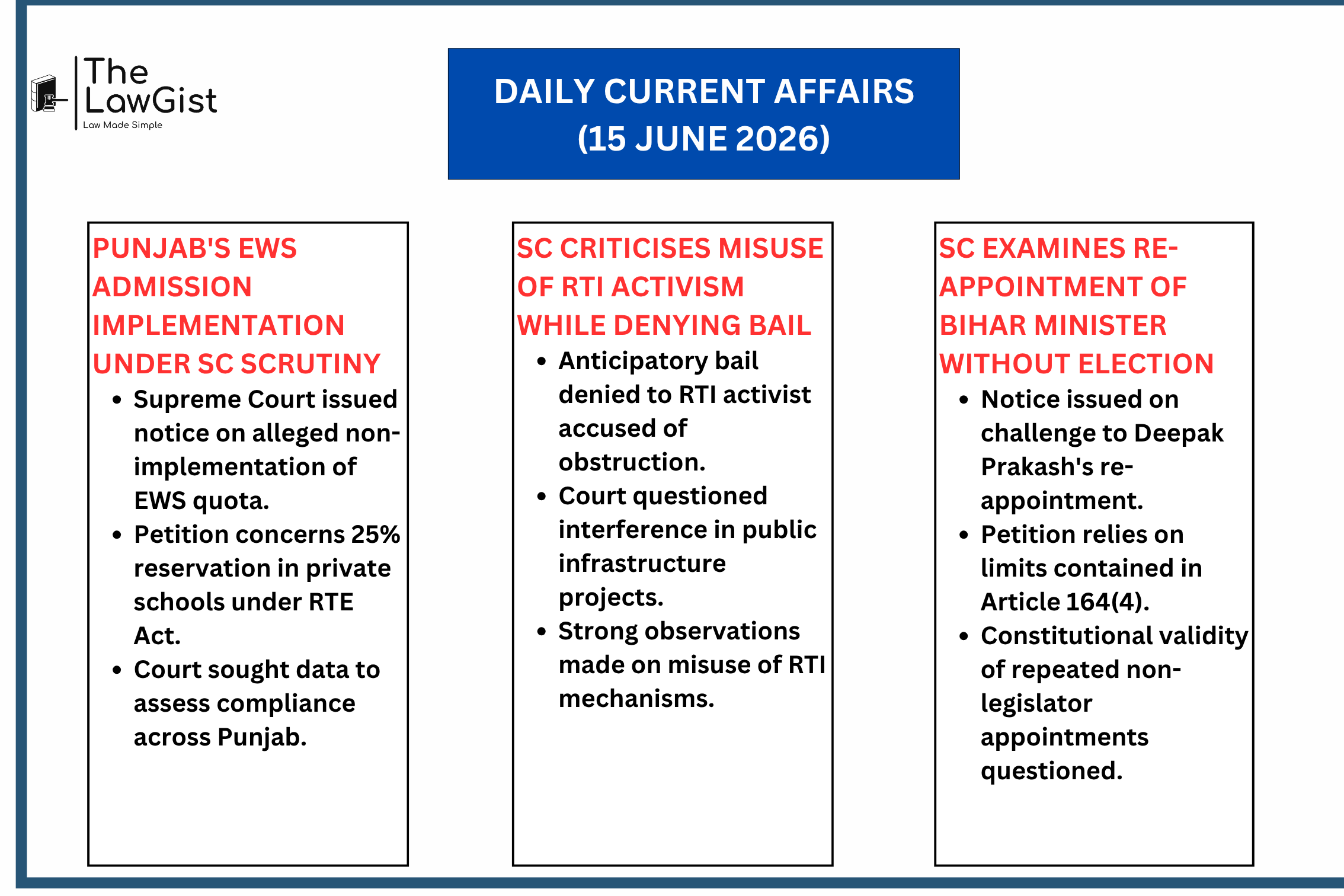
DAILY CURRENT AFFAIRS (15 JUNE 2026)
SC ISSUES NOTICE ON PLEA ALLEGING PUNJAB’S FAILURE TO IMPLEMENT EWS ADMISSIONS UNDER RTE ACT
Case Name: Petition Regarding Implementation of Section 12(1)(c) of the Right to Education Act in Punjab
The Supreme Court issued notice on a petition alleging that Punjab has failed to effectively implement the Right to Education Act’s mandate requiring private unaided schools to reserve 25% entry-level seats for children from Economically Weaker Sections (EWS) and disadvantaged groups. The Court sought supporting data to assess the extent of compliance across the State.
LEGAL PROVISIONS & FRAMEWORK
- Right of Children to Free and Compulsory Education Act, 2009
- Section 12(1)(c) – 25% EWS reservation in private schools
- Article 21A – Right to Education
- Educational inclusion and equality principles
- State obligation towards disadvantaged children
- School admission and reimbursement framework
Source: Supreme Court of India
‘RTI ACTIVISM HAS BECOME A NEW BUSINESS’: SC DENIES ANTICIPATORY BAIL
Case Name: Rakesh Kumar Behl v. State of Punjab
The Supreme Court denied anticipatory bail to an RTI activist accused of obstructing a public servant during road construction work. During the hearing, the Court made strong observations on the misuse of RTI activism, questioning private interference in public projects and emphasizing that transparency mechanisms should not become tools for obstruction or intimidation.
LEGAL PROVISIONS & FRAMEWORK
- Right to Information Act, 2005
- Bharatiya Nagarik Suraksha Sanhita, 2023
- Anticipatory bail jurisprudence
- Public servant protection laws
- Obstruction of public duties principles
- Judicial discretion in bail matters
Source: Supreme Court of India
SC ISSUES NOTICE ON CHALLENGE TO BIHAR MINISTER DEEPAK PRAKASH’S RE-APPOINTMENT
Case Name: Rakesh Kumar Singh v. State of Bihar & Ors.
The Supreme Court issued notice on a petition challenging the re-appointment of Bihar Minister Deepak Prakash without his election to the State Legislature. The plea argues that Article 164(4) provides only a temporary constitutional exception and does not permit repeated appointments of a non-legislator without securing legislative membership.
LEGAL PROVISIONS & FRAMEWORK
- Article 164(4) of the Constitution
- Ministerial appointment provisions
- Constitutional accountability principles
- Legislative membership requirements
- Democratic governance framework
- Judicial review of executive appointments
Source: Supreme Court of India
ALSO READ – DAILY CURRENT AFFAIRS (13 JUNE 2026)