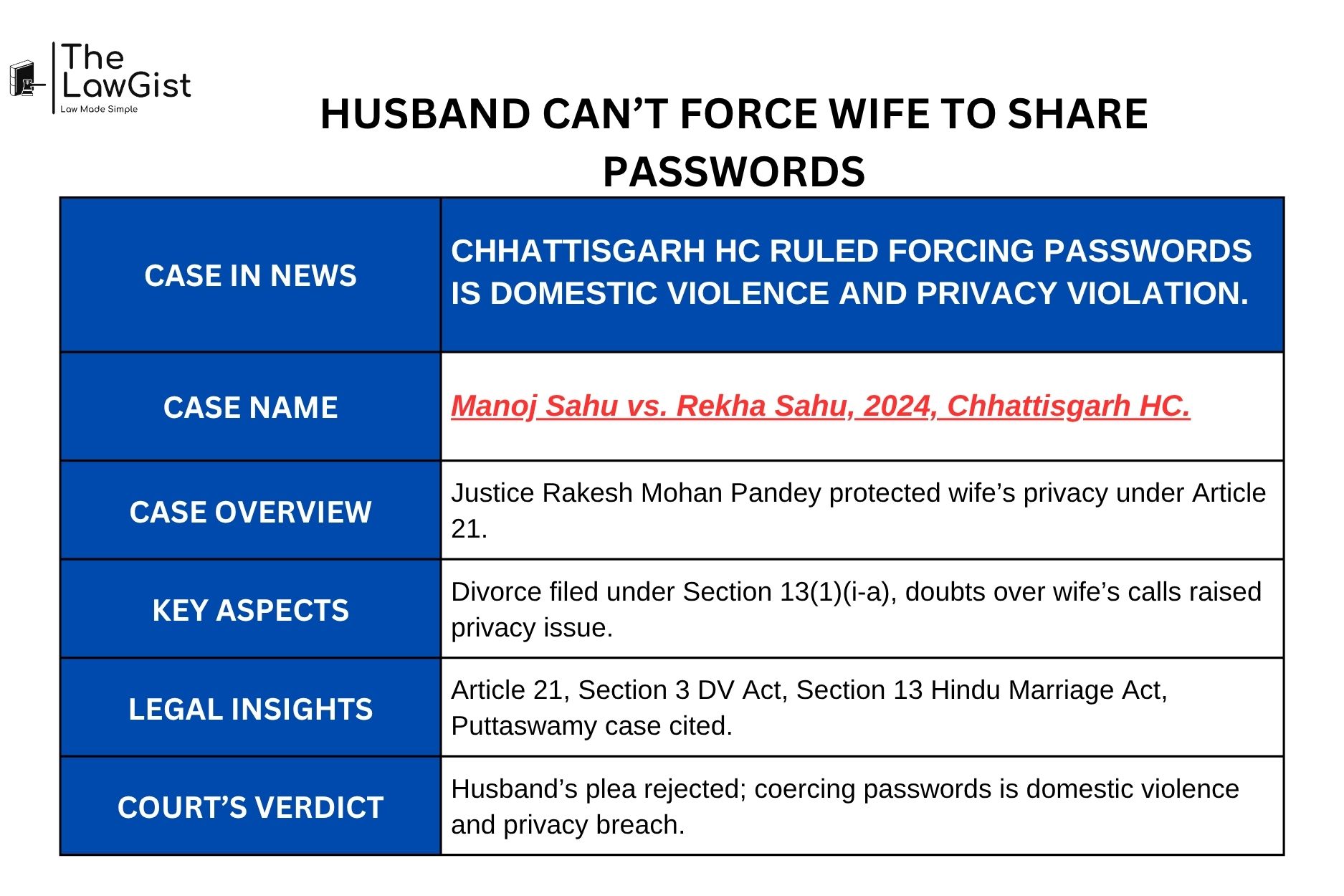
Chhattisgarh High Court rules husbands cannot demand passwords from wives; privacy and dignity upheld in matrimonial disputes under Article 21 and DV Act.
Case in News
Husband can’t force wife to share passwords, rules Chhattisgarh High Court in a Matrimonial Disputes case involving privacy and domestic violence concerns .
Case Overview
Case Name – Manoj Sahu vs. Rekha Sahu, Chhattisgarh High Court, 2024
The Chhattisgarh High Court, led by Justice Rakesh Mohan Pandey ruled that compelling a wife to share her mobile phone and bank account passwords violates her right to privacy and may amount to domestic violence . The case arose when the husband filed for divorce under cruelty grounds and attempted to obtain his wife’s call records to question her character. Both the Family Court and High Court rejected his request reaffirming constitutional privacy protections even in Matrimonial Disputes .
Key Aspects
The case centered around the question of whether suspicion in a marriage justifies breaching privacy . The petitioner sought personal data of his wife under allegations of cruelty .
- Husband filed for divorce under Section 13(1)(i-a), Hindu Marriage Act, 1955 .
- Claimed cruelty and requested call detail records (CDRs) of his wife .
- Applied before SSP and Family Court; both requests were denied .
- Raised issue before High Court on grounds of mistrust in marital relationship .
Legal Insights
The Court’s decision draws upon critical constitutional and statutory protections related to individual privacy and dignity. It also highlights how coercion within a marital setup can be classified as domestic violence .
- Article 21 of the Constitution of India – Guarantees the Right to Privacy as part of the Right to Life and Personal Liberty .
- Section 3 of the Protection of Women from Domestic Violence Act, 2005 – Psychological or emotional abuse includes acts that insult dignity or invade privacy .
- Section 13(1)(i-a), Hindu Marriage Act, 1955 – Ground for divorce based on cruelty .
- K.S. Puttaswamy v. Union of India (2017) 10 SCC 1 – Declared privacy a fundamental right under Article 21 .
- People’s Union for Civil Liberties (PUCL) v. Union of India (1997) 1 SCC 301 – Safeguarded against unwarranted surveillance and interception .
- Mr. X v. Hospital Z (1998) 8 SCC 296 – Emphasized the importance of confidentiality in personal matters .
Court’s Verdict
The Chhattisgarh High Court held that suspicion cannot override a person’s privacy . Justice Rakesh Mohan Pandey stated that marriage does not entitle a husband to access his wife’s private communications or financial information . Coercion in this regard could be considered domestic violence under law . The Court thus dismissed the husband’s plea and upheld the Family Court’s rejection emphasizing trust, privacy and dignity in Matrimonial Disputes .
Source – High Court of Chattishgarh
Read also – Article 21 of Indian Constitution