Supreme Court sets aside anticipatory bail granted to absconding accused in 2026 landmark ruling.
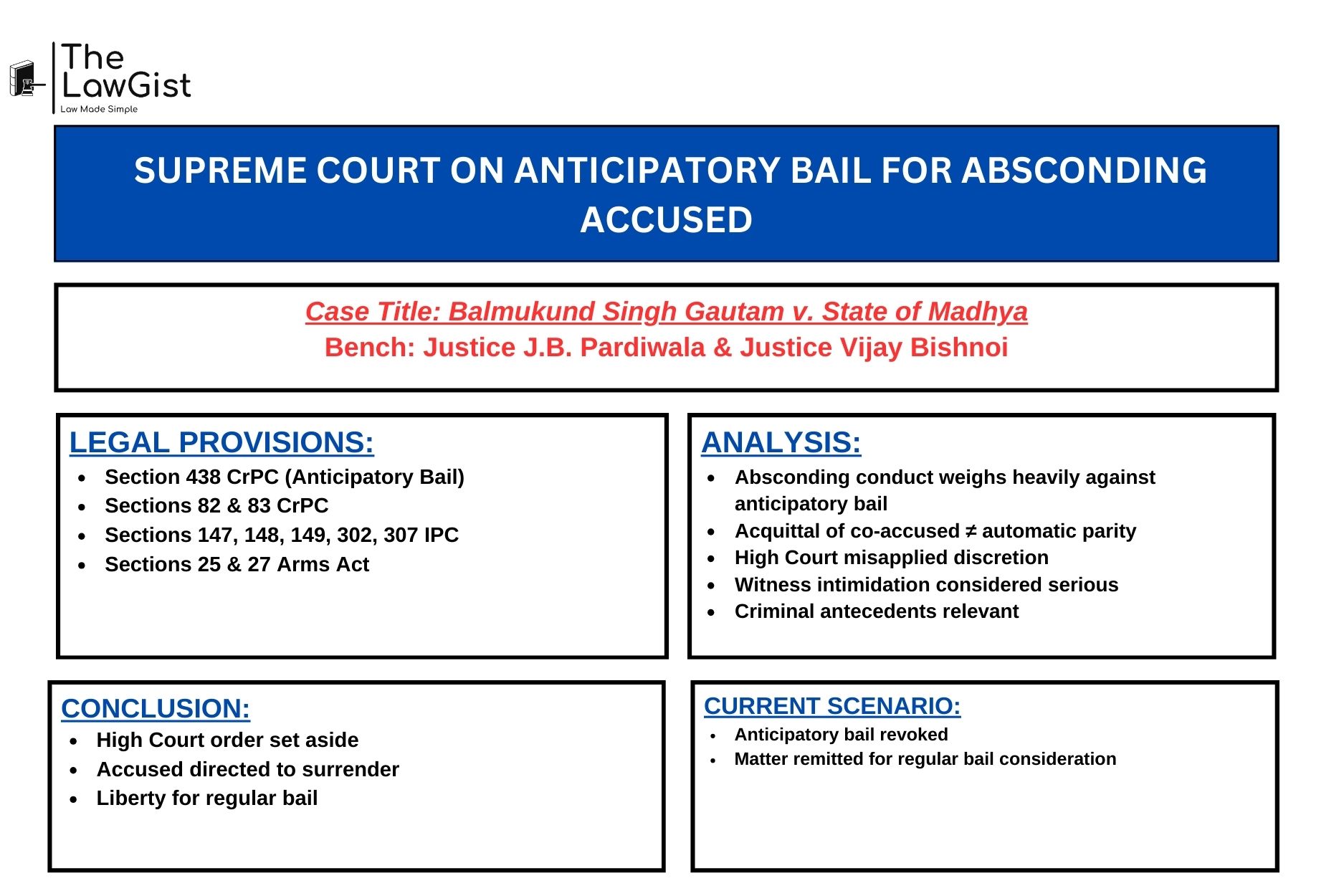
SUPREME COURT ON ANTICIPATORY BAIL FOR ABSCONDING ACCUSED
CASE SUMMARY – In Balmukund Singh Gautam v. State of Madhya Pradesh, the Supreme Court examined whether an absconding accused in a murder case could be granted anticipatory bail after co-accused were acquitted. The accused had evaded arrest for nearly six years in a politically motivated firing incident that resulted in one death. The High Court directed his surrender and same-day regular bail. The Supreme Court held that absconding conduct, criminal antecedents, and witness intimidation disentitled him from anticipatory bail. It ruled that acquittal of co-accused does not create automatic parity. The anticipatory bail order was set aside, directing surrender within four weeks.
| ASPECTS | DETAILS |
| Case Title | Balmukund Singh Gautam vs. State of Madhya Pradesh |
| Introduction | Appeal before the Supreme Court challenging the High Court’s order granting anticipatory bail to an absconding accused in a murder and rioting case arising from political rivalry. |
| Factual Background | Incident dated 02.06.2017 led to three FIRs. Subject FIR involved offences under IPC Sections 147, 148, 149, 307, 302 and Arms Act. One person (Bablu Chaudhary) died; another injured. Accused absconded for ~6 years. Co-accused were acquitted in 2023. High Court directed surrender and same-day regular bail. |
| Legal Issues |
|
| Applicable Law |
|
| Analysis | Supreme Court held absconding accused generally not entitled to anticipatory bail. Acquittal of co-accused does not automatically grant parity. High Court failed to consider seriousness, antecedents, witness intimidation, and non-cooperation. |
| Conclusion | Supreme Court set aside High Court’s order. Directed accused to surrender within 4 weeks; liberty to apply for regular bail. |
| Current Scenario | Anticipatory bail cancelled. Accused must surrender and seek regular bail afresh. Appeal allowed (13 Feb 2026). |
“An absconder cannot claim anticipatory bail as a matter of right merely because co-accused were acquitted.”
SOURCE – SUPREME COURT OF INDIA
READ ALSO – Section 438 CrPC,Sections 82 & 83 CrPC; Section 302 IPC, Section 307 IPC.
Discover insighs on Latin Maxims and Legal Glossary and simplify complex legal terms in seconds.The LawGist ensures exam success with quality Blogs and Articles on — Top Legal Picks (TLP), Current Affairs, latest Supreme Court judgments as Courtroom Chronicles. Backed by trusted resources and videos, The LawGist is every Professionals and Aspirant’s first choice. Discover more at thelawgist.org