SUPREME COURT HOLDS CURABLE PROCEDURAL IRREGULARITIES SHOULD NOT INVALIDATE ENTIRE RECRUITMENT PROCESS
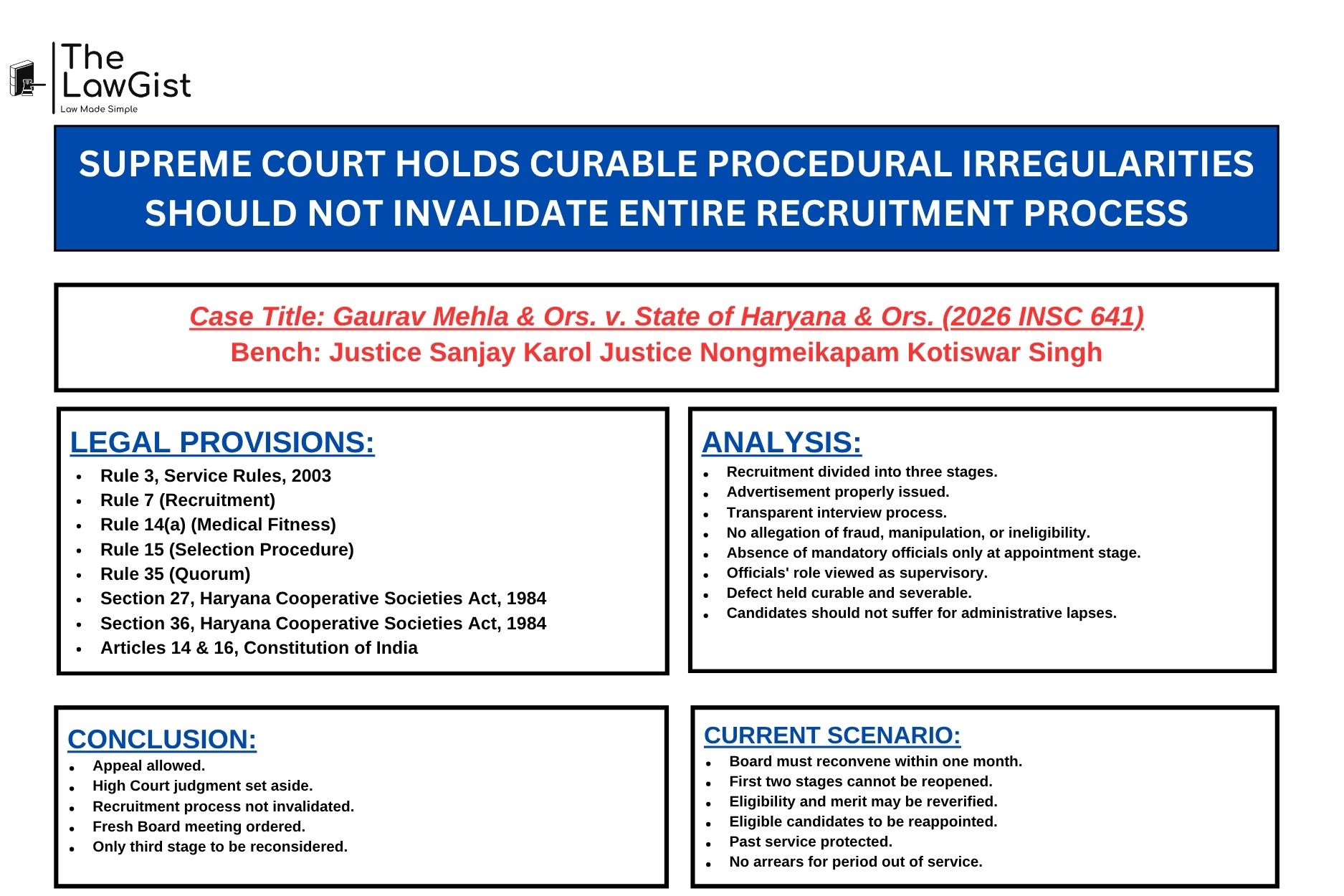
CASE SUMMARY – The Supreme Court in Gaurav Mehla & Ors. vs. State of Haryana & Ors. (2026 INSC 641) examined whether appointments could be cancelled because mandatory officials were absent from the Board meeting approving recruitment. The Court found that the recruitment process, including advertisement and interviews, was transparent and free from allegations of fraud or favouritism. The defect arose only during the final appointment stage. Holding that the absence of officials under Rule 3 constituted a curable procedural irregularity rather than a fundamental illegality, the Court set aside the High Court judgment and directed reconsideration of appointments through a properly constituted Board meeting while protecting employees’ accrued service benefits.
| ASPECTS | DETAILS |
| Introduction | The case concerned whether appointments made through a valid public recruitment process could be annulled solely because mandatory officials were absent during the Board meeting that approved the appointments. The Court examined the distinction between fundamental illegality and curable procedural irregularity. |
| Factual Background | In 2014, Thanesar Cooperative Marketing-cum-Processing Society advertised posts of Clerk-cum-Salesman and Peon-cum-Chowkidar. Candidates were selected through interviews and appointed. Society members challenged the appointments alleging violation of Rule 3 of the Service Rules, 2003 because mandatory officials (Assistant Registrar, Inspector Cooperative Societies and District Manager, HAFED) were absent from the Board meeting approving appointments. Authorities and the High Court invalidated the appointments. The employees approached the Supreme Court after serving for over ten years. |
| Legal Issues | 1. Whether Rule 3 is mandatory or directory.
2. Whether absence of mandatory officials invalidated the appointments. 3. Whether the defect was substantive or merely procedural and curable. 4. Whether Rule 35 and Section 36 could protect the appointments. 5. Whether employees deserved equitable protection after long service. |
| Applicable Law | • Rule 3, Primary Cooperative Marketing-cum-Processing Societies Ltd. Staff Service Rules, 2003.
• Rule 7 (Recruitment). • Rule 14(a) (Medical Fitness). • Rule 15 (Selection Procedure). • Rule 35 (Quorum). • Sections 27 & 36, Haryana Cooperative Societies Act, 1984. • Articles 14 and 16 of the Constitution of India. |
| Analysis | The Court divided recruitment into three stages: (1) advertisement, (2) selection/interview, and (3) final appointment by the Board. The first two stages were found fair, transparent and free from fraud or favouritism. No challenge came from unsuccessful candidates. The only defect existed at the third stage where mandatory officials were absent. The Court held that these officials performed a supervisory role and their absence did not taint the entire recruitment process. Since the defect was confined to the appointment stage and could be rectified by reconvening the Board, it was a curable irregularity rather than a fundamental illegality. |
| Conclusion | The Supreme Court allowed the appeal, set aside the High Court judgment, and directed the Cooperative Society to reconvene the Board meeting with the mandatory officials present. The Board was directed to reconsider only the final appointment stage and not reopen advertisement or interview stages. |
| Current Scenario | The appointments were not finally validated outright. The matter was remitted to the Board of Directors for fresh consideration. If the appellants are found eligible and free from disqualification, they must be reappointed with continuity of past service, though without back wages for the period spent out of service. |
“A procedural defect at the final stage of appointment, which is curable and not attributable to the selected candidates, cannot automatically invalidate an otherwise fair and transparent recruitment process.”
SOURCE – SUPREME COURT OF INDIA