Supreme Court clarifies the scope of judicial approval for alienation of a minor’s immovable property under Section 8 HMGA and reinforces the doctrine of parens patriae.
SUPREME COURT ON MINOR’S PROPERTY, GUARDIANSHIP AND SECTION 8 HMGA
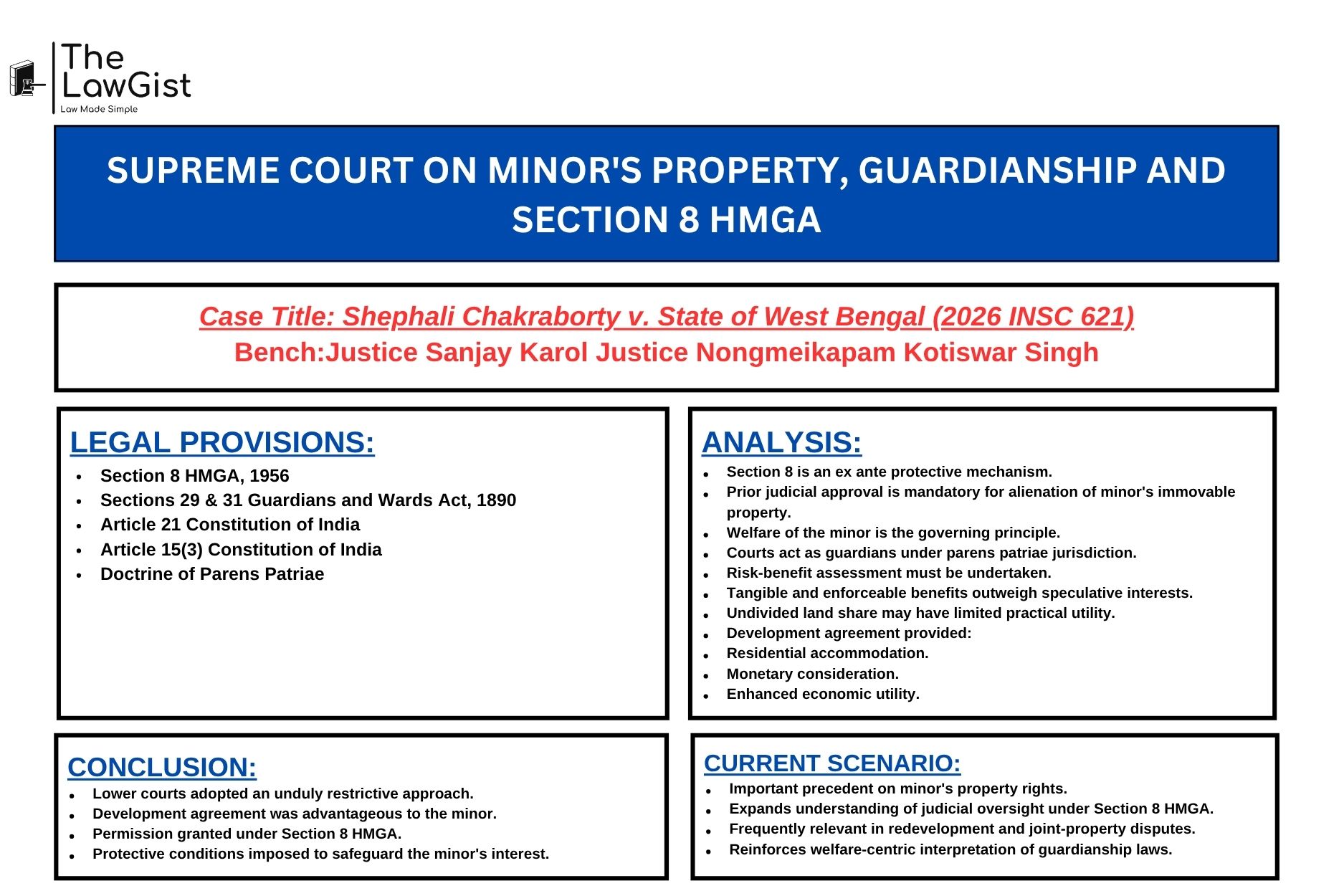
CASE SUMMARY – In Shephali Chakraborty vs. State of West Bengal (2026 INSC 621) concerned a mother’s request for permission under Section 8 of the Hindu Minority and Guardianship Act, 1956, to transfer her minor son’s share in ancestral property through a redevelopment agreement. The District Court and High Court rejected the application, holding that the benefit to the minor was not sufficiently established. The Supreme Court reversed these findings, emphasizing the doctrine of parens patriae and the welfare of the child. It held that a developed residential flat along with ₹10 lakh consideration offered greater practical benefit than an undivided share in undeveloped land and therefore permitted the transaction subject to safeguards protecting the minor’s interests.
| ASPECTS | DETAILS |
| Case Title | Shephali Chakraborty v. State of West Bengal, Civil Appeal arising out of SLP (C) No. 25053 of 2025, 2026 INSC 621 |
| Introduction | The Supreme Court examined whether a natural guardian could obtain permission under Section 8 of the Hindu Minority and Guardianship Act, 1956 (HMGA) to transfer a minor’s share in immovable property through a development agreement. The case involved balancing protection of a minor’s proprietary interests against practical economic benefits arising from redevelopment. |
| Factual Background | The minor, Basab Chakraborty, inherited a share in ancestral property after the death of his father. The co-owners entered into a development agreement with a developer. Under the agreement, the owners would receive a residential flat and ₹10 lakh consideration. The mother and natural guardian, Shephali Chakraborty, sought court permission under Section 8 HMGA to transfer the minor’s share. The District Judge rejected the application, and the High Court affirmed the decision. |
| Legal Issues | 1. Whether the proposed development agreement was necessary or evidently advantageous to the minor under Section 8(4) HMGA.
2. What standard courts should apply while granting permission for alienation of a minor’s immovable property. 3. Whether the lower courts correctly assessed the welfare and best interests of the minor. |
| Applicable Law | • Section 8, Hindu Minority and Guardianship Act, 1956.
• Sections 29 & 31, Guardians and Wards Act, 1890. • Doctrine of Parens Patriae. • Relevant precedents: Vishwambhar v. Laxminarayan (2001), Nangali Amma Bhavani Amma (2004), Sri Narayan Bal (1996), Saroj v. Sunder Singh (2013), Rani v. Santa Bala Debnath (1970). |
| Analysis | The Court explained the distinction between ex ante and ex post judicial scrutiny and held that Section 8 HMGA is an ex ante protective mechanism. Judicial permission serves as a safeguard to ensure transactions are genuinely beneficial to minors. The Court elaborated on the doctrine of parens patriae, emphasizing that courts act as protectors of vulnerable persons. It observed that an undivided share in undeveloped land often remains a passive asset, whereas a developed flat coupled with monetary consideration offers immediate and tangible benefits. Courts must compare risks and advantages while prioritizing the minor’s welfare. |
| Conclusion | The Supreme Court allowed the appeal and granted permission to implement the development agreement. It held that, in the facts of the case, receiving a share in a constructed flat and ₹10 lakh was more beneficial to the minor than retaining an undivided interest in undeveloped land. |
| Current Scenario | The judgment is now a significant precedent on Section 8 HMGA. It clarifies that courts should adopt a welfare-oriented and practical approach when evaluating transactions involving a minor’s property. The decision strengthens the application of the doctrine of parens patriae and provides guidance for future redevelopment and property-transfer cases involving minors. |
“The welfare of the minor remains paramount, and judicial approval under Section 8 HMGA is an expression of the doctrine of parens patriae.”
SOURCE – SUPREME COURT OF INDIA