Supreme Court clarifies territorial jurisdiction of the Delhi High Court in CAPF service disputes under Article 226 of the Constitution.
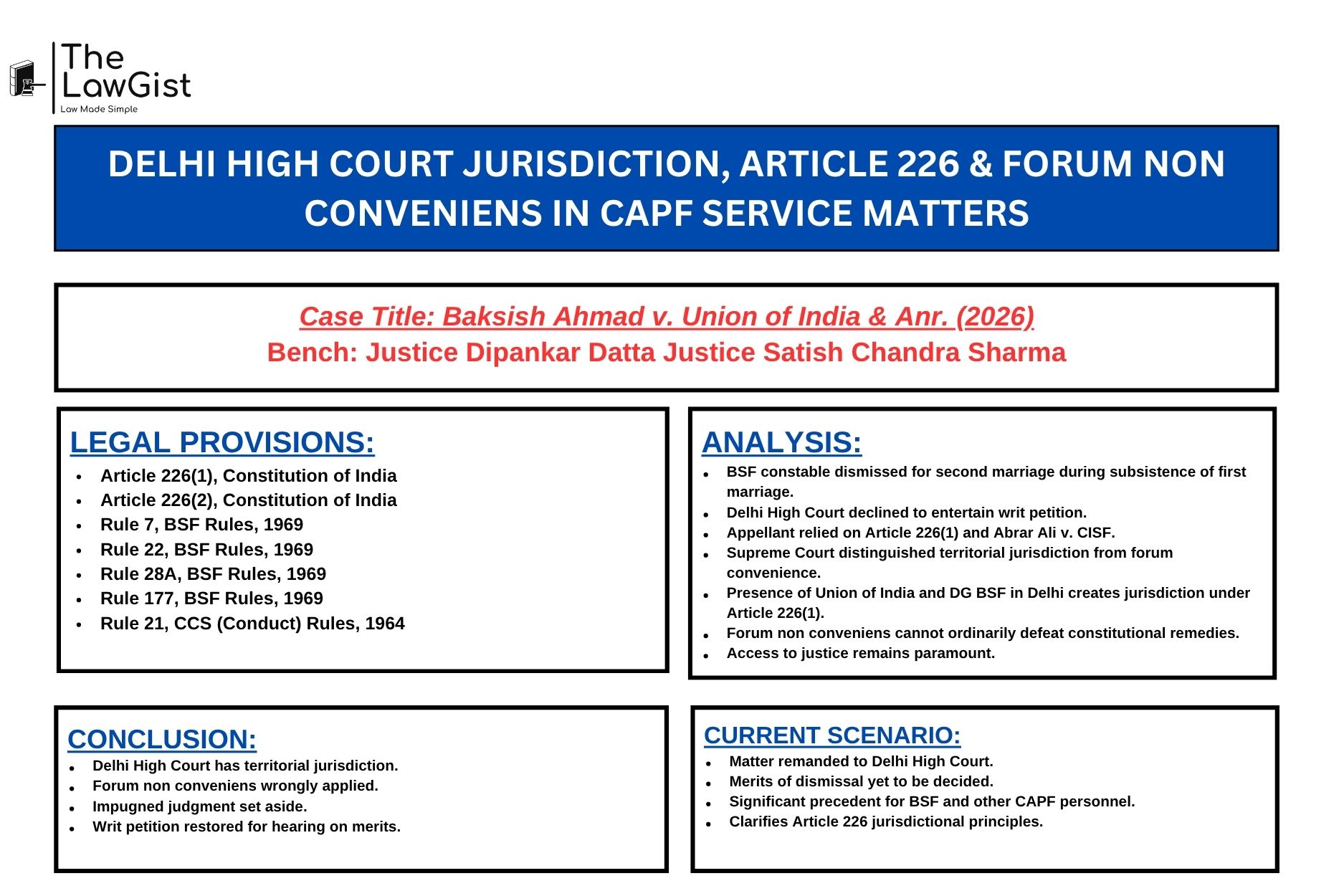
DELHI HIGH COURT JURISDICTION, ARTICLE 226 & FORUM NON CONVENIENS IN CAPF SERVICE MATTERS
CASE SUMMARY – The Supreme Court in Baksish Ahmad vs. Union of India (2026) considered whether the Delhi High Court could refuse to entertain a writ petition filed by a dismissed BSF constable on the ground of forum non conveniens. The appellant challenged his dismissal for contracting a second marriage during the subsistence of his first marriage. Although the events occurred in West Bengal and Jammu & Kashmir, the Supreme Court held that the Delhi High Court possessed territorial jurisdiction under Article 226(1) because the Union of India and Director General BSF were situated in Delhi. The Court restored the writ petition and emphasized that forum non conveniens should rarely restrict constitutional remedies.
| ASPECTS | DETAILS |
| Case Title | Baksish Ahmad vs. Union of India & Anr. (2026 INSC 630) |
| Introduction | The case concerns the territorial jurisdiction of the Delhi High Court under Article 226 of the Constitution and whether it could refuse to entertain a writ petition filed by a BSF personnel on the ground of forum non conveniens. |
| Factual Background | The appellant, a BSF constable, was accused of contracting a second marriage during the subsistence of his first marriage without obtaining permission from competent authorities. A Staff Court of Inquiry found him guilty of violating BSF Rules and CCS Conduct Rules. He was dismissed from service on 27 October 2022. His statutory petition was rejected by the Inspector General, BSF Jammu. He challenged both orders before the Delhi High Court, which declined jurisdiction citing forum non conveniens. |
| Legal Issues | 1. Whether the Delhi High Court had territorial jurisdiction under Article 226(1).
2. Whether the doctrine of forum non conveniens could justify refusal to entertain the writ petition. 3. Whether the presence of Union of India and Director General BSF in Delhi constituted a sufficient jurisdictional basis. |
| Applicable Law | Article 226(1) & 226(2) of the Constitution of India; Rule 7, Rule 22, Rule 28A and Rule 177 of BSF Rules, 1969; Rule 21 of CCS (Conduct) Rules, 1964. |
| Analysis | The Supreme Court examined earlier decisions including Abrar Ali v. CISF, Kusum Ingots, Eastern Coalfields Ltd. v. Kalyan Banerjee, Dinesh Chandra Gahtori, and Arif Azim. It held that since the Union of India and Director General BSF are located in Delhi, the Delhi High Court possessed territorial jurisdiction under Article 226(1). The Court further held that forum non conveniens should rarely be used to deny constitutional remedies under Article 226, particularly in service matters involving CAPF personnel. |
| Conclusion | The Supreme Court set aside the Delhi High Court’s order and restored the writ petition for consideration on merits. |
| Current Scenario | The appellant’s writ petition stands revived before the Delhi High Court. The Court must now adjudicate the challenge to dismissal on merits. The judgment also serves as an important precedent for CAPF personnel seeking constitutional remedies before the Delhi High Court. |
“Where writ jurisdiction is invoked under Article 226(1), the doctrine of forum non conveniens should rarely be applied so as to deny access to justice.”
SOURCE – SUPREME COURT OF INDIA