SUPREME COURT ACQUITS TALARI NARESH IN SC/ST ACT MURDER CASE
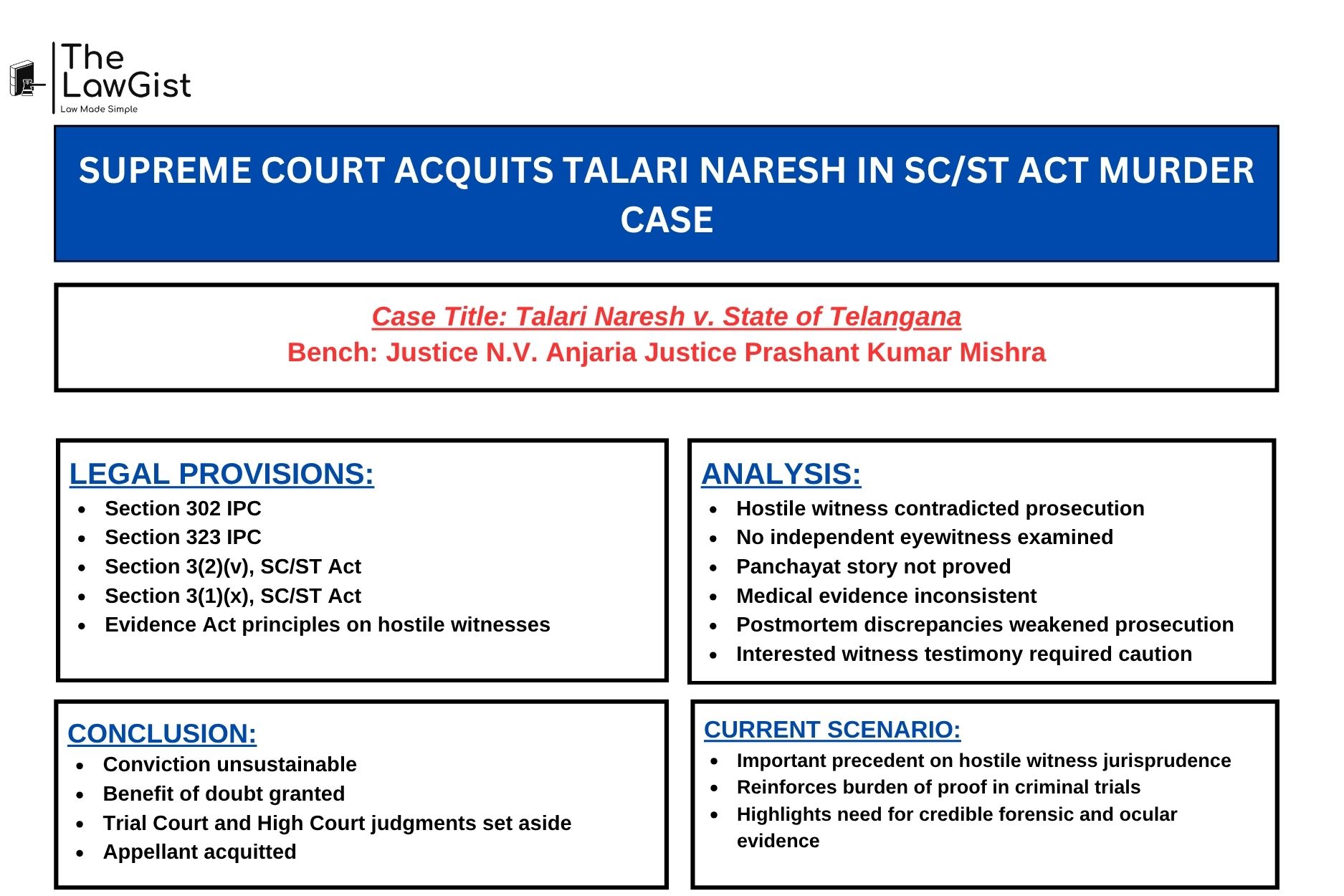
CASE SUMMARY – The Supreme Court in Talari Naresh vs. State of Telangana set aside the conviction of the appellant under IPC and SC/ST Act provisions after finding serious inconsistencies in the prosecution case. The Court observed that the main eyewitness turned hostile and contradicted the prosecution narrative, while independent witnesses were not examined despite the incident allegedly occurring in a public place. The medical evidence and postmortem report contained unexplained discrepancies, reducing their reliability. Emphasizing that hostile witness testimony may also aid acquittal, the Court ruled that the prosecution failed to establish guilt beyond reasonable doubt and acquitted the appellant.
| ASPECTS | DETAILS |
| Case Title | Talari Naresh vs. State of Telangana |
| Bench | Justice N.V. Anjaria and Justice Prashant Kumar Mishra |
| Court | Supreme Court of India |
| Citation | 2026 INSC 486 |
| Date of Judgment | 13 May 2026 |
| Introduction | The appeal challenged the conviction of the appellant under Sections 302 and 323 IPC and Sections 3(2)(v) and 3(1)(x) of the SC/ST Act. The Supreme Court examined whether the prosecution had proved the case beyond reasonable doubt. |
| Factual Background | The deceased Shiva Shankar had allegedly eloped with the appellant’s sister, leading to village tensions and an alleged Panchayat settlement. Later, a quarrel occurred near the appellant’s house, where the deceased was allegedly assaulted with a stone. The prosecution claimed caste-based abuse and murder. |
| Legal Issues | 1. Whether the prosecution proved the murder charge beyond reasonable doubt.
2. Whether hostile witness testimony could weaken the prosecution case. 3. Whether defective medical evidence affected the reliability of prosecution evidence. 4. Whether conviction under the SC/ST Act was sustainable. |
| Applicable Law | Sections 302 and 323 IPC; Sections 3(2)(v) and 3(1)(x) of the SC/ST Act, 1989; Principles relating to hostile witnesses and evidentiary value of postmortem reports under the Indian Evidence Act. |
| Analysis | The Court found major contradictions between eyewitness accounts and hostile witness testimony. PW3 denied informing PW1 and did not support the prosecution story. Independent witnesses were not examined despite the incident occurring on a busy public road. The postmortem report contained discrepancies regarding dates and timing, reducing its evidentiary value. The Court emphasized that hostile witness testimony can also support acquittal if credible. |
| Conclusion | The Supreme Court held that the prosecution failed to prove the case beyond reasonable doubt. The conviction by the Trial Court and High Court was set aside, and the appellant was acquitted. |
| Current Scenario | The judgment strengthens principles relating to appreciation of hostile witness testimony and underscores the necessity of reliable medical and corroborative evidence in criminal trials. It also reiterates safeguards against wrongful conviction under serious criminal charges including the SC/ST Act. |
“The testimony of a hostile witness can be used not only for conviction but also for acquittal when it discredits the prosecution case.”
SOURCE – SUPREME COURT OF INDIA