Supreme Court of India delivers verdict restraining unwarranted CBI inquiries in recruitment disputes.
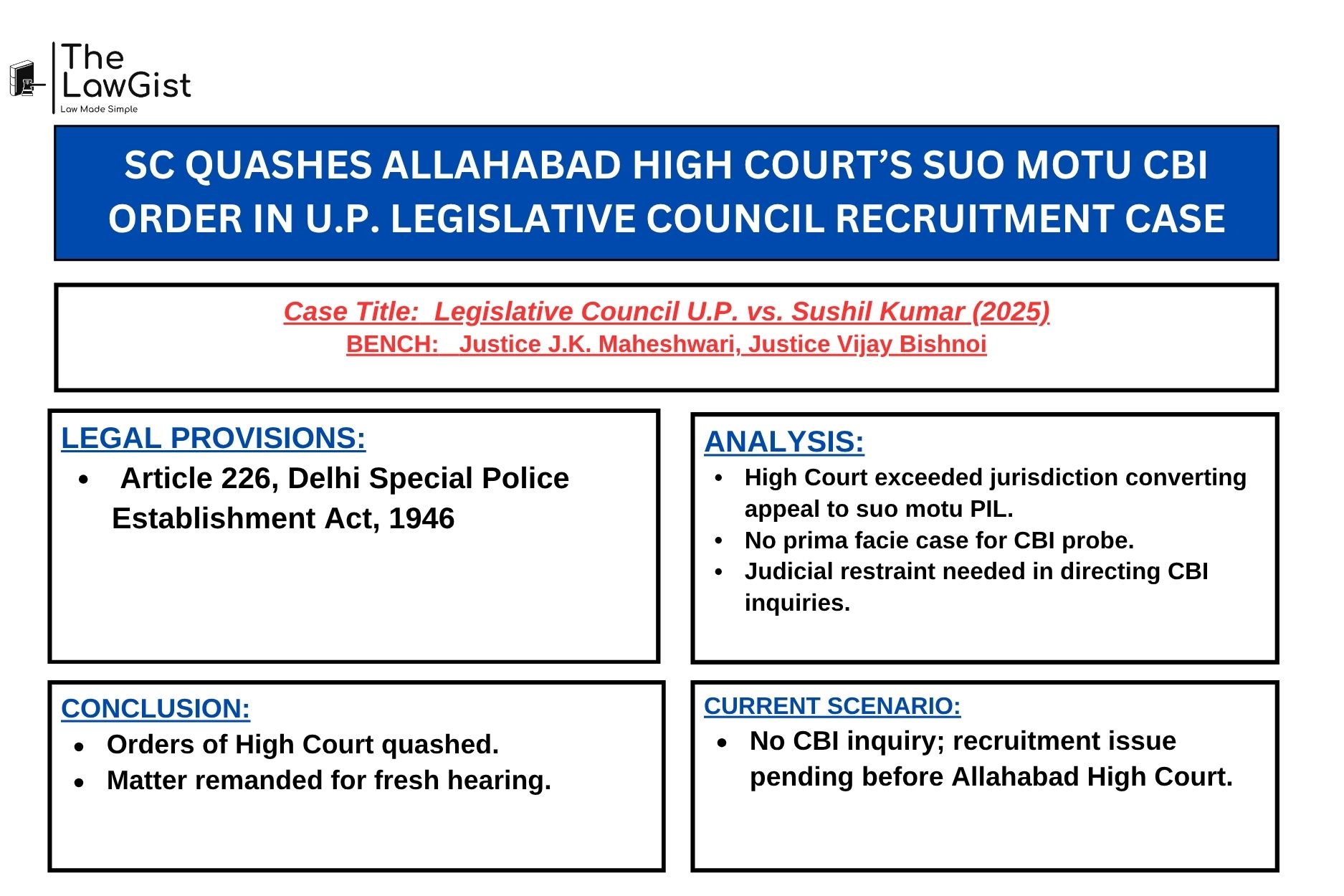
SC QUASHES ALLAHABAD HIGH COURT’S SUO MOTU CBI ORDER IN U.P. LEGISLATIVE COUNCIL RECRUITMENT CASE
CASE SUMMARY – In Legislative Council U.P. Lucknow vs. Sushil Kumar (2025), the Supreme Court quashed the Allahabad High Court’s suo motu order referring alleged irregularities in Legislative Council recruitment to the CBI. The Court held that the High Court exceeded its jurisdiction by converting a special appeal into a Public Interest Litigation and ordering a CBI probe without any foundational prayer or prima facie evidence. Citing precedents, the Supreme Court reaffirmed that CBI investigations must be reserved for exceptional cases involving substantial material. The appeals were allowed, and the matter remanded for fresh adjudication by the High Court.
| ASPECTS | DETAILS |
| Case Title | Legislative Council U.P. Lucknow & Ors. vs. Sushil Kumar & Ors., Civil Appeal Nos. 11842–11846 of 2025 |
| Introduction | The case involves multiple appeals against Allahabad High Court’s order directing a CBI preliminary inquiry into alleged irregularities in recruitment under Advertisement No. 1/2020 for posts in the U.P. Legislative Council Secretariat. |
| Factual Background | The respondents (contractual employees) challenged the 2020 recruitment alleging arbitrariness and favoritism. The Single Judge ordered future recruitments through UPSSSC. On appeal, the Division Bench suo motu converted the matter into a PIL and ordered a CBI inquiry. |
| Legal Issues |
|
| Applicable Law |
|
| Analysis | The Supreme Court emphasized judicial restraint in ordering CBI probes, noting that such directions require prima facie evidence of criminality or systemic failure. The High Court’s action based on “doubt” lacked legal foundation and overstepped jurisdiction by converting an appeal into a PIL. |
| Conclusion | The Supreme Court set aside the High Court’s orders (dated 18.09.2023 and 03.10.2023) and remitted the special appeal to be heard on merits. It held that the CBI direction and suo motu PIL registration were unwarranted. |
| Current Scenario | The case stands remanded to the Allahabad High Court; no CBI investigation will proceed. Recruitment challenges to be decided afresh on merits per procedural law. |
“Directions for CBI enquiry should not be ordered in a routine manner without prima facie evidence.”
SOURCE – SUPREME COURT OF INDIA
READ ALSO – Article 226 of the Constitution of India
Discover insighs on Latin Maxims and Legal Glossary and simplify complex legal terms in seconds.The LawGist ensures exam success with quality Blogs and Articles on — Top Legal Picks (TLP), Current Affairs, latest Supreme Court judgments as Courtroom Chronicles. Backed by trusted resources and videos, The LawGist is every Professionals and Aspirant’s first choice. Discover more at thelawgist.org