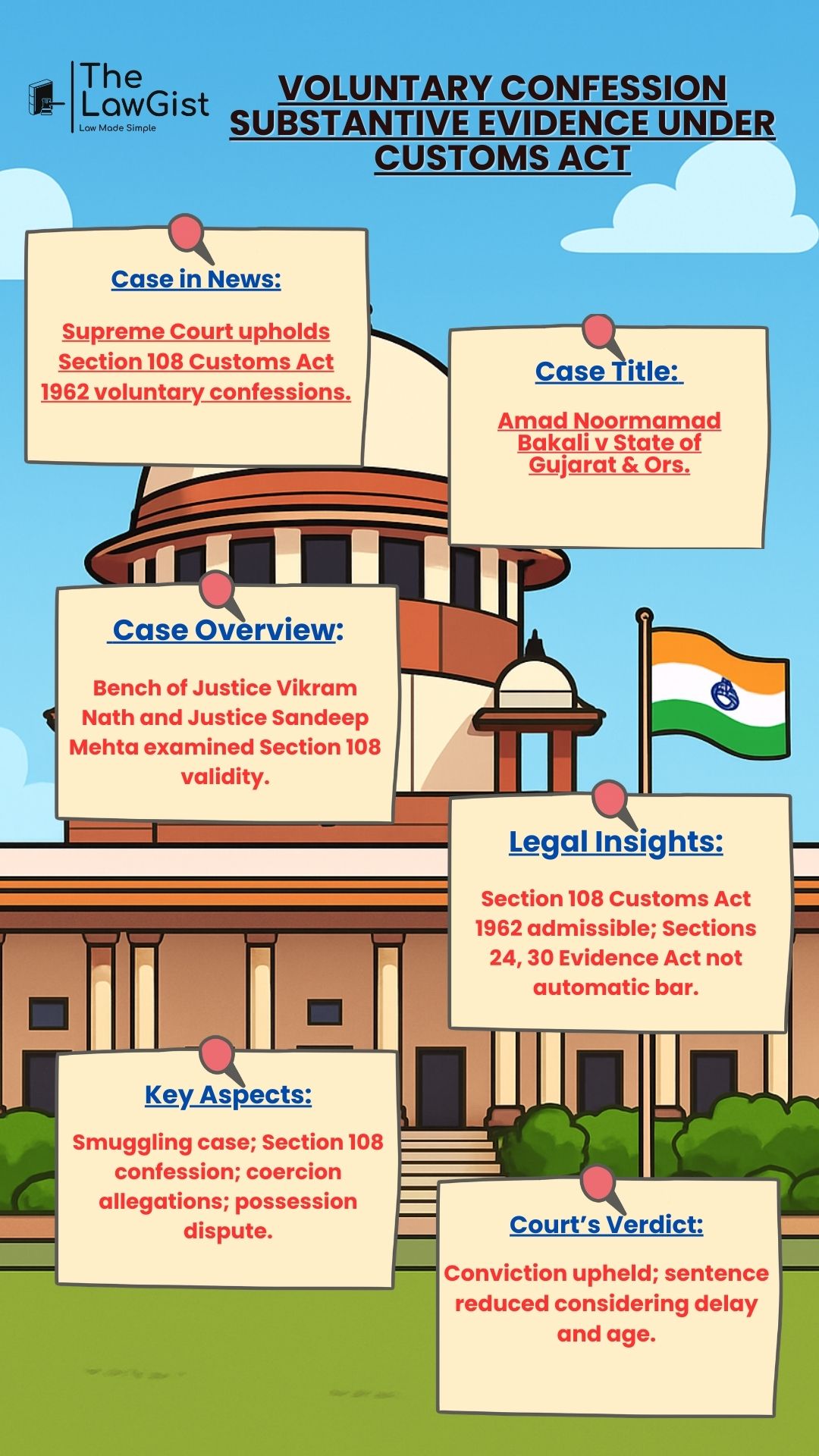
Supreme Court clarifies that voluntary confessions under Section 108 of the Customs Act 1962 are substantive evidence if proven free from coercion.
Case in NewsThe Voluntary Confession Substantive Evidence Under Customs Act ruling clarifies evidentiary standards . |
Discover powerful Latin Maxims and simplify complex legal terms in seconds.
Case Overview
Case Name: Amad Noormamad Bakali v. The State of Gujarat & Ors.
The Supreme Court of India examined whether a conviction under the Customs Act 1962 can be sustained primarily on the basis of confessional statements recorded by Customs officers. The bench of Justice Vikram Nath & Justice Sandeep Mehta dealt with an appeal arising from a 1985 smuggling incident in Mandvi Gujarat. The appellants were accused of smuggling 777 foreign-made wristwatches and 879 watch straps worth Rs. 2 lakhs. The High Court had upheld the conviction relying significantly on statements recorded under Section 108 of the Act.
Key Aspects
The controversy revolved around the evidentiary value of statements recorded by Customs authorities. The appellants questioned the voluntariness of the confessions & argued that there was no direct proof of conscious possession. The Court had to determine whether such confessions allegedly obtained under coercion could legally sustain a conviction.
- Seizure of smuggled wristwatches & straps in 1985 .
- Statements recorded under Section 108 of the Customs Act 1962 .
- Allegations of custodial torture & coercion .
- Issue: Whether conviction can rest on confessional statements without independent proof of possession .
Legal Insights
The Court clarified the statutory structure governing admissibility of confessions under customs law. It emphasized that Customs officers exercise investigative powers distinct from police officers. The judgment reaffirmed settled principles on voluntariness & burden of proof.
Section 108, Customs Act 1962
- Empowers Customs officers to summon persons and record statements.
- Statements are admissible as substantive evidence if voluntary.
Sections 24, 30 & 34 Indian Evidence Act, 1872
- Section 24 excludes confessions caused by inducement, threat or promise.
- Sections 30 & 34 deal with confessions of co-accused & joint liability.
- Section 108 statements are not automatically barred under the provisions.
Burden of Proof Principle
- Accused must establish that confession was obtained through coercion.
Court’s Verdict
The Supreme Court of India held that voluntary confessions under Section 108 of the Customs Act 1962 are substantive evidence capable of sustaining conviction. Finding corroborative material on record and no proven coercion the Court upheld the conviction. However considering the passage of 40 years & the advanced age of the appellants, the sentence was reduced to the period already undergone. The appeal was partly allowed.
Source – Supreme Court of India
The LawGist ensures exam success with quality notes—TPL, Current Affairs, Recent Judgments, and more. Backed by trusted resources and videos, The LawGist is every aspirant’s first choice.