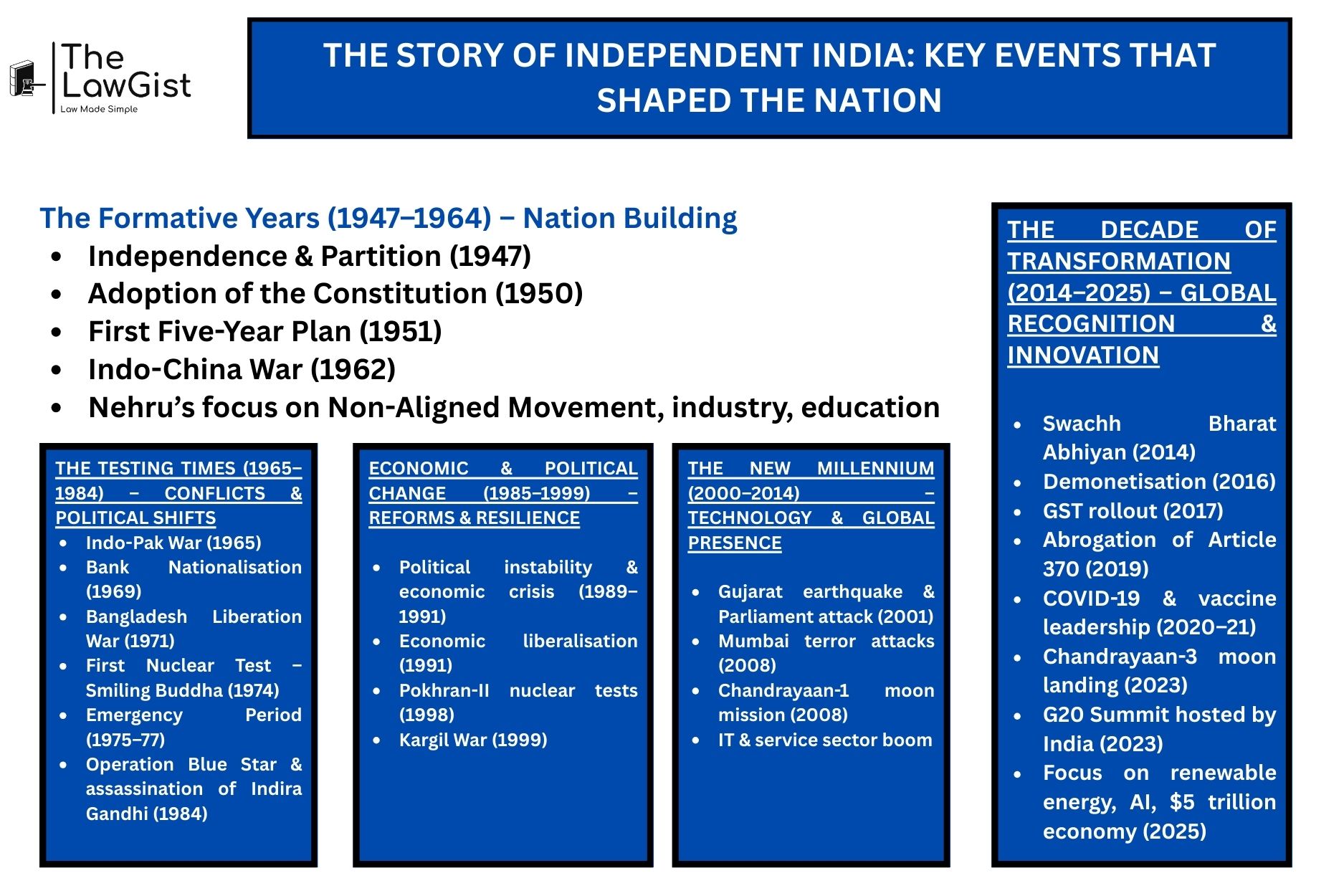
A timeline capturing India’s key historical moments—from the midnight of 15 August 1947 to Chandrayaan‑3’s lunar triumph in 2023 and beyond.
GIST –On 15 August 1947, as the midnight hour struck, India awoke to freedom after nearly two centuries of colonial rule. The tricolour unfurled, the air filled with hope, and the journey of building a sovereign, democratic nation began. |
THE STORY OF INDEPENDENT INDIA: KEY EVENTS THAT SHAPED THE NATION
1. The Formative Years (1947–1964): Laying the Foundations
The first two decades of independence were about healing the wounds of Partition and establishing the pillars of governance.
- 1947: India achieved independence, but Partition displaced millions and led to communal violence.
- 1950: Adoption of the Constitution of India — the country became a sovereign democratic republic.
- 1951: Launch of the First Five-Year Plan, focusing on agriculture and rural development.
- 1962: The Indo-China War tested the nation’s defence readiness.
Under Prime Minister Jawaharlal Nehru, India championed the Non-Aligned Movement and invested in industry, education, and science.
2. The Testing Times (1965–1984): Struggles and Shifts
The nation faced wars, political upheavals, and sweeping social changes.
- 1965: War with Pakistan over Kashmir.
- 1969: Nationalisation of 14 major banks, expanding credit access.
- 1971: Another war with Pakistan led to the creation of Bangladesh.
- 1974: India’s first nuclear test, Smiling Buddha, marked entry into the nuclear club.
- 1975–77: Emergency — a period of suspended democracy under Prime Minister Indira Gandhi.
- 1984: Operation Blue Star in Amritsar followed by Indira Gandhi’s assassination, sparking widespread unrest.
3. The Era of Economic and Political Change (1985–1999)
This period saw reforms, conflicts, and a new global image for India.
- 1989–1991: Political instability and an economic crisis.
- 1991: Economic liberalisation under P. V. Narasimha Rao and Finance Minister Manmohan Singh opened India’s markets to the world.
- 1998: Pokhran-II nuclear tests reaffirmed India’s strategic power.
- 1999: Kargil War — India defended its borders with determination.
4. The New Millennium (2000–2014): Technology and Global Ambitions
The 21st century began with a tech-driven economic surge.
- 2001: Gujarat earthquake and Parliament attack.
- 2008: Mumbai terror attacks shook the nation.
- 2008: Launch of Chandrayaan-1, India’s first mission to the Moon.
- Rapid growth in IT, telecom, and service industries positioned India as a global outsourcing hub.
5. The Decade of Transformation (2014–2025)
In recent years, India has seen sweeping policy changes, infrastructure growth, and global recognition.
- 2014: Launch of the Swachh Bharat Abhiyan (Clean India Mission).
- 2016: Demonetisation to combat black money.
- 2017: Rollout of the Goods and Services Tax (GST), simplifying taxation.
- 2019: Abrogation of Article 370, revoking Jammu & Kashmir’s special status.
- 2020–21: Battling COVID-19, India emerged as the pharmacy of the world through mass vaccine production.
- 2023: Chandrayaan-3’s successful soft landing near the Moon’s south pole.
- 2023-24: India hosted the G20 Summit, asserting its global leadership.
- 2025: Focus on renewable energy, AI, defence innovation, and becoming a $5 trillion economy.
Conclusion
From the chaos of Partition to the glory of space exploration, India’s journey from 1947 to 2025 has been one of grit and glory. Each decade brought its own challenges, yet the spirit of a billion people kept the nation moving forward.
As India marches toward 2047, the centenary of its independence, the vision is clear — a prosperous, inclusive, and innovative nation that continues to inspire the world.
“Freedom in India is not just a right given by the Constitution — it is a duty to protect justice, equality, and the rule of law for every citizen.”
SOURCE – KNOW INDIA
READ ALSO – TERRORISM AND THE INDIA-PAKISTAN CONFLICT: A LEGAL AND STRATEGIC ANALYSIS