Supreme Court rules on juvenility claim in murder trial.
SUPREME COURT RULES RESPONDENT NOT A JUVENILE IN 2011 MURDER CASE
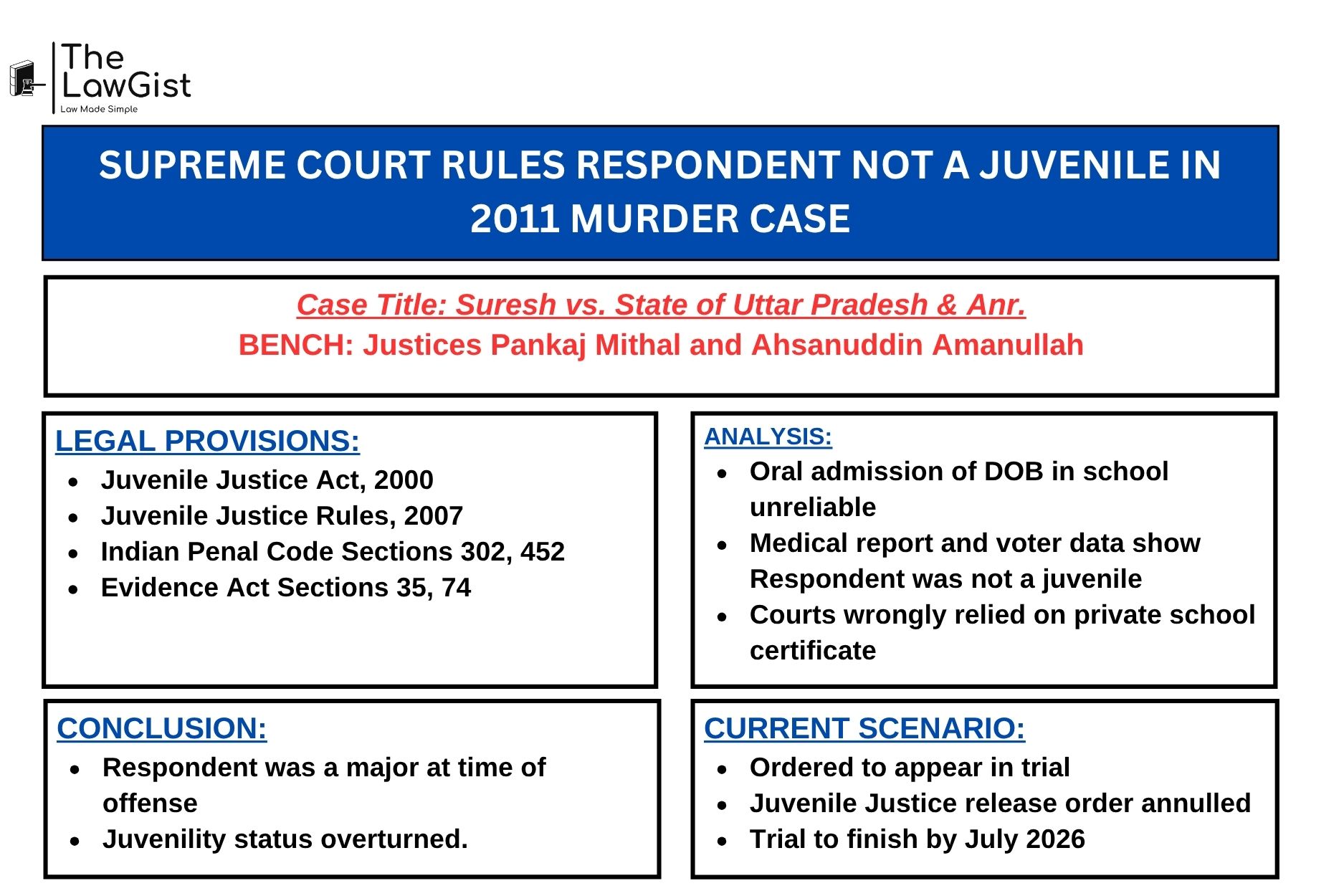
CASE SUMMARY – In Suresh v. State of Uttar Pradesh & Anr., the Supreme Court overturned lower court rulings that deemed the accused, Devi Singh, a juvenile during a 2011 murder. The Court ruled that the school transfer certificate relied upon was unreliable as it was based on oral claims by the father. Contradictory documents like a medical report and public records indicated Singh was over 18. Hence, his status as a juvenile was revoked. The release order under the Juvenile Justice Act was set aside, and he was ordered to face a regular trial, which must conclude by July 2026.
| ASPECTS | DETAILS |
| Case Title | Suresh vs. State of Uttar Pradesh & Anr. |
| Introduction | The appeal challenges the High Court and Trial Court’s finding that Respondent No. 2 (Devi Singh) was a juvenile at the time of committing a murder in 2011. |
| Factual Background | Devi Singh was accused of murdering Rajesh Singh. He claimed juvenility (DOB: 18.04.1995). Contradictory records like the Voter List and Medical Report exist. |
| Legal Issues | Whether Respondent No. 2 was a juvenile on the date of the incident and whether the school transfer certificate could be relied upon to determine his age. |
| Applicable Law |
|
| Analysis | The SC found the school certificate unreliable as it was based on oral claims; medical evidence and public records suggested Respondent No. 2 was over 18. |
| Conclusion | The respondent was not a juvenile; the declaration of juvenility was set aside. The trial was ordered to continue, with directions for bail and future conduct. |
| Current Scenario | The respondent must appear before the Trial Court within 3 weeks; release order under JJA was annulled. Trial to conclude by July 2026. |
“Statutory protection under the Juvenile Justice Act cannot be abused to shield serious criminal conduct.”
SOURCE – SUPREME COURT OF INDIA
READ ALSO – Juvenile Justice Act, 2000