Rahul Gandhi at a press conference where remarks on Savarkar led to a defamation case now stayed by the SupremeCourt.
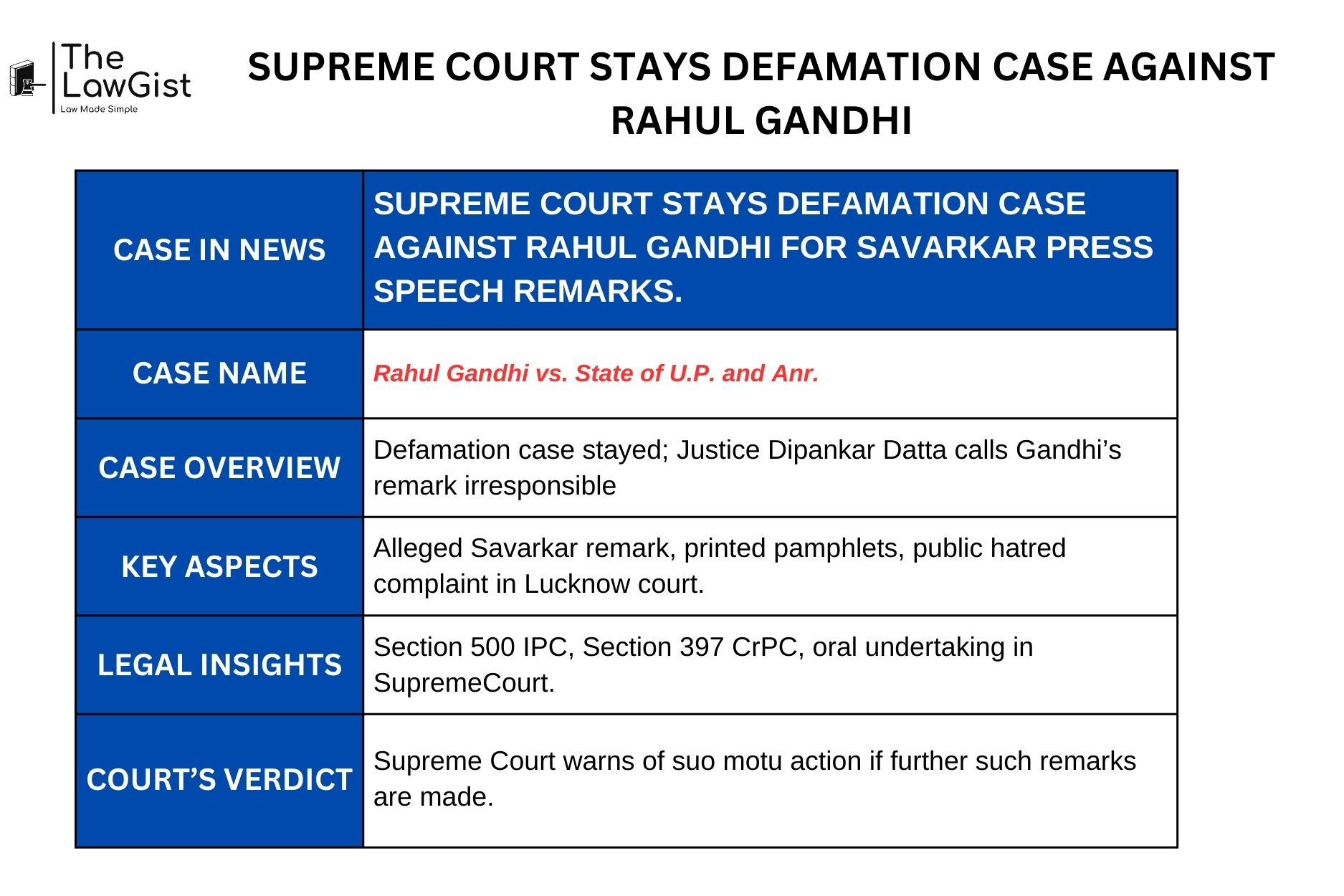
SUPREME COURT STAYS DEFAMATION CASE AGAINST RAHUL GANDHI
Case in News
Supreme Court stays defamation case against Rahul Gandhi over remarks on Savarkar in press speech.
Case Overview
Case Name – Rahul Gandhi vs. State of U.P. and Anr.
The Supreme Court of India led by Justice Dipankar Datta and Justice Manmohan stayed the criminal defamation proceedings against Rahul Gandhi for allegedly calling Vinayak Damodar Savarkar a “servant of the British .” The remarks were made during a press conference which triggered a complaint in a Lucknow court . Despite granting the stay the Supreme Court sternly warned Gandhi against making such comments in the future .
Key Aspects
- Rahul Gandhi in a public statement allegedly called Savarkar a “British servant” and claimed he received a pension .
- The remarks were made during a press conference and involved the distribution of printed pamphlets .
- A criminal complaint was filed by Advocate Nripendra Pandey in Lucknow accusing Rahul Gandhi of spreading hatred in public .
- The Allahabad High Court refused relief earlier leading to the present SLP before the Supreme Court of India .
- Justice Dipankar Datta objected to Gandhi’s understanding of history and called the comments “irresponsible .”
Legal Insights
- Section 500 IPC – relates to criminal defamation invoked against Rahul Gandhi.
- Section 397 CrPC – Remedy advised by Allahabad High Court to move before Sessions Court .
- SLP (Crl.) before the Supreme Court of India to challenge the refusal of the High Court .
- Oral undertaking given by counsel under judicial caution .
Court’s Verdict
The Supreme Court of India granted a stay on the defamation proceedings but warned Rahul Gandhi of “suo motu” action if similar kinds of remarks are repeated by him . While permitting the relief Justice Dipankar Datta stressed the dignity of freedom fighters and noted the seriousness of public figures making historically inaccurate statements .
Source