SUPREME COURT RESTORES CISF CONSTABLE DISMISSAL
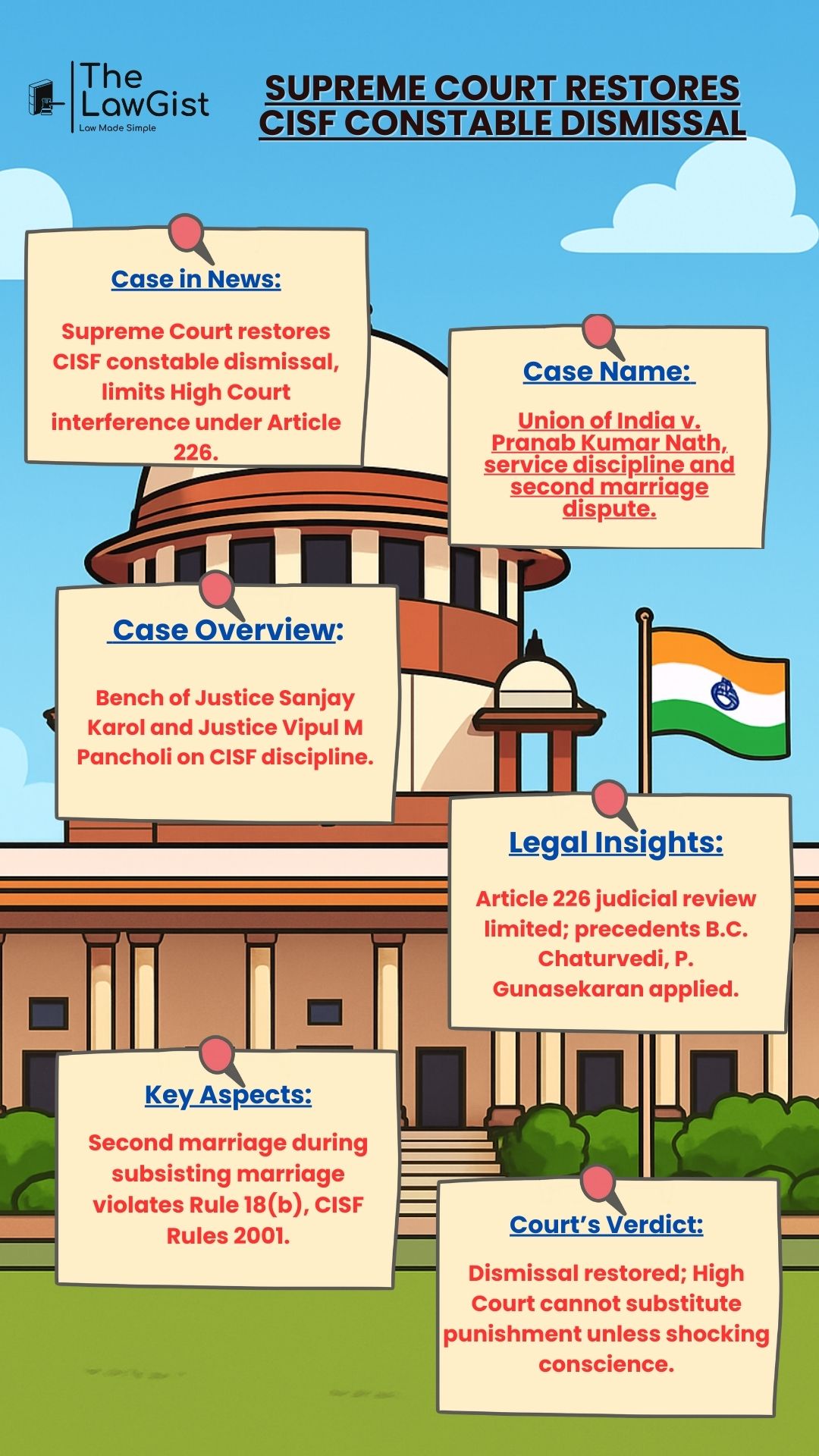
Case in News
Supreme Court restores CISF constable dismissal for second marriage reinforcing limits on High Court interference .
Discover powerful Latin Maxims and simplify complex legal terms in seconds.
Case Name
Union of India v. Pranab Kumar Nath
Case Overview
In Union of India v. Pranab Kumar Nath, a Bench comprising Justice Sanjay Karol and Justice Vipul M Pancholi dealt with the scope of judicial review in disciplinary matters concerning uniformed forces . The respondent, appointed as a constable in CISF in 2006, faced disciplinary action after his wife complained in 2016 that he had contracted a second marriage during the subsistence of the first . Proceedings were initiated under the CISF Rules, 2001 . Although dismissal from service was upheld by departmental authorities, the High Court interfered on grounds of proportionality leading to the present appeal .
Step into the world of justice withCourtroom Chronicles
Key Aspects
The controversy revolves around service discipline in armed forces and the extent to which constitutional courts can interfere with penalties imposed after a lawful inquiry . The facts and issues highlight the balance between individual hardship and institutional discipline .
- Wife’s written complaint alleging second marriage and neglect of minor child .
- Charge memorandum issued for grave misconduct under Rule 18(b), CISF Rules, 2001 .
- Departmental inquiry conducted following due process; charges proved .
- Dismissal ordered on 1 July 2017; affirmed in appeal and revision .
- High Court held dismissal disproportionate and directed reconsideration of penalty .
Legal Insights
The judgment reiterates settled principles of service jurisprudence and judicial restraint . The Court clarified the legal limits of interference while examining disciplinary penalties imposed under statutory rules .
- Article 226, Constitution of India: High Court’s power confined to judicial review, not appellate reassessment .
- Rule 18(b), CISF Rules, 2001: Prohibits second marriage during subsistence of first marriage without permission .
- Precedents applied: B.C. Chaturvedi v. Union of India (1995), Union of India v. P. Gunasekaran (2015) .
- Punishment can be interfered with only if shocking conscience or procedurally illegal .
Court’s Verdict
Allowing the appeal, the Supreme Court set aside the High Court judgments and restored the dismissal order . The Court held that the rule was clear, unambiguous and essential for maintaining discipline in CISF invoking the maxim dura lex sed lex—the law may be harsh, but it must be enforced .
The LawGist ensures exam success with quality notes—TPL, Current Affairs, Recent Judgments, and more. Backed by trusted resources and videos, The LawGist is every aspirant’s first choice.
Source – Supreme Court of India
Read also – Constitution of India