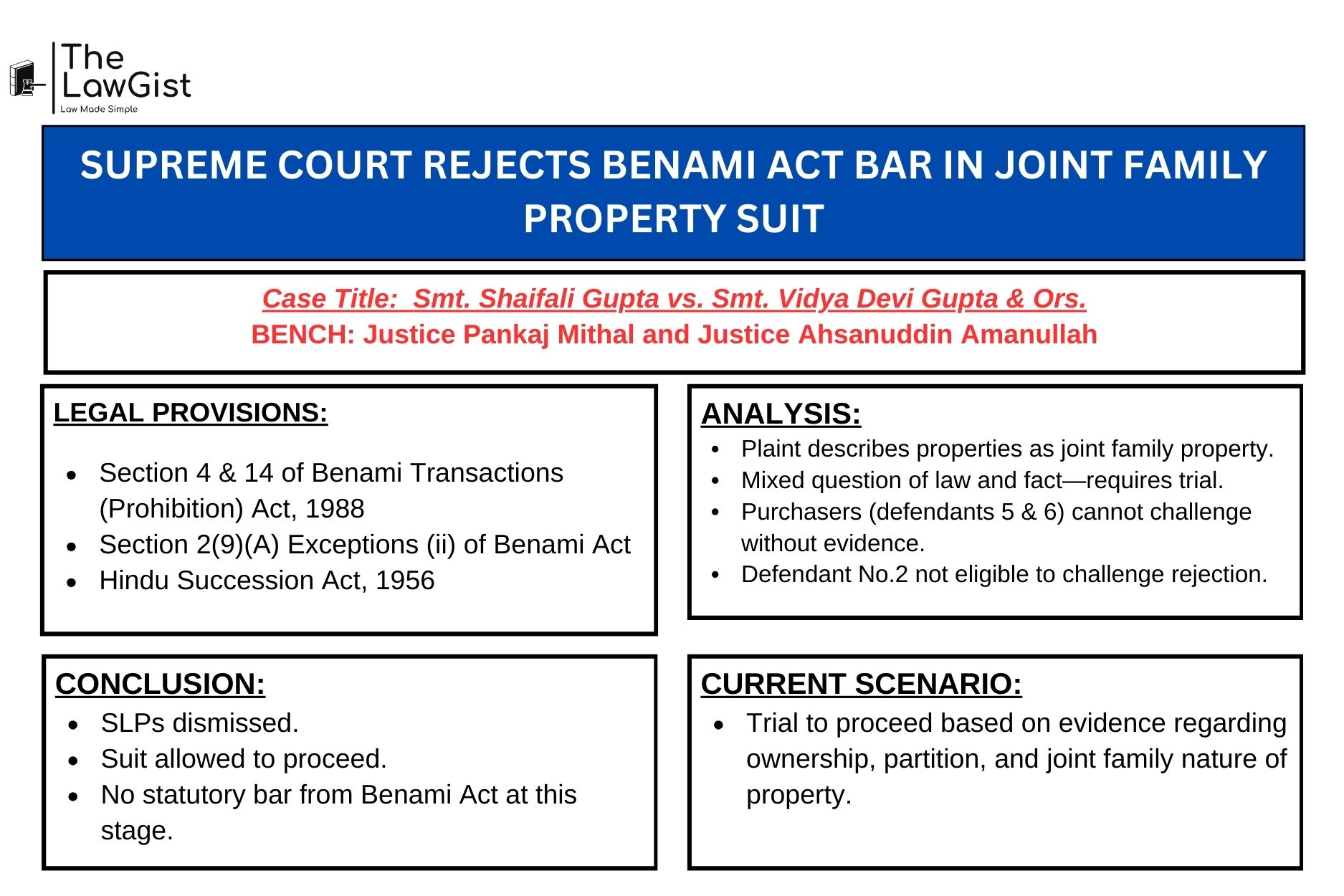
Supreme Court rules on maintainability of family property dispute under Benami Act.
In Smt. Shaifali Gupta vs. Smt. Vidya Devi Gupta & Ors., the Supreme Court of India dismissed two Special Leave Petitions challenging the maintainability of a civil suit for partition and declaration of joint family properties. The petitioners claimed the suit was barred under the Benami Transactions (Prohibition) Act, 1988. However, the Court held that the plaint presented triable issues regarding the properties’ joint family nature. Since these were mixed questions of law and fact, they required evidence. Therefore, rejecting the plaint at the threshold was unwarranted, and the suit was allowed to proceed on merits.
| ASPECTS | DETAILS |
| Case Title | Smt. Shaifali Gupta vs. Smt. Vidya Devi Gupta & Ors. |
| Introduction | The case concerns a civil dispute over joint family properties and the applicability of the Benami Transactions (Prohibition) Act, 1988. |
| Factual Background | Plaintiffs (mother and son) claimed partition and ownership over family properties against other family members and subsequent purchasers, alleging properties were bought using joint family funds. |
| Legal Issues |
|
| Applicable Law |
|
| Analysis | The Court held that:
|
| Conclusion | The Supreme Court upheld the lower courts’ decisions and dismissed both SLPs, allowing the suit to proceed on merits. |
| Current Scenario | The civil suit will proceed for trial, where parties will lead evidence regarding the nature of ownership and partition claims. |
“Determining benami nature of property requires evidence; cannot reject plaint merely on allegations.”
SOURCE – SUPREME COURT OF INDIA
READ ALSO – Hindu Succession Act, 1956