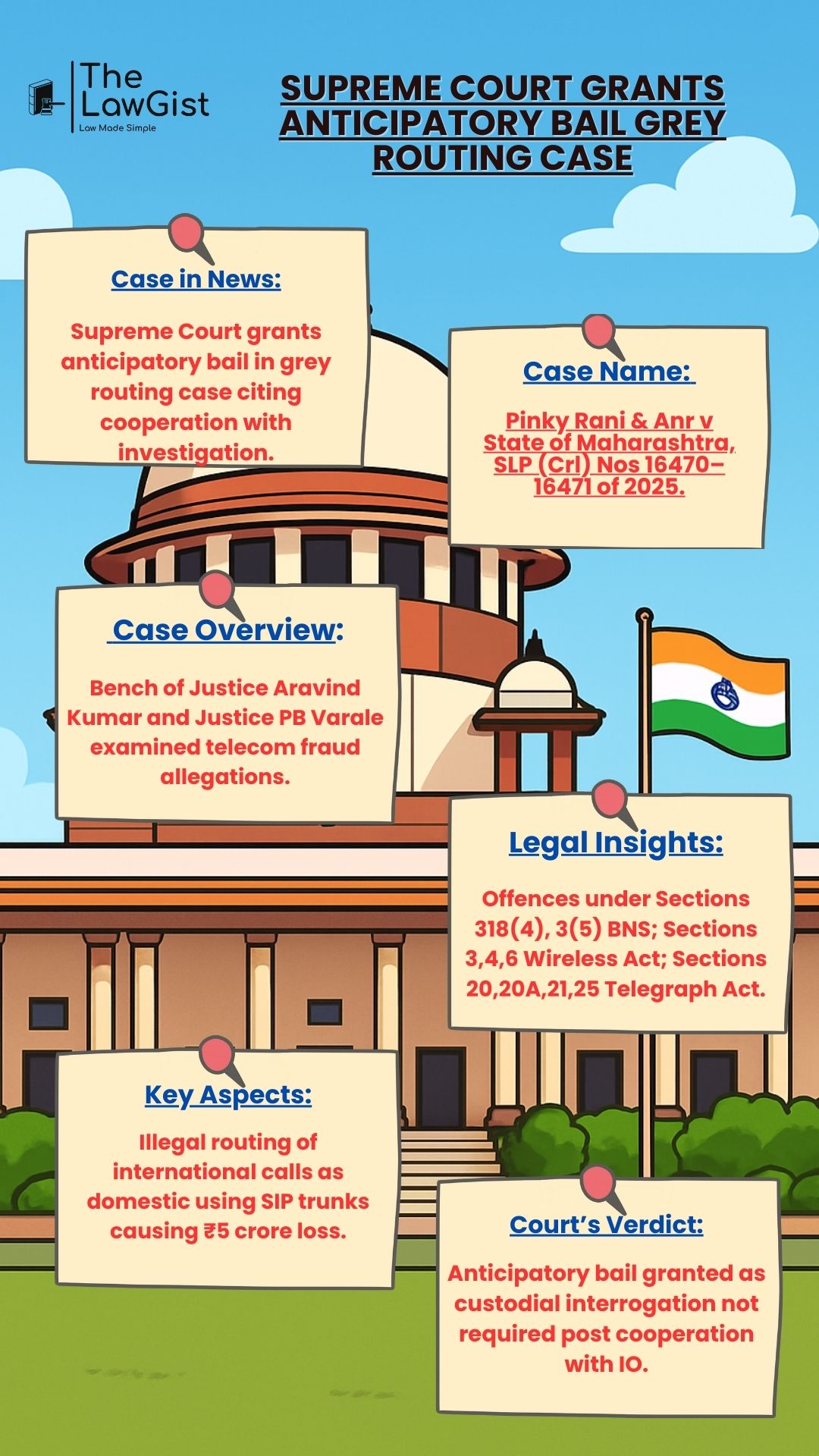
Supreme Court grants anticipatory bail in grey routing case, holding custody unnecessary after accused cooperated with telecom fraud investigation.
Case in NewsSupreme Court Grants Anticipatory Bail Grey Routing Case after finding custody unnecessary despite serious telecom allegations . |
Discover powerful Latin Maxims and simplify complex legal terms in seconds.
Case Overview
Case Name: Pinky Rani & Anr. vs State of Maharashtra
In Pinky Rani & Anr. v State of Maharashtra, the Supreme Court examined allegations of illegal “grey routing” of international calls . The Bench comprising Justice Aravind Kumar and Justice PB Varale dealt with appeals against the rejection of anticipatory bail by the Trial Court and the Bombay High Court . The appellants, directors of M/s Srivansh Consulting Private Limited were accused of facilitating unlawful routing of international calls as domestic Indian calls. After considering their cooperation with the investigation, the Court made the interim anticipatory bail absolute .
Step into the world of justice with Courtroom Chronicles
Key Aspects
The case revolves around misuse of telecom infrastructure and alleged financial loss to the exchequer . The investigation focused on whether custodial interrogation was essential for uncovering a larger conspiracy behind illegal call routing activities .
- Complaints received by DoT between April and July 2024 regarding international calls appearing as local calls .
- Calls allegedly routed through SIP trunk lines to mislead recipients .
- Infrastructure allegedly hosted by M/s Srivansh Consulting Pvt. Ltd.
- Internet and hosting services allegedly provided via M/s Web Werks, Mumbai.
- Seizure of routers and servers indicating unauthorised internet-based call routing .
- Alleged government revenue loss exceeding ₹5 crore .
Legal Insights
The prosecution invoked multiple statutory provisions to establish illegal telecom operations . The Court assessed whether these charges justified custodial interrogation at the anticipatory bail stage .
- Bharatiya Nyaya Sanhita, 2023: Sections 318(4) read with 3(5) relating to cheating and organised unlawful activities .
- Indian Wireless Act, 1933 : Sections 3, 4 and 6 concerning possession and use of wireless apparatus without authority .
- Indian Telegraph Act, 1885 : Sections 20, 20A, 21 and 25 dealing with unauthorised telecom operations and penalties.
- Emphasis on settled principles governing Anticipatory Bail where investigation cooperation exists.
Court’s Verdict
The Supreme Court held that custodial interrogation was not required since the appellants had cooperated and no fresh incriminating material surfaced after recording their statements. Consequently, the interim protection was made absolute, granting Anticipatory Bail .
Source- Supreme Court of India
Read also– Bharatiya Nyaya Sanhita, 2023
The LawGist ensures exam success with quality notes—TPL, Current Affairs, Recent Judgments, and more. Backed by trusted resources and videos, The LawGist is every aspirant’s first choice.