Supreme Court clarifies statutory entitlement to additional Amenity TDR under Section 126(1)(b) of the MRTP Act.
SUPREME COURT ON ADDITIONAL AMENITY TDR UNDER MRTP ACT
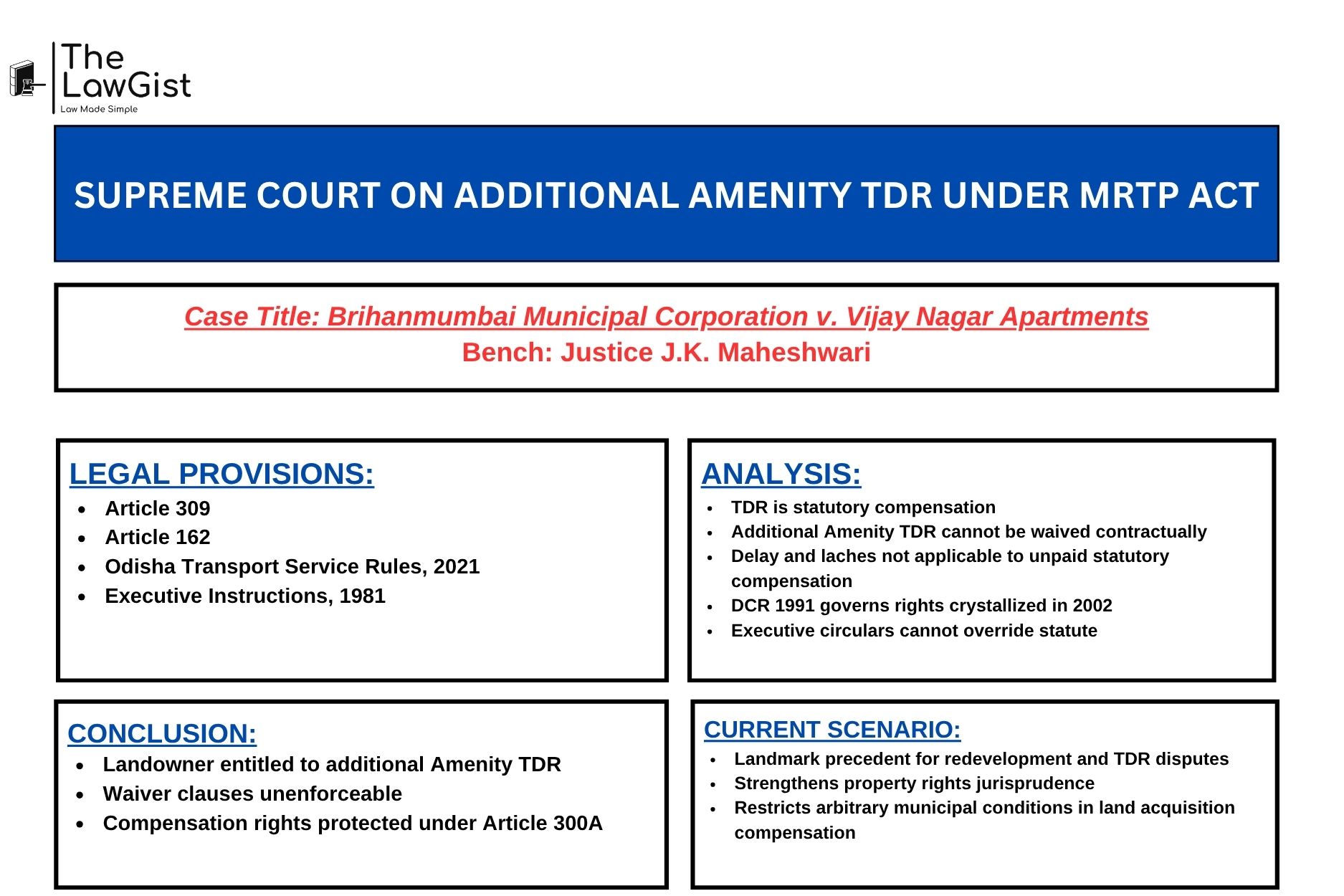
CASE SUMMARY– The Supreme Court in Brihanmumbai Municipal Corporation vs. Vijay Nagar Apartments held that statutory compensation in the form of additional Amenity TDR under Section 126(1)(b) of the MRTP Act cannot be denied through contractual waiver clauses. The landowner had surrendered land reserved for a public garden and developed the amenity at its own expense. Although the Corporation argued waiver, delay, and applicability of DCPR 2034, the Court ruled that compensation rights crystallized upon surrender of land in 2002 under DCR 1991. The Court emphasized that statutory rights under Article 300A cannot be defeated by executive conditions, agreements, or delay and laches.
| ASPECTS | DETAILS |
| Case Title | Brihanmumbai Municipal Corporation and Ors. vs. Vijay Nagar Apartments and Ors. |
| Introduction | The Supreme Court examined whether a landowner who surrendered land reserved for a public garden under the MRTP Act was entitled to additional Amenity TDR despite contractual clauses waiving such rights and despite delay in claiming compensation. |
| Factual Background | The land in Chembur, Mumbai, reserved for a garden under the MRTP Act, was surrendered by the landowner in 2002. The landowner developed the garden at its own expense and transferred the land to BMC. In return, basic TDR for the land was granted. However, the Corporation denied additional Amenity TDR citing waiver clauses in agreements and a 17-year delay. |
| Legal Issues | 1. Whether the claim for additional Amenity TDR was barred by delay and laches.
2. Whether the landowner waived statutory rights through LOI, Undertaking, and Maintenance Agreement. 3. Whether DCR 1991 or DCPR 2034 applied. |
| Applicable Law | Section 126(1)(b), Section 125, Section 2(2) of MRTP Act; Regulation 34 and Appendix VII-A of DCR 1991; Article 300A of Constitution of India. |
| Analysis | The Court held that compensation through TDR is a statutory entitlement under Section 126(1)(b). Contractual conditions forcing waiver of additional TDR are invalid because statutory rights cannot be contracted out of. The Court relied heavily on Godrej & Boyce I, Godrej & Boyce II, Kukreja Construction, and Yeshwant Jagannath Vaity. It further held that delay does not defeat a compensation claim when statutory compensation remains unpaid and no prejudice is shown. |
| Conclusion | The Supreme Court upheld the landowner’s right to receive additional Amenity TDR. The Court rejected BMC’s arguments regarding waiver, estoppel, contractual restriction, and delay. It affirmed that compensation rights crystallized when the land was surrendered in 2002. |
| Current Scenario | The judgment strengthens landowners’ rights under the MRTP Act and confirms that planning authorities cannot dilute statutory compensation through executive circulars or private agreements. It also reinforces Article 300A protections relating to fair compensation in land acquisition matters. |
“Statutory compensation under Section 126(1)(b) of the MRTP Act cannot be waived through contractual clauses imposed by planning authorities.”
SOURCE – SUPREME COURT OF INDIA